
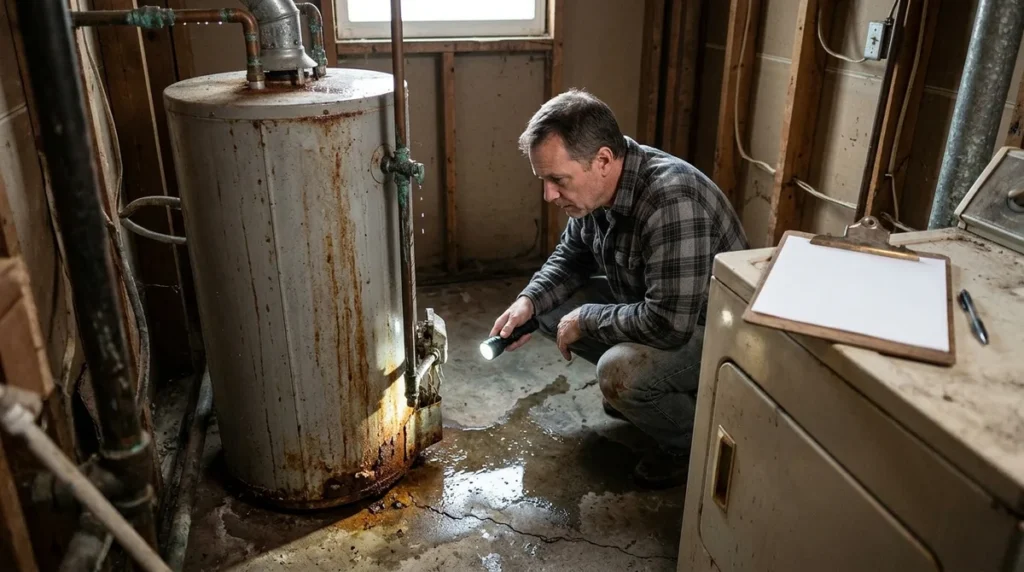
Home warranty exclusions are the fine print that decides whether your broken system actually gets paid, and they matter more than the plan name on the brochure. A home warranty is a contract, and the Federal Trade Commission notes that it is usually sold separately from the home or appliance. In one sample contract, liability tops out at $5,000 per covered item and $15,000 total during the coverage period, and coverage doesn’t start until 30 days after the contract start date. So a failure in week one? Don’t count on it.
Florida takes a tougher line on disclosure. Under Florida’s Department of Financial Services rules, home warranty contracts must print their exclusions in boldface and state on the front page that certain items and events are not covered. Sounds like legal noise? Maybe, but the signal is simple: read the exclusions before you pay, not after the repair tech shows up with bad news.
Key Takeaways
- Read the exclusion list in your home warranty contract before you pay, because the exclusions decide whether your broken system gets paid, not the plan name on the brochure.
- Your home warranty only covers items the contract names as included, so if your water heater, garage door opener, or sump pump isn’t listed, you’ll pay for its repair yourself.
- Your claim can be denied for pre-existing problems or neglected routine maintenance like filter changes and coil cleanings, so keep dated receipts and photos of every filter and service invoice.
- Your plan will usually skip mold, asbestos, and radon testing or removal, plus follow-up water damage from a covered failure, so set aside your own cash for that cleanup.
- Your contract can cap payouts at $5,000 per covered item, $15,000 total per coverage period, and $1,000 for inaccessible items, and coverage may not start until 30 days after the contract start date, so get every number in writing before you sign.
What Does a Home Warranty Actually Exclude?
A home warranty covers only what its contract says it covers. Anything on the excluded list is out, and anything the contract never names as included can be left out too. The marketing name, like “Platinum” or “Total Care,” tells you very little.
A home warranty is an agreement to repair or replace a structural component of your home or an appliance when it fails from normal wear and tear or a defect. That sounds simple. The catch is that the contract, not the promise, decides what counts.
Here’s the first thing to understand. A home warranty is a service contract, and it costs extra. It’s sold separately from the house or the appliance. A manufacturer’s warranty may come with the product at no added charge, but a home warranty is something you buy on top of everything else.
Coverage follows the lists. Read the included and excluded sections line by line. If your water heater, garage door opener, or sump pump isn’t specifically marked as included, assume you’ll pay for it yourself. Don’t assume the salesperson meant it.
This is where plans really differ. Two plans can sound almost identical on the phone and split wildly once you read the exclusions. One might carve out a system you use every day, while another covers it for a lower fee. The sales pitch rarely tells you that.
Watch the trade-call fee too. In the sample contract, the fee for a scheduled service visit can still be charged even when the repair turns out to be excluded or the claim is denied. So you could pay for a tech to come out, hear “not covered,” and still owe the visit.
Before you sign, find the exclusions, read them, and ask yourself one question: if this breaks next month, is it on the list of things I’m paying for?
Why Do Pre-Existing Problems and Routine Maintenance Get Left Out?

Pre-existing problems and routine maintenance get left out because the contract treats them as your responsibility, not the plan’s. A home warranty is built to cover sudden failure from normal wear or a defect. It isn’t built to fix a system that was already broken when you signed.
Repairs or replacements can be excluded when a covered system is inoperable because of a pre-existing condition, deficiency, or defect. In plain English, if your air conditioner’s compressor was already failing when the contract started, the company can argue the breakdown began before you were covered. You don’t have to know about the problem for that to happen.
That’s the part that stings. A slow refrigerant leak or a cracked heat exchanger can build for months with no warning. When the unit finally quits, the claim can land squarely on the pre-existing exclusion, and you’re left paying for a repair you had no way to see coming.
Maintenance is even more straightforward, and easier to miss. A sample contract makes routine upkeep the customer’s job, and it names periodic HVAC service, coil cleaning, and filter replacement as examples. Skip those tasks, and the company has a ready-made reason to deny the claim. The argument is that the failure came from neglect, not a defect.
So keep proof. Save receipts and invoices for filter changes and coil cleanings, and write the date on the filter frame the day you swap it. Snap a photo of the invoice or the filter and store it somewhere you can find it in five years. If a claim gets denied for neglect, a dated receipt turns an argument into a case you can actually win.
Timing matters too. If coverage doesn’t begin until a waiting period ends, a system that fails early in your contract may look like a pre-existing problem even when it’s brand-new trouble. Ask when your coverage actually starts, and get the answer in writing before the first cold snap tests it.
Are Mold, Asbestos, and Radon Ever Covered?
No, not usually. The sample contract excludes identification, detection, abatement, encapsulation, or removal of asbestos, radon, mold, and other hazardous substances. In plain English, if someone has to figure out whether a material is dangerous, the plan won’t pay for that test. If the crew has to seal it or haul it away, that bill is yours too.
The sneakier problem is consequential damage. That’s the harm a covered failure causes along the way, and the sample contract excludes it. Its examples include mold, misuse, failure to maintain, fire, freezing, power surge, water damage, theft, storms, and pest damage.
Here’s how it plays out. Your dishwasher’s pump dies, and the plan pays to replace the pump. But the water it pushed across your kitchen floor and into the cabinet base? That’s water damage, and it’s excluded. The pump gets fixed, and the mess stays on your plate.
Mold is where this stings most. A slow leak behind a wall can feed mold for weeks before anyone smells it. The appliance repair may be paid, while the mold testing and removal are not.
Power surges work the same way. A failed control board might be covered, but if the same surge also fried a second appliance, that second loss falls under the surge exclusion.
So plan for it separately. A covered repair does not automatically include the cleanup, the drying, or the hazardous-material work that follows. Set aside a cash cushion for those costs, because the plan’s payment ends where the repaired part ends.
Before you need it, ask the company to show you, in writing, which hazardous-substance work and which follow-up damage are excluded. Then, if a leak or failure happens, photograph the damage the same day, and call a licensed professional before tearing anything out.
What Happens to Walls, Floors, and Cabinets When Access Is Blocked?
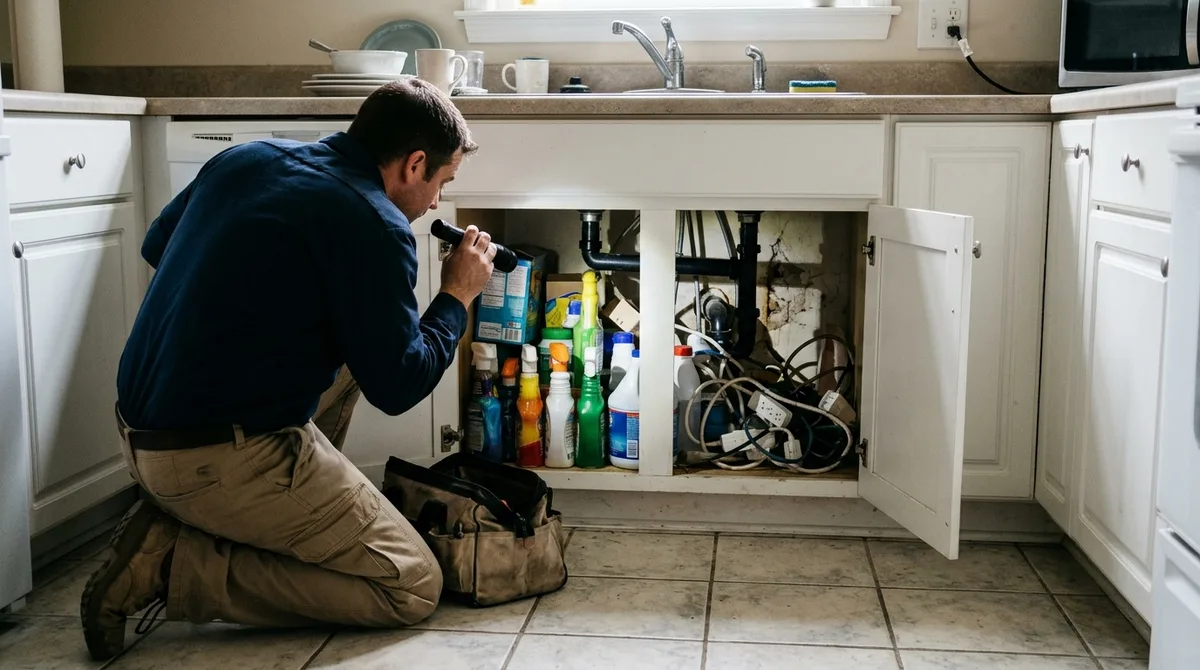
When a broken part sits behind a wall, under a floor, or inside a cabinet, the plan may cover the repair while leaving you to pay for everything that has to come apart to reach it. The sample contract says it does not restore wall coverings, flooring, plaster, cabinets, countertops, tile, or paint after access work. The technician can open the wall to reach the pipe, but nobody is putting the drywall back.
Picture a supply line buried behind a finished bathroom wall. The leak itself may be covered, and the plumber can fix it. But the tile around the shower, the paint, and the drywall they cut open? Those are yours. If a cabinet has to come out just to reach a shutoff valve, the bill climbs fast.
The sample contract also caps covered service on inaccessible or obstructed items at $1,000 in total for the coverage period. That’s one shared pot, not a fresh amount for each visit. A single leak that needs an opening, a repair, and a closure can burn through that $1,000 before the pipe is even sealed.
So a pipe or unit buried behind finished surfaces can leave you paying out of pocket for demolition, rebuilding, and refinishing. Many homeowners only learn this after the tech has already cut the hole.
Before you file a claim, ask three questions:
– Where exactly is the part? Behind a wall, under a slab, or inside a cabinet? – What access work does the plan cover? Does it include opening and closing the surface, or only the repair itself? – Is there a cap on that work? If so, how much is left in your coverage period?
Get the answers in writing. If the plan won’t restore finished surfaces, price the rebuild before a failure happens, not after.
How Dollar Caps and Water Heater Rules Limit Your Payout
A covered system can get fixed, and you can still end up with a big bill. The sample contract sets a ceiling on what it pays for any single covered item, and a separate ceiling on the total for the whole coverage period. Whichever limit you hit first is where the plan stops paying. Anything above that line is yours.
Think about what that means for an expensive repair. If the parts and labor on one unit blow past the per-item cap, the plan pays up to the cap and the rest lands on your credit card. If you file several claims in one year, the total ceiling shrinks with every visit, and a few big repairs can drain it faster than you’d expect.
Water heaters get their own rule, and it’s a harsh one. In the sample contract, any water heater over 75 gallons is excluded from standard coverage. If you own a large tank, you could pay for a plan and still find the unit isn’t covered at all.
Sediment is the sneaky part. Minerals settle at the bottom of a tank over time, and that buildup can wear the unit down until something fails. Under standard coverage, problems from sediment are excluded. The same sample contract lists sediment-related problems as included in premium coverage. So the same tank, with the same failure, can be a paid claim on one tier and a denied claim on another.
That’s the real lesson. Upgrading to a higher tier can change what gets paid, but a fancier name doesn’t guarantee better coverage. Don’t let a sales rep tell you the premium plan “covers everything.” Pull up both exclusion lists and compare them line by line. Focus on:
- The per-item cap and the total cap on each tier
- The water heater size cutoff and whether your tank falls above it
- How sediment-related problems are described on each list
- Any access or consequential damage limits that stay the same across tiers
Then weigh the extra cost of the upgrade against what it actually adds. If the premium list only changes one line you’d never use, you’re paying for noise.
Do State Rules Change What a Plan Can Exclude?

Yes, and the rules depend on where you live. Each state sets its own home warranty rules, and some protections exist only because a state wrote them into law. Your state decides how clearly a plan has to disclose its limits and which exclusions it can’t use.
Florida is one of the states that gets specific. Its home warranty contracts must print exclusions, restrictions, and limitations in boldface. The front page has to state that certain items and events are not covered, so you can’t claim you never saw it.
Florida also limits one of the most common reasons for denial. For new and renewal contracts effective January 1, 2020, a company may not exclude coverage just because of rust or corrosion. The exclusion only holds if rust or corrosion actually contributed to the mechanical breakdown or failure of the covered appliance, unit, or system.
Texas took a different route. Regulation of home warranties and home-service contracts moved from the Texas Real Estate Commission to the Texas Department of Licensing and Regulation effective September 1, 2021. If you live in Texas, that’s the agency whose rules govern your plan.
Here’s the catch. Florida’s disclosure rules stop at the Florida line, and Texas’s agency only oversees contracts in Texas. A protection that exists in one state may not exist in yours.
So check before you assume. Start by asking these questions:
– Which state agency or insurance regulator oversees home warranty contracts where I live? – Does a state law require exclusions to be printed in bold or listed on the front page? – Are there rules that limit how rust, corrosion, or other conditions can be used to deny a claim?
If the answer is “I don’t know,” find it before you sign. A protection you’re counting on should be written into the law or the contract, not just implied by the sales rep.
Does a Home Warranty Cover Windows, Sump Pumps, or Electrical Problems?
Only if your specific contract lists them as included, and many plans don’t. Windows are one of the most common gaps because plans often file them under structural or exterior items, which are frequently left off the covered list. Sump pumps and electrical problems follow the same rule. Whether they’re covered depends on whether your contract names them, not on what the salesperson says on the phone.
Windows deserve extra suspicion. A cracked pane, a failed seal that fogs the glass between layers, or a frame that won’t close can feel like an appliance problem, but the plan may treat it as part of the building itself. Search the exclusion list for words like “structural” and “exterior” before you assume anything is covered.
Here’s the trap. Many contracts promise coverage only for listed items, so anything missing from the included list can be left out. An unnamed sump pump means you pay for the pump, the labor, and the cleanup after a basement flood. Electrical faults can also be covered on one tier and skipped on another, so check each tier on its own.
Ask the provider for the exact covered-item list in writing before you buy. Don’t accept “it covers almost everything.” Ask whether the sump pump, the electrical panel, the outlets, and the windows appear by name, and whether any of them show up on the excluded side.
If an item shows up on neither list, treat it as not covered and plan to pay for it yourself. A written answer costs you one email. Guessing could cost you a repair bill you never budgeted for.
Reading Your Contract Before You Sign

Before you pay a dime, treat the contract like a crime scene and dig for evidence. Work through these steps in order:
- Read the full exclusion list, line by line, and mark every item that’s in your home.
- Find the date your coverage actually starts, and get it in writing.
- Write down the per-item cap, the total cap, and the cap on inaccessible items.
- Ask whether the trade-call fee applies to a visit where the claim gets denied.
- Confirm the exclusions appear in boldface and the front page warns about uncovered items, if your state requires it.
- Photograph your HVAC system, water heater, and other major systems, and save every maintenance receipt.
If any answer is missing, vague, or only spoken on the phone, don’t sign yet. Read first, pay second.
Turn the Contract Into a Checklist
Here’s your next move. Grab the actual contract, not the brochure or the website summary, and sit down with a highlighter and a list of every system in your home you’d hate to pay for out of pocket. Mark each one, then check it against the included and excluded lists. If it isn’t named as covered, assume you’re on the hook.
Then get the answers in writing. Ask for the coverage start date, the per-item cap, the total cap, the inaccessible-item cap, and whether the trade-call fee applies when a claim is denied. If you own a large water heater, ask whether it’s above the 75-gallon cutoff. A verbal “you’re covered” is worth nothing once the tech is standing in your kitchen.
If the company dodges, stalls, or says “just trust us,” that’s your answer. Walk away and compare another plan. Plenty of shoppers get stuck because they paid first and read later, so don’t be one of them.
Keep the signed contract, every maintenance receipt, and your dated photos in one folder, both on paper and on your phone. Then, when something breaks, you’ll know exactly which page to open first.
Frequently Asked Questions
1. What should I do if a repair is excluded but I think it should be covered?
Ask the company to deny the claim in writing and name the exact contract line it relies on. Then reread that section yourself and compare it with your photos, maintenance receipts, and the covered-item list. If the denial still looks wrong, take it to your state’s regulator, because the rules for home warranties vary by state.
2. Do I have to pay extra to cover items my basic plan excludes?
Often, yes, and the usual route is a higher tier rather than a single add-on. In the sample contract, sediment-related water heater problems are excluded from standard coverage but listed as included in premium coverage. Compare the exclusion lists tier by tier, and pay for an upgrade only if it changes a line you would actually use.
3. Does homeowners insurance cover the water damage and mold that a home warranty excludes?
Homeowners insurance is a separate product, and many policies cover sudden water damage, such as a burst pipe or a leak from a failed appliance. Gradual leaks and mold are often excluded, so the details depend on your policy wording. Read your insurance exclusions next to your warranty exclusions so you know who pays for the cleanup.
4. How do I check whether my water heater is over the 75-gallon cutoff?
The tank’s capacity is usually printed on the rating label attached to the unit, and it is listed in gallons. The sample contract excludes water heaters over 75 gallons from standard coverage. Confirm the cutoff in your own contract before you buy, because the wording can differ from one plan to another.