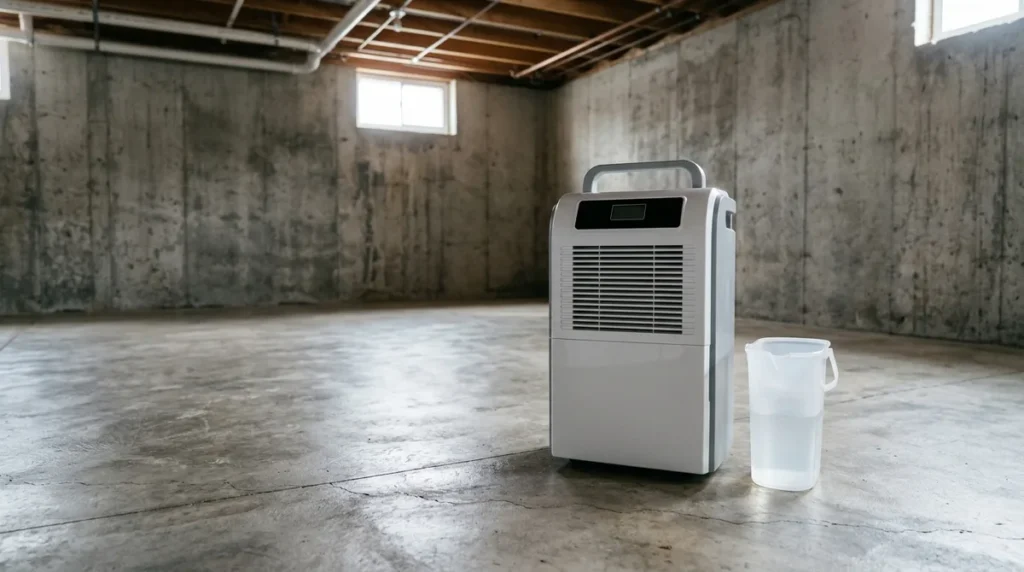
The best dehumidifier for a basement is almost always a portable unit sized to the room’s floor area and how damp it really is, with a plan for where the water goes. Don’t let a big number on the box make the decision. For a room under 2,000 square feet that is only slightly to moderately damp, ENERGY STAR recommends 20 to 30 pints per day. When the room is wet, that climbs to 30 to 50 pints. Your basement’s dampness sets the size you need, not the sales page.
Why bother? The EPA advises keeping indoor humidity below 60 percent, ideally between 30 and 50 percent, to limit the conditions mold needs to grow. That musty smell is a warning, not just an annoyance. Cold basements add a catch. ENERGY STAR warns that performance can suffer below 65°F, and frost can form on the coils. Then there’s the water itself. A bucket needs regular emptying, a hose needs a floor drain or sump nearby, and a built-in pump can push water upward. Sort that out before you buy. Typical 50-pint basement units list for roughly $249 to $309, but the running cost and the drainage setup matter just as much.
Key Takeaways
- A musty smell that lingers after the room has dried points to a leak or mold, not a weak dehumidifier.
- Shoppers should only compare pints-per-day ratings between units tested the same way because the federal test moved from 80°F to 65°F in 2019.
- Cool basements call for desiccant units, which usually need a separate outside duct to vent warm, wet air.
- Shoppers should treat the HomeLabs 4500’s 80-pint peak claim as hot-air marketing, not what a basement will see.
Is Your Basement Damp Enough to Need One?
Yes. Most damp basements are fixed by a portable dehumidifier sized to the room and how damp it really is, paired with a plan for where the water goes. The right model depends on those three things, not on the biggest number printed on the box.
So how do you know if your basement is damp enough to need one? Start with your nose and your eyes, then check the numbers.
Signs to check this week:
– A musty smell that hits you the second you open the door – Walls that look sweaty or wet on a cool morning – Water beading on cold pipes – Carpet or rugs that feel damp underfoot – White or fuzzy spots on stored cardboard boxes
Don’t shrug off that last one. Fuzzy spots on a box are an early warning, not decoration.
The musty smell is the one people argue about most. It usually fades as the humidity drops. If it sticks around after the room has been drying for a while, the machine isn’t the problem. You likely have a slow leak or mold that’s already growing, and that needs a real inspection, not a bigger dehumidifier.
Now for the numbers. Grab a cheap hygrometer, the little gauge that reads relative humidity, and leave it on a shelf in the basement for a few days. Your goal is to stay under the EPA’s 60 percent ceiling, ideally between 30 and 50 percent.
The reading also tells you your tier. ENERGY STAR sorts rooms into slightly to moderately damp at 50 to 75 percent, very damp at 75 to 90 percent, and wet at 90 to 100 percent. Those tiers set the pints-per-day range you should shop for. Get the reading first, then open the browser tab.
Matching Pints per Day to Your Room and Dampness
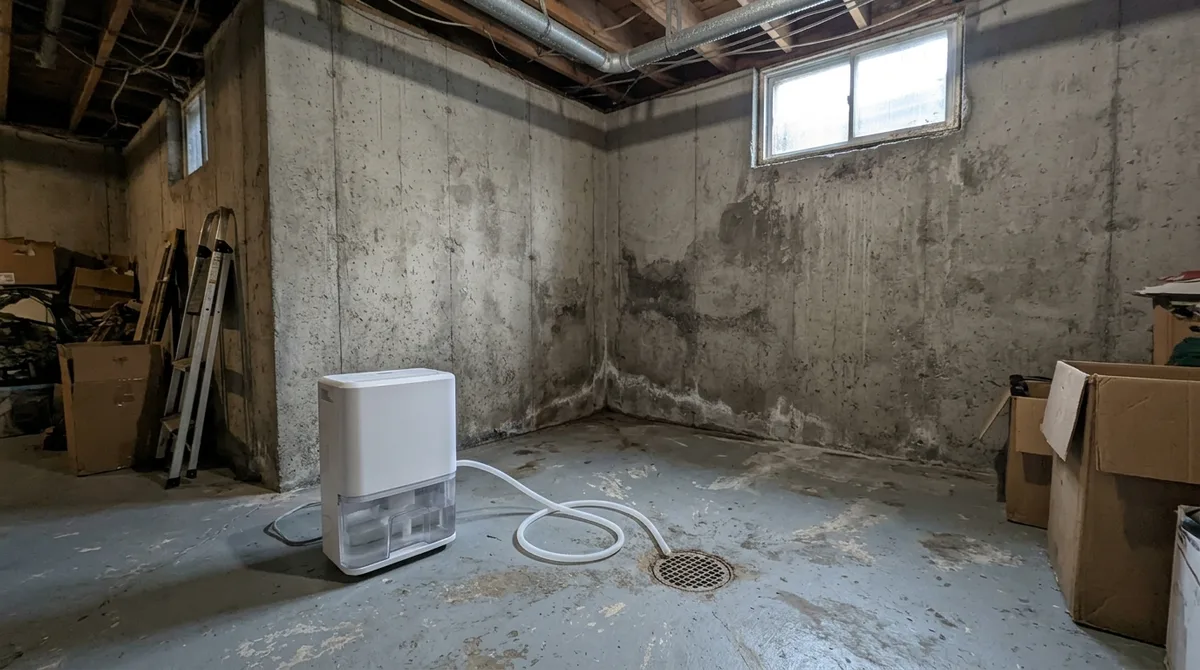
Here’s where people get burned. The pints-per-day number on the box is the water a unit removes in a set lab test, not a promise for your basement. ENERGY STAR’s testing and capacity page defines capacity as the water removed in 24 hours at test conditions, reported in pints per day. Compare that number only between units tested the same way.
Until 2019, the federal test for portable units ran at 80°F. The test now uses a 65°F dry-bulb condition, which better reflects how a basement actually performs. An old 80-degree rating looks bigger on paper than a cool basement will deliver, so treat it as an inflated number.
Federal efficiency rules come from the Department of Energy’s consumer dehumidifier page. The energy-conservation standards sit at 10 CFR 430.32(v), and the rating test runs for two hours at 65°F, plus or minus 2°F. The efficiency numbers on a listing are tied back to those same tests.
Square footage and dampness work together. Above 2,000 square feet, ENERGY STAR’s recommended capacity rises to 30+ pints for slightly to moderately damp spaces, 40+ for very damp ones, and 50+ for wet ones. A big coverage claim does not rescue a small room that is soaked. Picture a 900-square-foot basement sitting at 90 percent humidity. That room needs a unit in the 30 to 50 pint range, not one that just advertises a large area.
A damp, large basement needs more pints per day, not just more square feet on the label. If your reading lands in the very damp tier, aim for the upper part of the range.
Finally, check the standard. ENERGY STAR’s current dehumidifier specification took effect October 1, 2025. Before you compare a new listing with an older one, see which standard each uses. Otherwise you’re measuring with two different rulers.
Drainage, Cold Floors, and What You’ll Really Pay
Water has to go somewhere, and each drainage method comes with its own headaches.
– The bucket. You empty it by hand, so a unit that runs all day can fill faster than you expect. Choose a model with a tank big enough that it won’t overflow while you’re upstairs. – The gravity hose. Water drains through a hose to a floor drain or sump. The hose has to fall away from the unit the whole way, or water can back up. ENERGY STAR advises placing a hose-drained unit close to a floor drain or sump so the hose stays short, and keeping water away from electrical circuits and cords. – The built-in pump. If the nearest drain is above the unit or across the room, a pump lifts the water up to a sink, tub, or window. It works, but it adds parts that can fail and noise you’ll hear all night.
Cold floors change everything. Compressor units suit warmer basements. Desiccant units are built for cooler spaces, but they usually need a separate outside duct to vent the warm, wet air they release, so plan for that before you buy. Check the low-temperature rating on the spec sheet against your basement’s coldest month, not the reading from a sunny July afternoon.
Now the money. A 50-pint basement unit typically sells for roughly $249 to $309. That sticker price leaves out the hose, the pump if you need one, and filter replacements. Running cost depends on how many hours the unit runs and its energy rating. A humidity setting or timer that lets it shut off once the air is dry enough can cut hours, and hours are what your electric bill pays for.
Midea Cube 50 Dehumidifier: The Versatile Pick for Larger Damp Basements
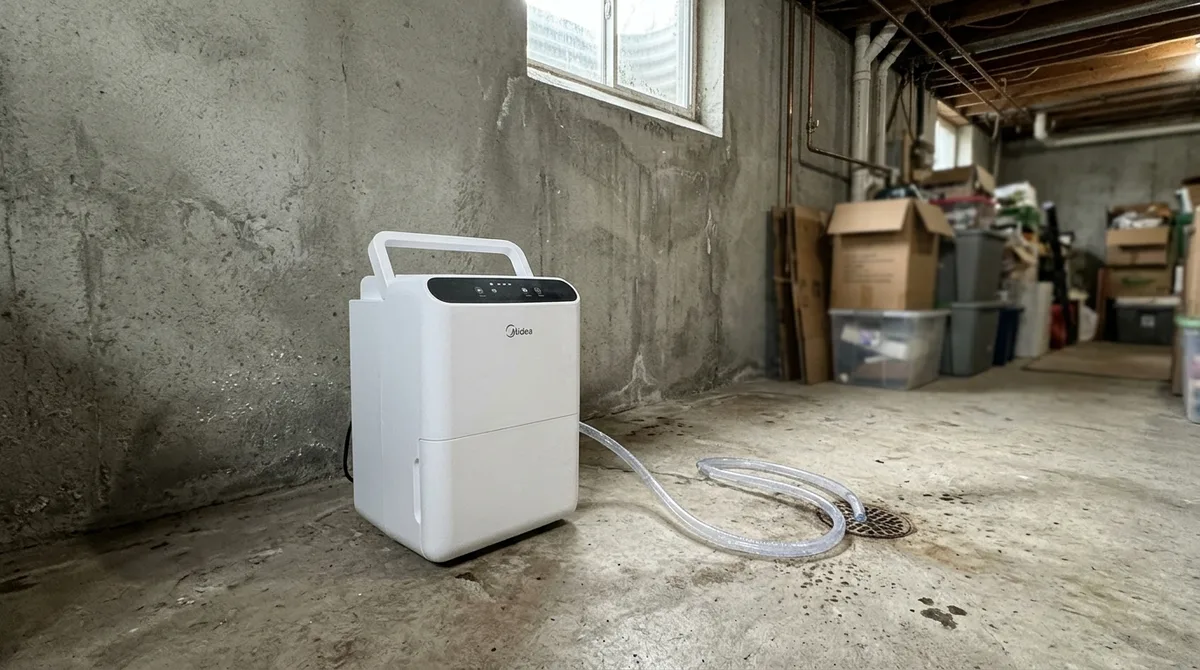
The Midea Cube 50 pulls moisture out of your basement air and collects it in its bucket, or sends it out through a drain hose if you’d rather not empty anything by hand. It suits a larger, damp basement that stays above 41°F. A small, mildly damp room only needs a basic unit, so don’t pay for capacity you won’t use.
Two features set it apart. The pump version adds SmartHome app and voice-assistant control, so you can run it from your phone or a smart speaker. The non-pump model uses gravity drainage instead. One top-ranking guide picks it for extended use, but a ranking is no substitute for your own room’s numbers.
Here’s the catch. The 50 pints on the box is Midea’s advertised figure, while ENERGY STAR’s standardized rating for the pump model is 49.67 pints per day. Those come from different tests, so plan your sizing around 49.67. Cold is the bigger risk. Midea’s manual says to run the unit where temperatures stay at or above 41°F, because colder air can frost the coils and cut performance. A chilly basement can keep it from performing as advertised.
If the nearest drain sits above the unit or far across the room, choose the pump version. Midea lists a one-year warranty for it. The Midea product page shows a Where to Buy option but no price, so that’s where to look for current pricing.
At a glance
- Best for: Bigger damp spaces where the floor stays reliably warm
- Pint Capacity: 50 pints per day advertised; 49.67 pints per day standardized for the pump model
- Coverage Area: Up to 4,500 square feet (pump version)
- Drainage: Bucket or drain hose; pump version available
- Warranty: One year (pump version)
Frigidaire High-Humidity Dehumidifier: Pump-Equipped Pick With Smart Controls
The Frigidaire FHDP5033Y1 is a current 50-pint example from Frigidaire’s high-humidity line. It’s a portable unit that pulls moisture out of indoor air, and you get two ways to handle the water. Let it collect in the bucket, or run continuous drainage through a hose. Turn on the built-in pump and it can push water up to a sink or window, which matters if your basement has no drain nearby.
This suits a moderately damp basement where the unit’s size matches the room. Small, mildly damp rooms can get by with a basic unit. Big, wet, or cold basements need more. Frigidaire’s sizing guide suggests a 50-pint unit for a 700-square-foot space that is slightly or moderately damp, but only 500 square feet when the space is very damp. Dampness shrinks the room a unit can handle, and cooler conditions can limit performance.
The standout feature is the built-in pump, which can push water up to a sink or window. One top-ranking guide names it the best overall basement pick and praises its timer and digital readout. That same guide calls it pricey and a bit loud on high speed. Make sure any spec you read belongs to the 50-pint FHDP5033Y1 you’re buying.
Don’t trust the coverage number alone. A major home-improvement retailer lists this model at 4,500 square feet, which is broader than Frigidaire’s dampness-based guidance. ENERGY STAR’s certification record shows 49.95 pints per day, a standardized rating rather than a promise for your basement. If your nearest drain is far away, the pump version is the one to pick.
At a glance
- Best for: Moderately damp basements where the nearest drain is far away
- Pint Capacity: 49.95 pints per day in ENERGY STAR’s certification record, a standardized rating
- Coverage Area: 4,500 square feet as advertised by a major retailer
- Drainage: Bucket, continuous hose drain, or built-in pump that lifts water to a sink or window
Frigidaire 50-Pint Dehumidifier: Gravity-Drain Option for Basements Near a Drain
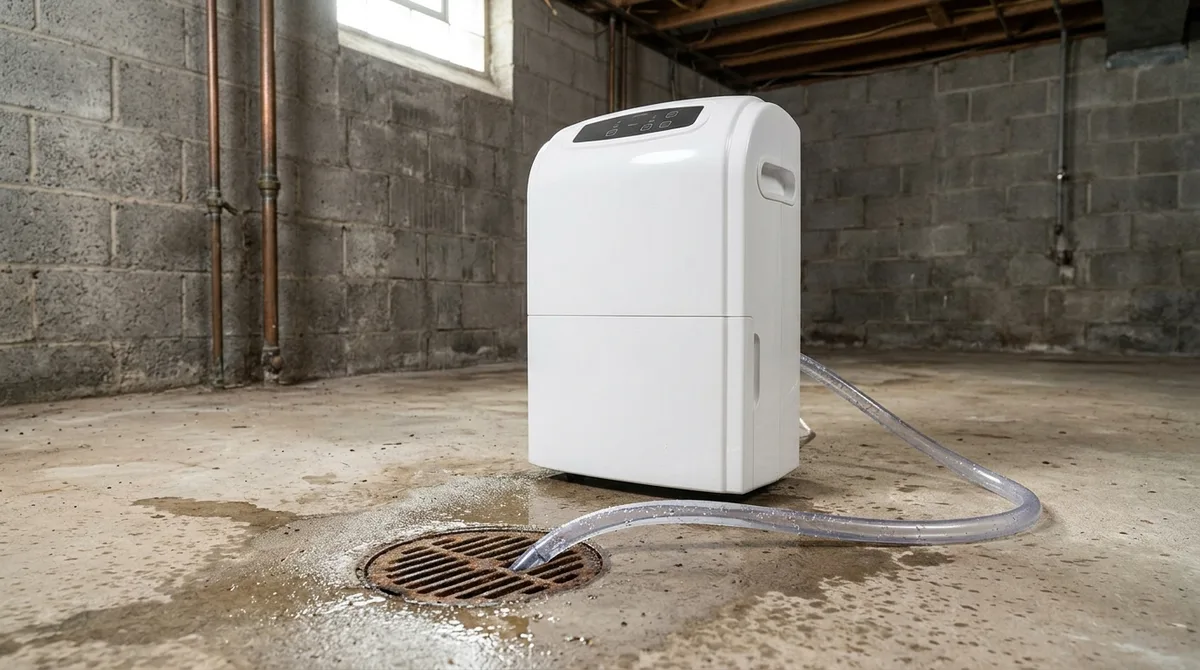
The Frigidaire FHDD5033Y1 pulls moisture out of indoor air and collects it in a 1.9-gallon bucket, or sends it through a gravity-drain hose to a nearby drain. The unit is ENERGY STAR certified, and Frigidaire’s spec sheet lists it at 50 pints per day.
This one suits a basement that is moderately to very damp and has a floor drain close by. Small, mildly damp rooms only need a basic unit, and big, wet basements need more capacity than this. A cool basement can still cut its output, so check how cold your space gets in winter.
Here’s the catch. There’s no built-in pump, so the drain has to sit below the unit, and the hose can’t kink or rise along the way. Frigidaire doesn’t publish a square-foot coverage figure for this model, so size it by floor area and dampness instead. Compare its 50-pint label against the DOE test rating, because ENERGY STAR lists this model at 49.95 pints per day under the current test. That’s the number to trust, not the marketing copy.
At a glance
- Best for: Moderately to very damp basements with a floor drain nearby
- Pint Capacity: 50 pints per day on the label; 49.95 pints per day per ENERGY STAR
- Coverage Area: Not published by the maker, so size by floor area and dampness
- Drainage: 1.9-gallon bucket or gravity-drain hose; no built-in pump
DuraComfort Dehumidifier with Pump: Pump Model for Large Rooms and Awkward Drains
The DuraComfort DH50PWM is a portable compressor dehumidifier that gives you two ways to handle the water. It can collect moisture in its bucket, or its built-in pump can lift water up to 16.4 feet through the included drain hose. That pump is the main reason to pick this model over a plain bucket unit. If the nearest drain sits uphill or across the room, the pump does the lifting for you.
This one suits a big, damp basement where the drain is not right beside the unit. The maker lists it for areas up to 4,500 square feet.
Now read the numbers carefully. The 50-pint rating is the DOE figure, but the maker also advertises up to 115 pints per day at 86°F and 80 percent humidity. Those are different tests under different conditions, so the two numbers can’t be compared head to head. Treat 115 as a marketing peak, not what your basement will see.
The cold-room catch is the big one. The manual says moisture removal drops in cooler rooms, and the unit operates between 41°F and 90°F. A chilly basement will get less out of it than the headline suggests, and a basement near freezing falls outside its design range.
The warranty covers parts and labor for 12 months from purchase. The official product page listed the DH50PWM at $201.80 when it was checked, so prices move. Put it side by side with other 50-pint pump models before you order.
At a glance
- Best for: Large, damp basements where the drain is uphill or across the room
- Price: $201.80 on the official product page when checked
- Pint Capacity: 49.7 pints per day on the DOE-based product record; 115-pint peak is a hot-air maximum
- Coverage Area: Up to 4,500 square feet, per the maker
- Drainage: Bucket or built-in pump with a 16.4-foot drain hose
- Warranty: 12 months on labor and parts, per the manual
Hisense Energy Star 50-Pint Three-Speed Dehumidifier: Quiet Pick for Cool Basements
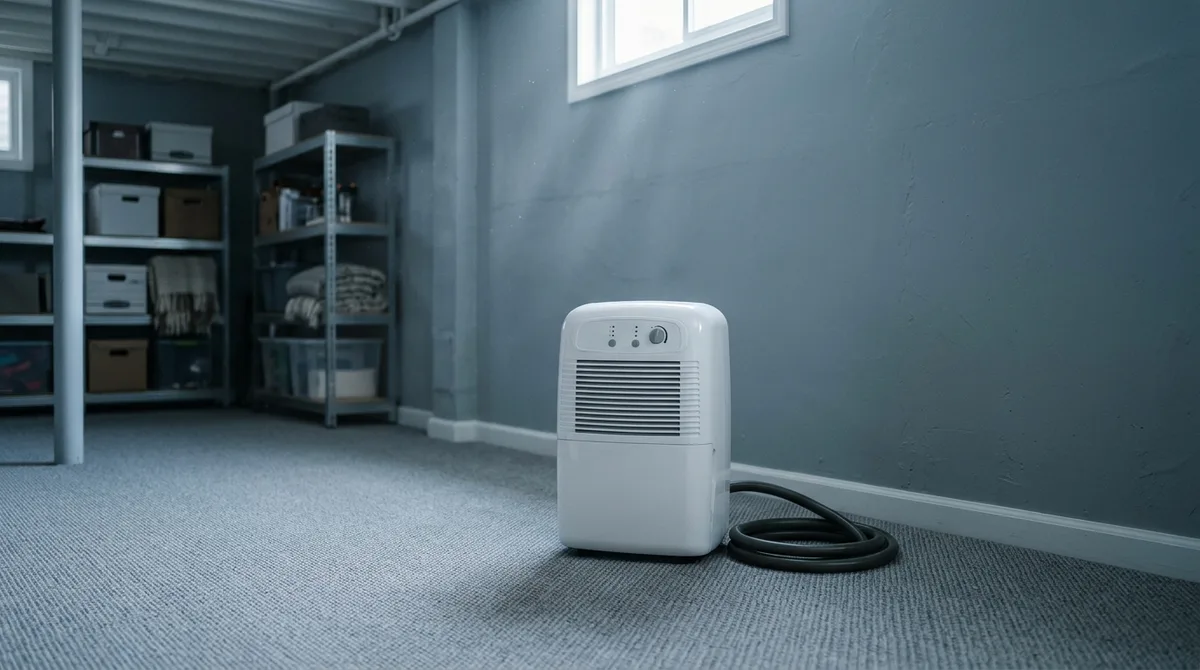
The Hisense DH5023KP is the quiet, cold-friendly pick in this lineup. It pulls moisture out of room air and collects it in a removable bucket, which you empty by hand when it fills. You can also drain it through a garden hose, and pump-function versions add pump-assisted draining for basements with no drain nearby.
This one suits a cool basement. Hisense says the DH5023KP runs at temperatures as low as 38°F, colder than the 41°F floors listed for several models in this guide. If noise is your biggest worry, one top-ranking guide names it the quietest basement dehumidifier it reviewed. Three speeds let you turn it down for a quiet night and up when the room is wet.
The catch starts with size. Hisense’s current product page recommends it for rooms up to 300 square feet, which is small for most basements, so size the unit to your actual floor area and dampness. The use-and-care guide also says the bucket must be emptied before the unit will resume running, and gravity drainage needs a separately purchased garden hose. Pump-assisted draining applies only to pump-function models, so know which version you’re buying.
Hisense’s current product page lists a two-year parts-and-labor warranty. A refurbished DH5023KP was listed on a major online marketplace for $139.98, sold by a third-party seller with no written warranty. That’s a used-market price, not a new-unit offer, and it sits well below the roughly $249 to $309 band typical for 50-pint basement units. For current new-unit pricing, see the official site.
At a glance
- Best for: Cool basements and buyers who care most about noise
- Price: $139.98 for a refurbished unit on a third-party marketplace listing
- Pint Capacity: Up to 50 pints per day, per the maker
- Coverage Area: Up to 300 sq. ft. on the current product page
- Drainage: Bucket or gravity hose; pump-assisted draining on pump-function versions
- Warranty: Maker’s current listing shows two years of coverage
HomeLabs Energy Star Dehumidifier: Budget Pick for Smaller Basements
The HomeLabs HME0089 is a portable, Wi-Fi dehumidifier that pulls moisture out of indoor air. It collects the water in a removable tank with a full-tank alert, or it sends the water out through a drain hose for continuous drainage. It makes the most sense for a smaller basement or room that is only mildly to moderately damp, where budget matters most. A big, soggy basement needs more muscle than this.
The maker advertises it as a 32-pint unit for spaces up to 4,500 square feet. ENERGY STAR’s certification record lists its tested capacity at 32.46 pints per day, and that certified figure is the one to trust. One top-ranking guide calls it the best budget basement pick. The maker’s product page listed it at $211.49, but it is currently marked sold out and open for pre-order, so check stock before you plan around it.
Now the catch. Advertised pints depend on the test method, so compare certified capacities only. A drain hose is an option rather than a given, so check whether it comes with the unit before you count on continuous drainage. The manual sets the operating range at 41 to 90°F and 30 to 90 percent relative humidity, so a basement that gets colder than 41°F falls outside it. The warranty is one year on new, unused units bought from the maker or an authorized reseller, with proof of purchase.
At a glance
- Best for: Budget buyers who want Wi-Fi control for a modest room
- Price: $211.49 on the maker’s product page, currently marked sold out/pre-order
- Pint Capacity: 32 pints per day advertised; 32.46 pints per day certified by ENERGY STAR
- Drainage: Removable tank with full-tank alert, or drain hose option
- Warranty: One-year limited warranty on new, unused units with proof of purchase
HomeLabs 4500 Dehumidifier: Large-Space Wi-Fi Pick With a Peak-Claim Warning
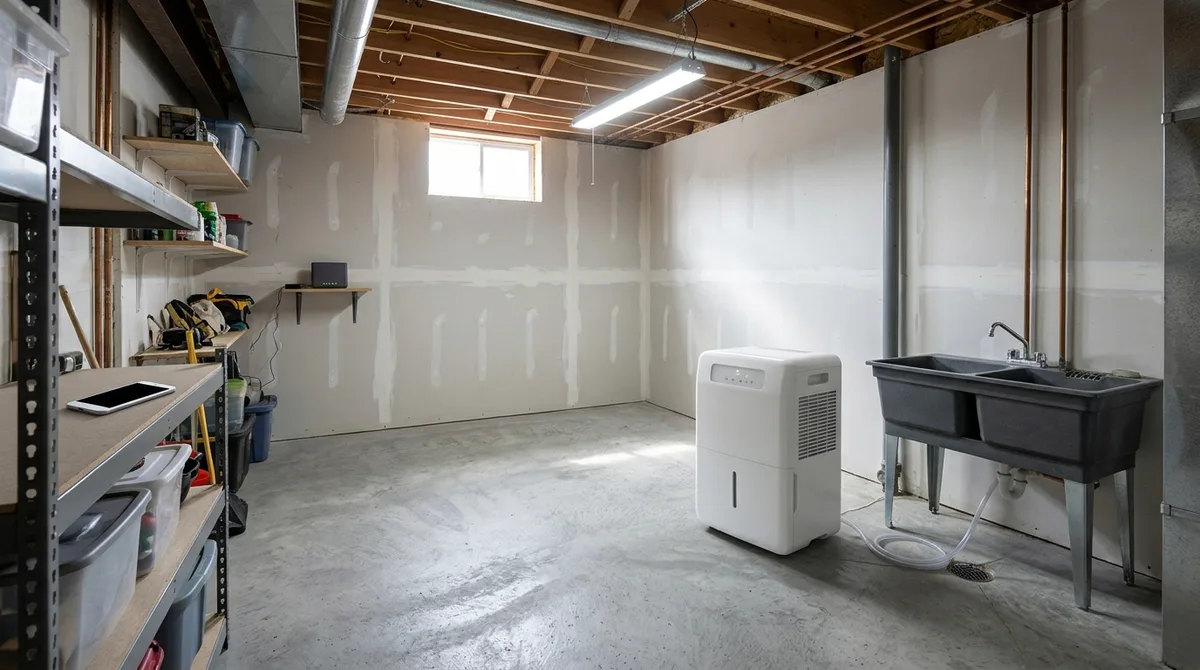
The HomeLabs 4500 is a portable Wi-Fi dehumidifier. It pulls moisture out of indoor air and collects it in a removable tank, or it runs continuously through a drain hose if you’d rather not empty anything by hand. The current listing is a 32-pint unit with a removable washable filter. The maker advertises up to 80 pints per day at 95°F and 90 percent relative humidity, and that’s the headline number you’ll see everywhere.
Here’s the catch. The 80-pint figure is a peak for hot, humid air, not what a cool basement will see. The unit’s ENERGY STAR rated capacity is 32.46 pints per day, which fits a large, slightly to moderately damp room better than a large, wet one. So the 4,500-square-foot coverage claim is not a guarantee for a big, soggy space. One top-ranking guide recommends it for large basements, and that’s the right fit only if your basement is larger and moderately damp. The manual also sets a floor of 41°F, so a cold basement is a real limit.
Plan the drain route before you buy. There’s no pump, so hose drainage depends on gravity, which means the drain has to sit lower than the unit. A tank fills fast at high output, so a bucket-only setup can mean frequent trips downstairs. Also, the “hOmeLabs 4500” name has been used for older 50-pint models, so make sure you’re getting the 32-pint version. The warranty is one year for new products bought from hOme or an authorized reseller, with proof of purchase. At the time checked, the official product page listed it at $211.49 but marked it sold out or pre-order, so the price moves. Compare it against other large-space units before you commit.
At a glance
- Best for: Larger, moderately damp basements that need a bigger unit
- Price: $211.49 at the time checked, when the unit was sold out or on pre-order
- Pint Capacity: 32.46 pints per day (ENERGY STAR); up to 80 pints per day at 95°F and 90% relative humidity (maker claim)
- Coverage Area: 4,500 square feet (maker claim, not a guarantee for large, wet spaces)
- Drainage: Removable tank or gravity drain hose; no built-in pump
- Warranty: Keep your receipt; coverage runs one year from purchase
Honeywell Smart Portable Dehumidifier: Wi-Fi Room Unit With Voice Control
The Honeywell Smart Portable Dehumidifier TP70AWKN is a compressor-based unit that pulls moisture out of the air. You can collect the water in a removable 14-pint tank, or let gravity carry it out through the included continuous-drain hose. Honeywell rates it for spaces up to 4,000 square feet. It works with the Honeywell Air Comfort app and voice control, but you can also run it from the control panel if you skip the app.
It suits a basement that stays at or above 41°F, especially if you want to adjust it from your phone or a smart speaker. The app only connects to a 2.4 GHz Wi-Fi network, so a 5 GHz-only setup won’t work.
Now the drawbacks. There’s no built-in pump, so the drain has to fall away from the unit. A tank needs regular emptying. The 41-degree floor is the big catch. RTINGS’ review of a sibling model, the TP70AWKNR, warned that airflow may hinder performance in especially cool, humid basements. Also, the “70 pints” on older listings uses the earlier rating. Under the 2019 DOE standard, this unit is rated at 50 pints per day, so compare that number.
Honeywell Store lists the TP70AWKN at $449.95 but currently marks it out of stock. Put that price next to other Wi-Fi units in the same size class before you buy. The warranty covers one year of parts and labor, plus four more years on sealed-system parts. For current details, head to the official Honeywell product page.
At a glance
- Best for: Basements that stay at or above 41°F, and rooms that want app and voice control
- Price: $449.95 listed by Honeywell Store, currently out of stock
- Pint Capacity: 50 pints per day under the 2019 DOE standard; 70 pints per day under the earlier rating
- Coverage Area: Up to 4,000 square feet
- Drainage: 14-pint tank, with a continuous-drain hose included
- Warranty: Sealed-system coverage runs four years past year one
Santa Fe Compact70: Low-Profile Unit for Tight Basement and Crawl Space Spots
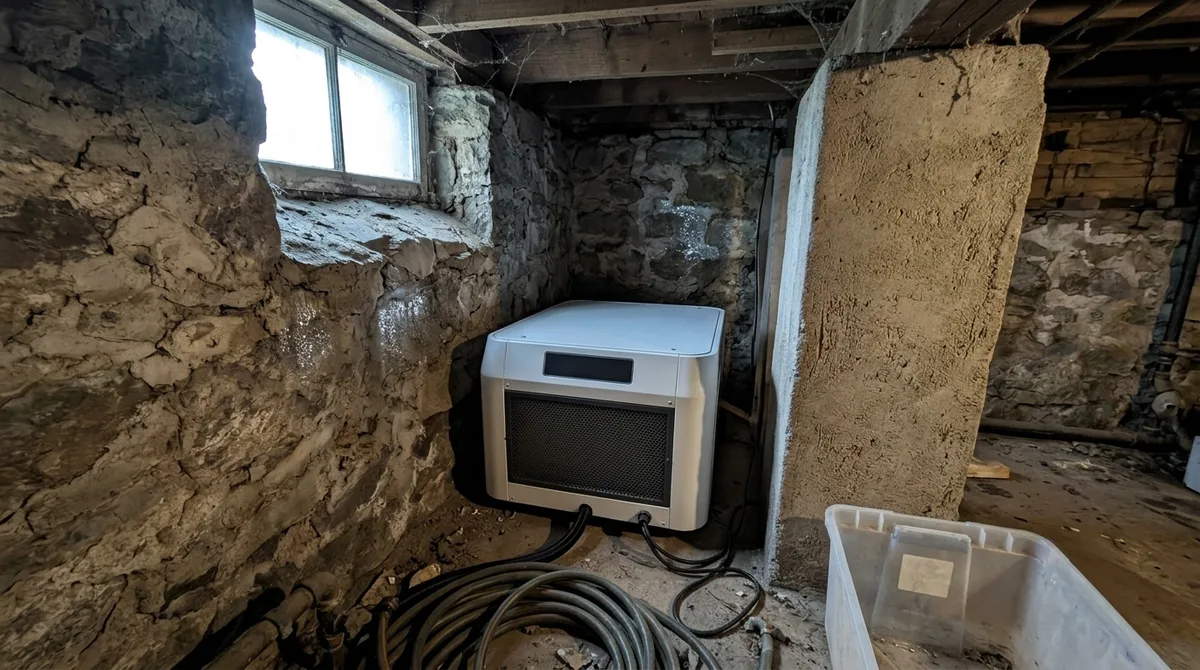
The Compact70 measures 12 by 12 by 21 inches, weighs 55 pounds, and is designed to slide into low clearances or sit between floor joists. It pulls moisture out of the air and sends the water out through an 8-foot gravity drain hose. There’s no built-in pump.
That makes it a fit for a low basement or crawl space with a clear downhill route to a drain. If the drain sits uphill or across the room, you’ll need the optional condensate pump, which the maker says can lift water up to 12 feet. Plan that cost in from the start. Coverage depends on sealing too. The maker lists up to 2,600 square feet for a tightly sealed space, 2,000 for moderately sealed, and 1,800 for loosely sealed.
Here’s the headline: 70 pints per day. Look closer, though. That figure is measured at 80°F and 60 percent humidity. At 65°F and 60 percent, the maker lists 43.7 pints per day. A cool basement lives much closer to the second number. The operating range runs from 49°F to 95°F, and the unit works best from 56°F up, so a chilly crawl space can push it to the edge. One popular roundup praises its air filtration, which is a nice bonus, not a reason to ignore the cold-room math.
Warranty coverage is five years on materials and workmanship and six years on components. Filters, labor, and shipping are excluded. An online retailer listed the unit at $1,565, reduced from $1,689.99, and marked it backordered when the page was checked. Compare that against other compact units before you commit.
At a glance
- Best for: Tight basements and crawl spaces with a gravity drain route below the unit
- Price: $1,565 at an online retailer when checked, reduced from $1,689.99 and backordered; see the official site for current details
- Pint Capacity: 70 pints per day at 80°F and 60% RH; 43.7 pints per day at 65°F and 60% RH
- Coverage Area: Up to 2,600 square feet when tightly sealed
- Drainage: 8-foot gravity drain hose; optional condensate pump lifts water up to 12 feet
- Warranty: Filters, labor, and shipping excluded; see the manual’s terms
AlorAir Storm DP 50: Mid-Size Pump Unit for Restoration-Grade Drying
The AlorAir Storm DP is a commercial-grade dehumidifier, and it’s built for rough work. AlorAir’s manual describes it for professional jobs, including flooding and restoration. It pulls moisture out of your basement air, then uses its built-in pump to push the collected water out through a hose. The included hose is 19.6 feet long, and the pump lifts water up to 14.7 feet. The manual also says the hose must be uncoiled, kept unblocked, and never discharged at a height of 15 feet.
This is a unit for a bigger or colder damp space, where a tank-style room unit would fill up too fast. It covers up to 1,300 square feet and runs down to 33.8°F. Remote app control and automatic defrost are the features that make it stand out. One top-ranking guide names it the best mid-size basement unit with app control, rated at 50 pints per day.
Now the fine print. The 50-pint figure is AlorAir’s AHAM rating at 80°F and 60 percent relative humidity. The 110-pint number is the maximum at 90°F and 80 percent humidity. Those are different tests, so read the conditions before you compare the two. It’s also heavier and more industrial than a household model, so plan its spot before you haul it down the stairs. The six-year warranty applies to orders placed on or after May 14, 2026, but only the first two years cover parts, labor, and unit replacement. The official listing showed $799 alongside a “notify me when available” message, so current price and stock are worth checking there.
At a glance
- Best for: Larger or colder damp basements where a tank-style unit would fill too fast
- Price: $799 on the official listing, which showed a “notify me when available” message
- Pint Capacity: 50 pints per day (AHAM, 80°F, 60% relative humidity); 110 pints per day maximum (90°F, 80% relative humidity)
- Coverage Area: Up to 1,300 square feet
- Drainage: Built-in pump with a 19.6-foot hose and a maximum lift of 14.7 feet
- Warranty: Six years for orders placed on or after May 14, 2026: two years of parts, labor, and unit replacement, then four years of refrigeration-system parts only
AlorAir Storm 80X: Heavy-Duty Pick for Big, Wet Basements
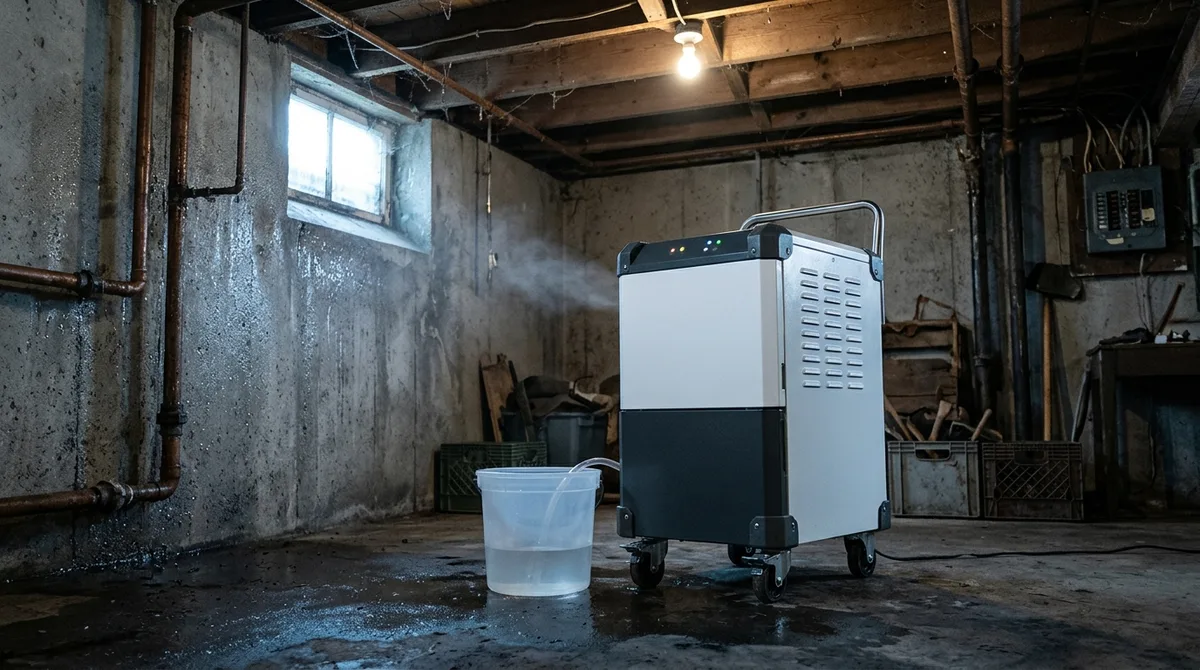
The AlorAir Storm 80X is a portable, commercial-grade dehumidifier that pulls moisture out of the air. It doesn’t rely on a tank you have to carry upstairs. Instead, a built-in pump sends the collected water out through a hose. Rise aims it at very damp basements and water-damage restoration, and that’s the job it’s built for. A small or mildly damp room doesn’t need this much muscle, so don’t buy it just because the box looks serious.
The headline number is 170 pints per day, but AlorAir measures that at 90°F and 90 percent humidity, a hot, soggy test most basements never see. The AHAM rating, run at 80°F and 60 percent humidity, is 80 pints per day, and that’s the figure to compare with other units. A built-in pump does the lifting, so you don’t need a drain above the unit. Automatic defrost is built in, though moisture removal can drop during a defrost cycle, and the listed operating floor is 35.6°F.
Here’s the catch. Its capacity, size, and noise can be too much for a typical home basement, and Rise says the same. The pump lift and weight will decide where you can place it, so pick the spot before delivery day. Measure your doorways and stairs first, because a unit this heavy has to get down there in one piece. Plan your drain or sump ahead of time, and compare the price and warranty with other commercial-grade models. The six-year limited warranty includes full coverage for the first two years.
At a glance
- Best for: Large, persistently wet basements and water-damage restoration work
- Price: $639.99 on the official product page when accessed; prices change often
- Pint Capacity: 80 pints per day (AHAM rating); up to 170 pints per day at 90°F and 90% relative humidity (maker claim)
- Drainage: Built-in pump with a 19.6-foot included hose, lifting water up to 19.6 feet
- Warranty: Six years advertised; confirm the written terms before buying
- Where to Buy: AlorAir’s official site, which sells the unit directly
AlorAir Galaxy 85P: Compact Pump Unit for Low-Ceiling Basements
The AlorAir Galaxy 85P is a compact, commercial-style dehumidifier with no collection bucket. It pulls moisture out of the air and sends the water away through a built-in pump or a gravity drain. It’s built for the spots where a standard unit can’t fit or can’t keep up: a low-ceilinged basement or a damp crawl space that still needs serious removal power.
The maker claims coverage up to 2,300 square feet. The pump lifts water up to 19.6 feet, and the drain hoses are listed at 6.56 and 19.6 feet. It runs as quiet as 55 dBA, and automatic defrost helps when the coils start to frost. One top-ranking guide rates it at 85 pints per day for tight basements.
Here’s the catch. AlorAir publishes two ratings: 85 pints per day at 80°F and 60 percent relative humidity, and 180 pints per day at 90°F and 90 percent relative humidity. Those come from different test conditions, so compare the 85 figure only with other units rated the same way. Cold is the other problem. The spec sheet gives a minimum operating temperature of 37.4°F, while the product page table lists 33.8°F. Those numbers don’t match, so ask AlorAir which one applies before you buy for a chilly basement.
The drain route has to work before you switch the unit on, because there’s no bucket to catch the water. Warranty coverage is one year for parts and labor, three years for parts and labor on the refrigeration system, and five years for refrigeration-system parts, with limitations and possible shipping costs. The official AlorAir page listed the unit at $899.11 and marked it out of stock when checked.
At a glance
- Best for: Low-ceilinged or tight basements and damp crawl spaces that need serious removal capacity
- Price: $899.11 on the official site when checked, marked out of stock
- Pint Capacity: 85 pints per day at 80°F and 60% relative humidity; 180 pints per day at 90°F and 90% relative humidity
- Coverage Area: 2,300 square feet per the maker; size by dampness first
- Drainage: Built-in pump lifting water up to 19.6 feet, or gravity drain; no collection bucket
- Warranty: One year parts and labor; three years parts and labor on the refrigeration system; five years on refrigeration-system parts
Dapper Supply 105-Pint: Entry-Price Pump Unit for Serious Moisture
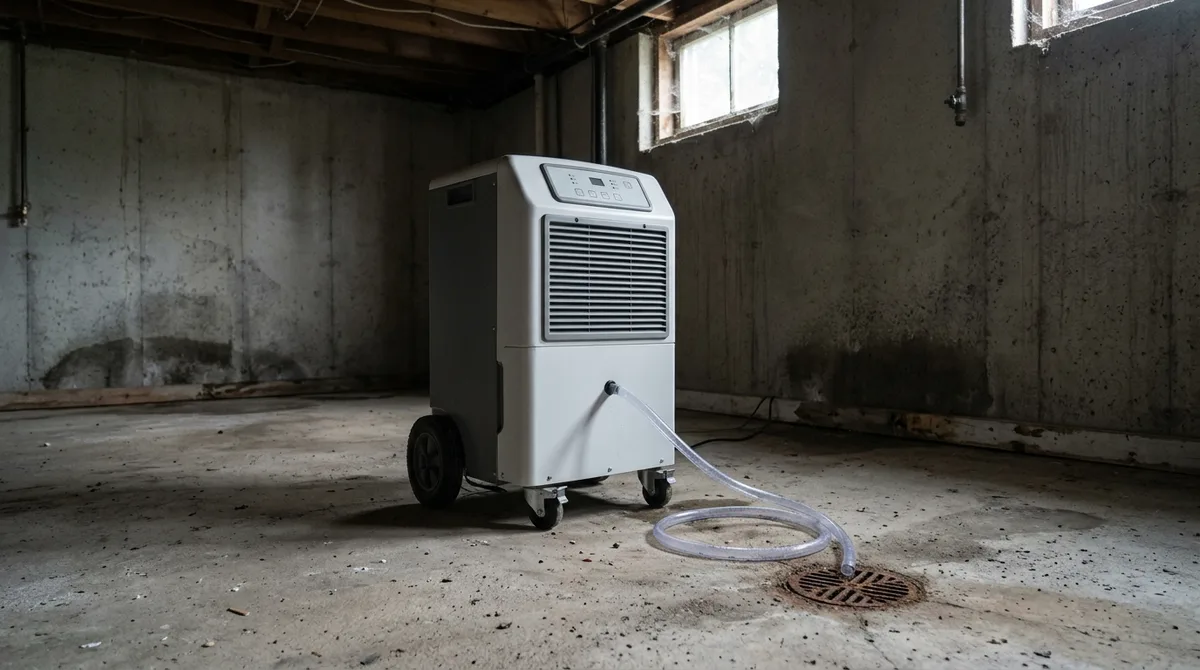
The Dapper Supply DP-CD1128 is a commercial dehumidifier built for basements, crawl spaces, and storage areas. It pulls moisture out of the air and collects it in a 1.32-gallon tank. Or it sends the water away. The built-in pump lifts water up to 16.4 feet, and the included gravity-drain hose works when the drain sits lower than the unit.
This is a heavy hitter for a wet basement that needs real capacity. A tiny room or a light dampness problem doesn’t need this much machine. The maker advertises coverage up to 8,000 square feet, a two-speed fan, and 300 CFM of airflow.
The headline claim is up to 105 pints per day. The maker also lists 52.5 pints under the AHAM test at 80°F and 60% relative humidity, so the big number is not a typical result. One top-ranking guide names it the entry-price pump pick, but compare test conditions before you trust either figure. The maker lists operation down to 41°F, yet ENERGY STAR warns that frost can form on coils in cold conditions and reduce performance. A chilly basement will not get full output.
The product page shows a two-year warranty badge, but the warranty text and linked document say one year, and a major home-improvement retailer lists one year too. At the time checked, Dapper Supply listed the unit at $500, another retailer at $399, and a third at $299.99 as an online-only item. Prices move, so check the Dapper Supply product page for the latest figures.
At a glance
- Best for: Wet basements that need large capacity and a pump or low drain
- Price: $500 at Dapper Supply, $399 at one retailer, and $299.99 online-only at another, at the time checked
- Pint Capacity: Up to 105 pints per day (maker claim); 52.5 pints per day AHAM at 80°F and 60% RH
- Coverage Area: 8,000 square feet advertised; treat it as a ceiling, not a target
- Drainage: 1.32-gallon tank, built-in pump lifting water up to 16.4 feet, or 3.28-foot gravity-drain hose
- Warranty: One year per the warranty text and linked document, though the page shows a two-year badge
Ebac Neptune 52: Industrial Choice After a Basement Leak
The Ebac Neptune 52 is a portable, industrial-style dehumidifier built for restoration and commercial drying. It pulls moisture out of the air, but it doesn’t rely on a bucket you have to empty by hand. Instead, it sends the condensate through a gravity-drain hose, which matters when you’re pulling water out of a flooded basement all night.
This is a heavy-duty machine for a very wet basement after a leak or flood, not an everyday damp room. Small, mildly damp spaces need a basic unit, and this one is overkill there. Ebac lists a typical extraction rate of 52 pints per day and an effective volume of 8,370 cubic feet. Its operating range runs from 33°F to 95°F, and a rotary compressor with automatic hot-gas defrost helps it keep running in cool, damp corners where frost would otherwise choke the coils.
One top-ranking guide recommends it for basements after a leak and cites a three-year warranty on key parts. The owner’s manual, however, describes a one-year warranty covering parts and labor, so read the terms yourself. Here’s the bigger catch: Ebac’s official site marks the 10199GR-US Neptune as discontinued, yet it lists a Neptune under a different part number. Confirm the exact model and whether it’s still available before you commit. Also, the 52-pint rating was set under the older 80°F test, so it can’t be compared directly with newer units.
Prices sit in the four figures. In a general market check, one listing showed about $1,667. Before you buy, compare that against a restoration rental or a professional drying quote, and map out your drain route first, because the gravity hose needs a path that falls away from the unit.
At a glance
- Best for: Very wet basements after a leak or flood
- Price: About $1,667 in a general market check
- Pint Capacity: 52 pints per day typical extraction rate
- Coverage Area: 8,370 cubic feet effective volume
- Drainage: Gravity-drain hose; internal condensate pump is optional
- Warranty: One year parts and labor, per the owner’s manual
AlorAir Sentinel WHD100: Ducted Whole-House Option for Finished Basements
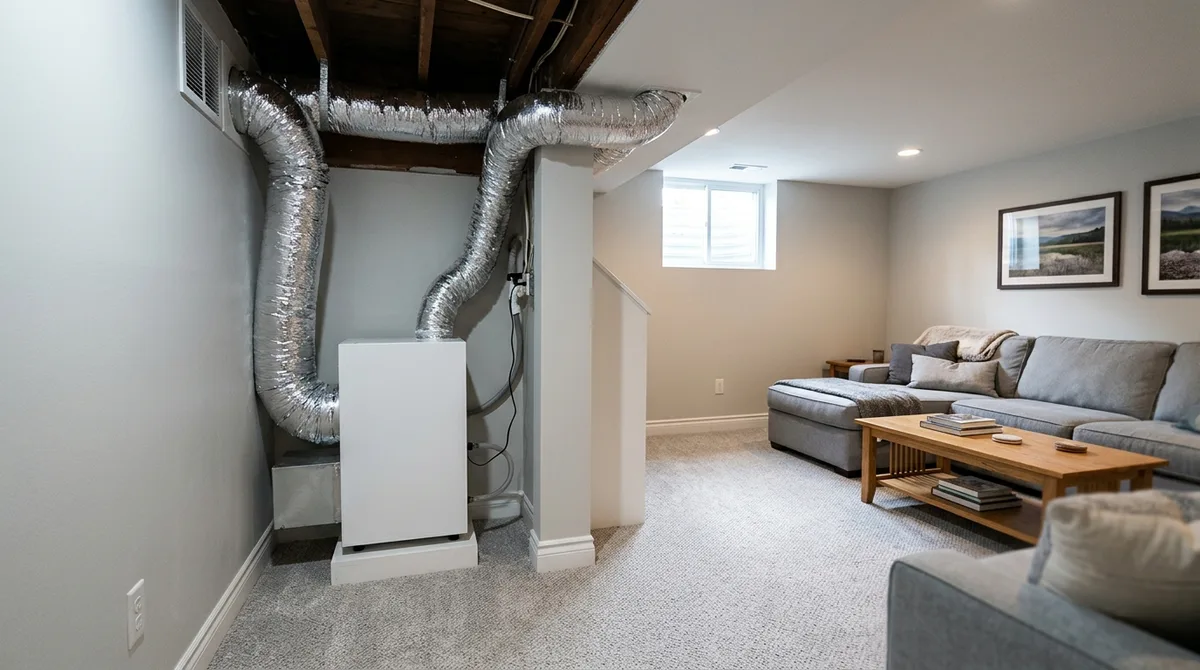
The AlorAir Sentinel WHD100 isn’t a bucket you park in the corner. It’s a heavy, fixed ducted unit weighing 89.07 pounds. It pulls moisture out of circulated air and sends the water away through a gravity drain, so you never haul a tank up the stairs.
It suits a finished basement that already has ductwork, or a large space where a portable unit would be impractical. One top-ranking guide recommends it for finished basements with ductwork at $1,399. Small, mildly damp rooms don’t need this kind of muscle.
The standout features are adjustable inlet and outlet duct configurations, a fresh-air function, and automatic defrost that pauses the compressor while the fan keeps running. AlorAir rates it at 90 pints per day at AHAM conditions of 80°F and 60 percent humidity. Under the DOE whole-house condition of 73°F, that drops to 70 pints per day. Its listed operating floor is 35.6°F.
Here’s the catch. The 90-pint headline comes from a different test than the 70-pint DOE figure, so compare it only with units rated the same way. The gravity drain needs a continuously downhill route to a drain, and a separate pump may be needed if the water has to be lifted. You can’t plug it in and try it first, so get an installer’s quote and confirm the drain fall before you commit. AlorAir’s product page advertises a six-year limited warranty, but its manual lists five years for refrigeration-system parts, so ask for the written terms for this model.
At a glance
- Best for: Finished basements with existing ductwork, or large spaces where a portable unit won’t work
- Price: $1,199 when checked, reduced from $1,399, with free shipping; see the official site for current details
- Pint Capacity: 90 pints per day at AHAM conditions; 70 pints per day at DOE whole-house conditions
- Coverage Area: Up to 2,300 square feet
- Drainage: Gravity drain, with no built-in pump
- Warranty: Six-year limited warranty on the product page; the manual lists five years for refrigeration-system parts
Ebac DD200 Desiccant: Specialist Pick for Basements Near Freezing
The Ebac DD200 works differently from the units above. It’s a compact, stainless-steel desiccant dehumidifier that uses a silica-gel wheel to pull moisture from the air and produce warm, dry air. The moisture leaves in a separate stream of warm, wet air, and that stream has to be ducted outside. There’s no tank to empty. The installation manual says the exhaust duct should be short and slope downward, away from the unit, so condensation doesn’t flow back into it. Map that route before you buy.
This is a cold-basement pick. Ebac rates the DD200 to operate down to -4°F, with a listed maximum of 104°F. Most basement units in this guide stop at 41°F, so this is the one for a space that drops toward freezing. One top-ranking guide picks it for exactly that job. One retailer suggests it for spaces up to 400 square feet, so think small and very cold, not large and soggy.
The standout traits are a rugged build, no condensate pump, and cold-temperature operation. Ebac lists a typical extraction of 36 pints per day at 27°C and 60% relative humidity. The retailer describes up to 40 pints per day in AHAM conditions. Those are different tests, so don’t compare the two numbers directly. The retailer also lists a one-year limited warranty.
The drawbacks are real. The ducting requirement, the industrial positioning, and the high price make the DD200 a specialist choice, not an everyday basement fix. One retailer lists it at $3,399 but marks it backordered, with a quote request option. For current availability, see the official Ebac page.
At a glance
- Best for: Small basements that drop toward freezing
- Pint Capacity: 36 pints per day at 27°C and 60% relative humidity (Ebac rating)
- Coverage Area: Up to 400 square feet (retailer suggestion)
- Drainage: Warm, wet air ducted outside; no tank or condensate pump
- Price: $3,399 at a retailer when checked, backordered
- Warranty: One-year limited (retailer listing)
Ivation 13-Pint Desiccant Dehumidifier: Small-Room Helper for Cool Spaces
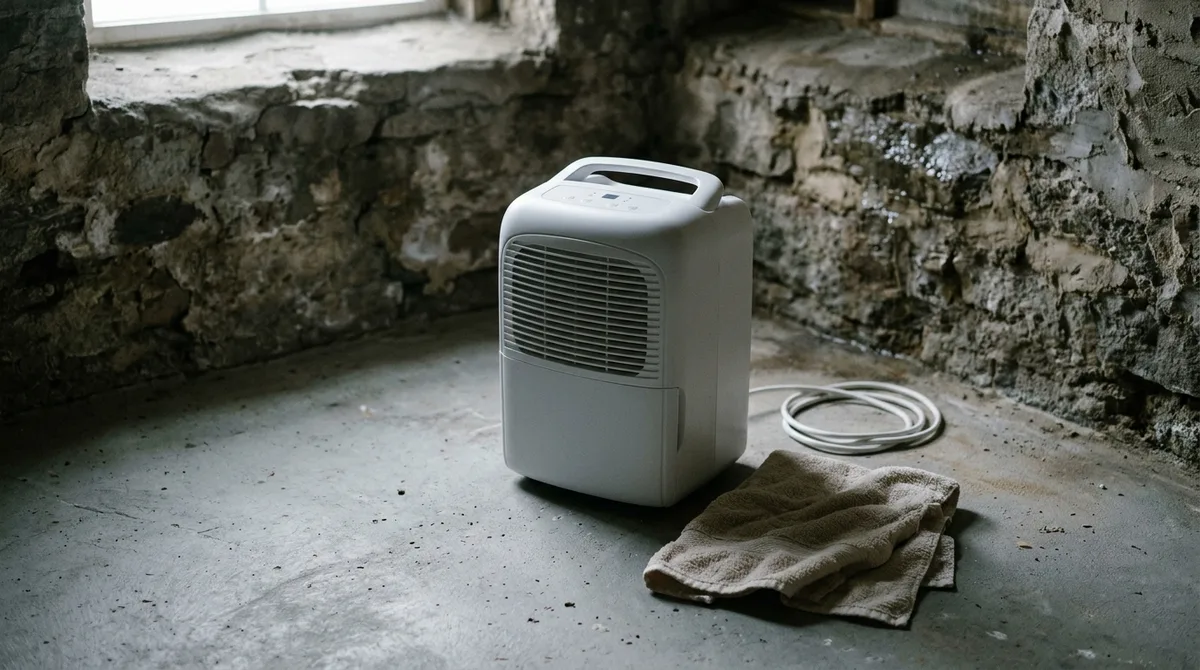
The Ivation IVADDH06 is a small portable desiccant dehumidifier, and it works differently from compressor units. A rotor pulls moisture out of the air and collects it in a removable tank holding about half a gallon, or it sends the water down a gravity-drain hose. Its controls cover humidity, fan speed, timer, sleep mode, and outlet swing, so you can set it and let it run overnight. A top-ranking guide recommends it for drying individual rooms in a basement.
This is a room helper, not a whole-basement fix. It suits one small, mildly damp room in a cool basement. Ivation rates it for spaces up to 270 square feet, which is small for a full basement. Big, wet, or very cold basements need more machine than this.
Read the capacity line twice. Ivation’s 2017 sell sheet lists 12 pints per day at 68°F and 60 percent relative humidity, while a major home-improvement retailer lists 13 pints under the same conditions. The user guide also says the unit is designed to run between 33°F and 104°F and will stop working outside that range, so a basement that dips near freezing is a real problem. The warranty is one year, limited, and subject to exclusions.
There’s no pump, so the drain has to sit lower than the unit. The gravity-drain hose is not included, so buy one with a 7/16-inch inner diameter and a steady downward slope if you want less emptying.
At a glance
- Best for: Spot-drying one compact room while the rest of the basement is fine
- Price: Ivation’s official store page listed it at $289.99 and in stock when checked; prices move
- Pint Capacity: 13 pints per day marketed; 12 pints per day on the 2017 sell sheet at 68°F and 60% relative humidity
- Coverage Area: Up to 270 square feet
- Drainage: Removable tank of about 0.5 gallons, or gravity-drain hose (hose not included)
- Warranty: One-year limited
Frizzlife DH80: Budget Tank Unit for Small Basement Corners
The Frizzlife DH80 is a compact semiconductor dehumidifier and the budget pick for tight spaces. It pulls moisture out of indoor air and collects the water in a removable 135-ounce tank. It also has a negative-ion air feature and a sleep mode that Frizzlife rates at 28 dB, so it won’t roar all night.
Who is it for? A small corner or one mildly damp room. Frizzlife lists coverage up to 1,000 square feet, but it also recommends the DH80 for small spaces. Believe the second part. A big, wet, or cold basement needs more muscle than a tank unit can give.
The headline number is 2.5 US pints per day, or 40 ounces. Frizzlife measured that at 86°F and 80 percent relative humidity, a hot, soggy test your basement probably won’t match. Top-selling online listings have featured it, but a popular listing doesn’t change the test conditions.
The real catch is cold and water. Frizzlife advises against using the DH80 below 50°F because it has no defrost function, and frost may need to melt before it runs again. Its product information doesn’t describe a drain hose or pump, so the tank is your only exit. Budget for regular emptying, keep the basement above 50°F, and note the one-year free warranty, which requires registration.
At a glance
- Best for: Small corners or single rooms that are only mildly damp
- Price: $89.99 on the product page, currently marked unavailable
- Pint Capacity: 2.5 US pints per day (40 ounces) at 86°F and 80% relative humidity, per the maker
- Coverage Area: Up to 1,000 square feet per the maker, but recommended for small spaces
- Drainage: 135-ounce removable tank; no drain hose or pump described
- Warranty: One-year free warranty with registration for 150% coverage
Picking the Right Basement Dehumidifier Without Overpaying
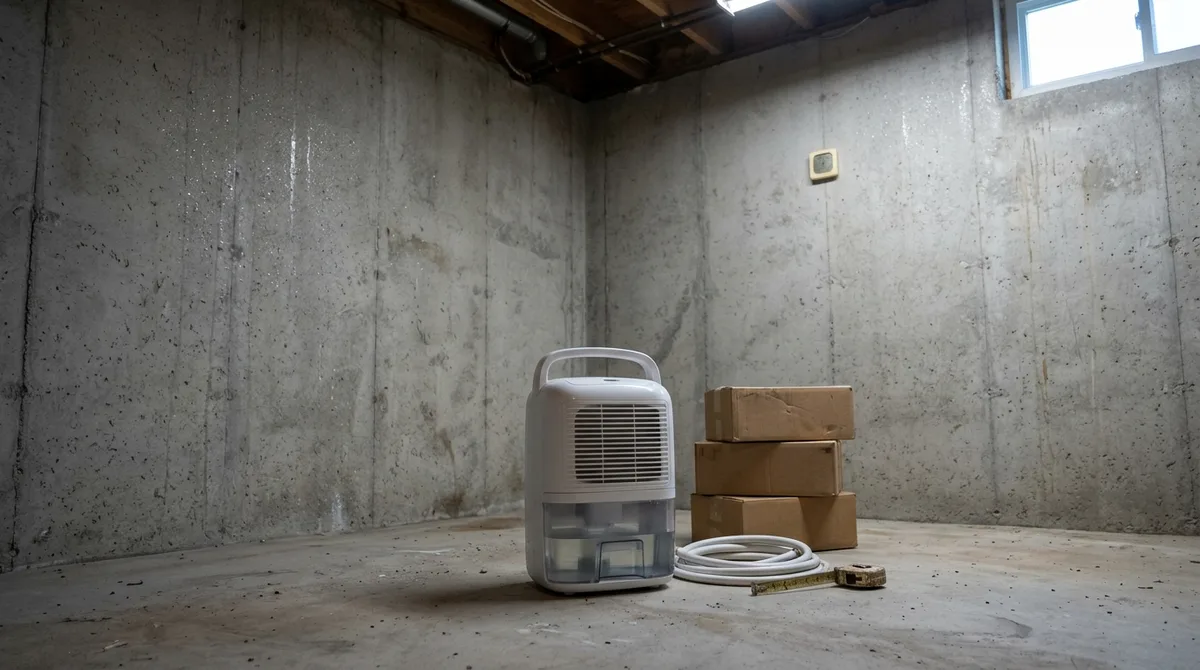
You’ve done the homework, so turn it into a checklist you can run in the store or on the sales page. Work through it in order.
– Measure the damp area. Write down the floor area of the basement, or of the part that’s actually wet. Don’t guess from the listing. – Use your hygrometer reading. That number sets your tier. Shop for the pint range that matches it, and lean toward the top of the range if your reading sits near the top of the tier. – Check the coldest week of winter. Find the lowest temperature your basement hits, then confirm the unit’s low-temperature rating covers it with room to spare. – Map the drain route first. Choose a bucket, a gravity hose, or a pump, then walk the path to the floor drain or sump with a tape measure before anything goes in the cart. – Compare certified numbers only. Line up the ENERGY STAR figures side by side, and ignore peak claims printed for hot, humid test conditions. – Add the hidden costs. The hose, a pump if you need one, filter replacements, and the electricity to run the unit for hours all belong in the real price. – Confirm price, stock, and warranty terms. Prices move and some listings are sold out or on pre-order. Read the written warranty, not just the badge on the page.
If a unit fails the drain check or the cold-room check, move on, no matter how good the box looks. A cheap dehumidifier that can’t reach your drain or can’t run in your coldest corner is a bad buy at any price.
Start Here: The Pre-Shopping Check
Start with one job tonight: note your basement’s floor area and the humidity reading from its wettest corner. Your hygrometer sets the tier, and the tier sets the size you shop for.
If the reading lands between 75 and 90 percent, look for a unit that removes 25 to 40 pints per day. At 90 percent or higher, you need 30 to 50 pints. Anything smaller will run all day and still fall behind.
Next, grab a tape measure and walk the path from the unit’s spot to the nearest floor drain or sump. Write down the distance and whether the drain sits lower than the unit. That one measurement tells you whether a gravity hose will work or whether you need a pump.
Then check the coldest night of the winter. Compare that temperature with the unit’s low-temperature rating, and leave some room to spare. A basement that drops near freezing may need a specialist unit, not a standard one.
Only after those three steps should you open a shopping tab. Compare certified pints, add the hose and filter costs, and confirm that the listing is in stock and that the warranty is in writing. Your next move is the measuring, not the checkout button.
Frequently Asked Questions
1. How do I work out what a 24-hour run will cost me on my electric bill?
To estimate a 24-hour run, multiply the unit’s wattage from its label by 24, then divide by 1,000 to get kilowatt-hours. Multiply that number by the price per kilowatt-hour on your power bill. A unit on a humidity setting shuts off once the air is dry enough, so a full 24-hour run is the worst case.
2. Will a dehumidifier stop mold on my basement walls by itself?
No, a dehumidifier lowers the moisture mold needs, but it won’t clean up growth that’s already there. Scrub visible mold off hard surfaces before you rely on the machine to hold it back. If water keeps seeping in from outside, that source has to be fixed first, or the mold will keep coming back.
3. Is it worth paying extra for Wi-Fi and app control on a basement dehumidifier?
Wi-Fi control is worth the extra money if you’d rather adjust settings from upstairs than walk down every time. Phone alerts can also warn you before a full tank overflows while you’re away. If you don’t mind checking the unit yourself, a basic model with a manual humidity dial does the same core job for less.
4. How often should I empty the bucket and clean the filter in a damp basement?
Check the bucket every day during the first week, when the basement is at its wettest and the unit runs hardest. Once the room dries out, you can check it less often. Rinse the filter whenever it looks dusty and let it dry fully before you put it back, so airflow stays strong.
5. Can one 50-pint unit handle a whole finished basement, or do I need two smaller units?
One 50-pint unit can work for a single open, damp basement, but a finished basement with separate rooms is a different job. ENERGY STAR’s guidance puts a wet space over 2,000 square feet at 50 or more pints per day, so a large, soaked basement can push one unit to its limit. If rooms are closed off, place a second unit in the farthest room or leave doors open so the air moves around.
6. What humidity setting should I use on a basement dehumidifier?
Set the humidistat to about 50 percent to start, then adjust based on how the room feels and smells. If musty odors return, lower the setting a few points and check again after a day. Setting it much lower makes the unit run longer, which raises your power bill without adding much comfort.