
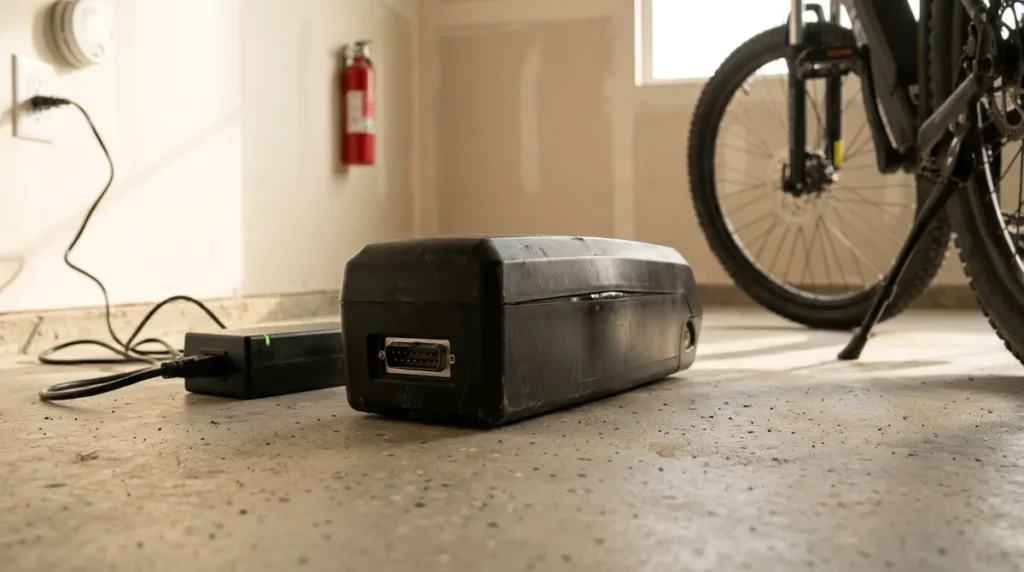
E-bike battery fire safety starts with three habits: charge with the maker’s charger, stay awake and nearby while it charges, and keep the pack away from anything that could burn or block your way out. Sounds basic? It is, and that’s the point. The UK’s government fire reports logged 170 e-bike fires in 2024, and 77 of them (45%) were confirmed conversions, meaning bikes made electric after they were sold as regular bikes.
The US picture is just as blunt. From 2019 to 2023, federal safety data logged 227 lithium-ion battery incidents across several types of micromobility devices, and 120 of them (53%) happened while the device was charging. Charging is where most of the trouble starts, so that’s where the rules below begin. Along the way, you’ll also learn what to check on the label, including UL 2849 and UL 2271, and when a battery that looks fine is actually a hazard.
Key Takeaways
- Official e-bike fire counts only capture reported incidents, so the real number of fires stays unknown.
- Unplug an e-bike battery as soon as it reads full, and never leave it charging overnight.
- Any e-bike battery that swells, leaks, or gives off smoke must be taken out of use immediately.
- Replacement battery packs need an exact model number and certification paperwork before you hand over any money.
- Never go back for a burning e-bike battery, since smoke can fill a room in seconds.
What Makes an E-Bike Battery Catch Fire?
A battery catches fire when one cell overheats and sets off a chain reaction the rest of the pack can’t stop. Engineers call that chain reaction thermal runaway.
Here’s how it works. A lithium-ion pack is a bundle of individual cells, and each cell stores a lot of energy. When one cell gets too hot, it starts releasing heat on its own. That heat warms the cells right next to it, those cells heat the next ones, and so on. Once the process snowballs, the pack is making heat faster than anything can cool it. Smoke and gas come first, then flames.
Why does it burn so hot and so fast? Because lithium-ion packs cram a huge amount of energy into a small, light box. Think of it as a fuel tank packed into something you can carry under your arm. When things go wrong, that energy has nowhere safe to go.
So what sets off the first cell? Usually one of four things:
- Physical damage. A drop, a crash, or a hard hit can crack or crush cells inside the case, even when the outside looks fine.
- Excess heat. A pack left in a hot garage, in direct sun, or near a heater starts closer to the danger zone.
- Faulty charging. A charger that doesn’t match the battery, or one that’s failing, can push too much current into the cells.
- Cheap or mismatched cells. Budget packs and mix-and-match replacements may use cells of uneven quality that were never built to work together with the bike’s electronics.
Fires are rarely random. They usually follow a warning period, where the battery runs unusually hot, swells, or gives off a strange smell before it fails. Ignore those signs, and a small problem can turn into a house fire.
How Big Is the E-Bike Fire Problem?
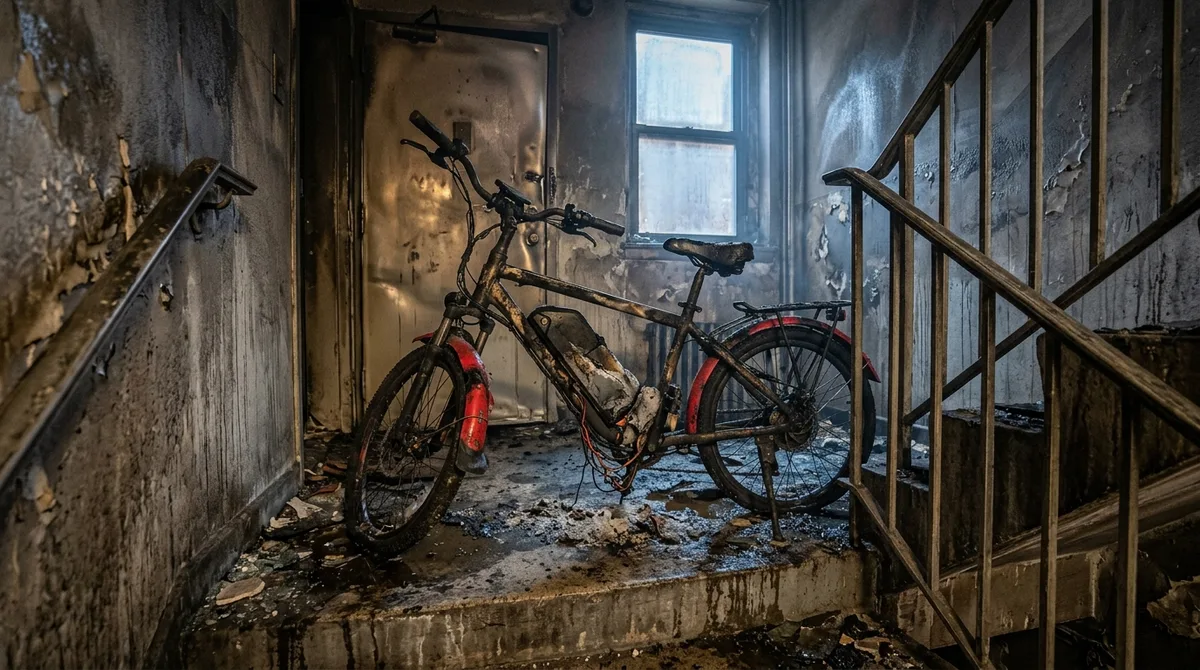
Nobody knows the true size of the e-bike battery fire problem, and the official numbers were never built to answer that question. Here’s why you should read them with a skeptical eye.
Start with the UK. Its government fire figures come from voluntary reports, meaning people choose to send in what happened. The 170 fires logged for 2024 are only the ones that got reported, so they can’t be used to estimate how many fires actually happened across the country.
The US data looks bigger, but check the label. The CPSC’s 2019 to 2023 set covers micromobility devices in general, not e-bikes alone. It logged 227 lithium-ion battery incidents, linked to 39 deaths and 181 injuries. Other micromobility devices sit in the same pile as e-bikes, so the risk is broader than bikes alone.
Where those fires started matters too. Of the 227 incidents, 120 happened while the device was charging. Another 23 happened when a product was stored or resting and caught fire with nobody using it. Charging gets the headlines, but a pack sitting quietly in a hallway can burn too.
Now think about what a voluntary system depends on. Someone has to notice the fire, decide it matters, and file a report. Every step leaks. A rider who smothers a smoking pack, wheels the bike out to the curb, and buys a new battery may never write a word about it.
So what does that mean for you? Reported counts are not the same as total fires. The gap between what happens and what gets written down is exactly where the true number hides. Treat the lack of a precise figure as a reason to be careful, not a reason to relax.
Are Charging Habits the Biggest Risk?
Yes, charging is the habit to fix first. It’s the moment when most of the US incidents happened, so the rules below start at the wall outlet.
Start with the charger. The one that came with your bike was matched to your pack’s voltage and current. A random plug-in brick from a marketplace listing is a guess, and a guess that pushes the wrong current into the cells is how a healthy pack goes bad. Use the supplied charger or the one the maker recommends for your exact battery, and check the label before you plug in.
Next comes supervision. The Consumer Product Safety Commission’s micromobility guidance is blunt: charge only with the supplied or recommended charger, stay present while it charges, and never charge while you’re asleep or away from home. If you’re in the room, a hissing or hot pack gets noticed in seconds. If you’re asleep or out, nobody is there to notice anything.
Here’s the rule that trips people up most. Don’t leave a pack on the charger overnight, especially in a bedroom. Once it reads full, unplug it. A light that says “full” or a trickle that looks harmless is not a reason to keep it connected.
Where you charge matters too. Pick a hard floor like tile, concrete, or sealed wood, and keep the bike off the bed, the sofa, and any pile of laundry. Soft materials trap heat around the pack and give a fire something to chew on. A hard surface gives you a clear spot to watch and a clear path to grab it.
Tonight, make it simple:
- Use only the supplied or maker-recommended charger, never a random brick.
- Charge only while you’re awake and in the same room.
- Unplug the moment charging finishes, and keep the pack on a hard floor.
Why kill the asleep-or-away habit first? Because it takes away your chance to catch a problem early. Most of the other risks can be spotted with a look or a sniff. Charging unattended means the first sign you get might be smoke, and by then the fire has a head start.
Where Should You Keep an E-Bike Battery at Home?
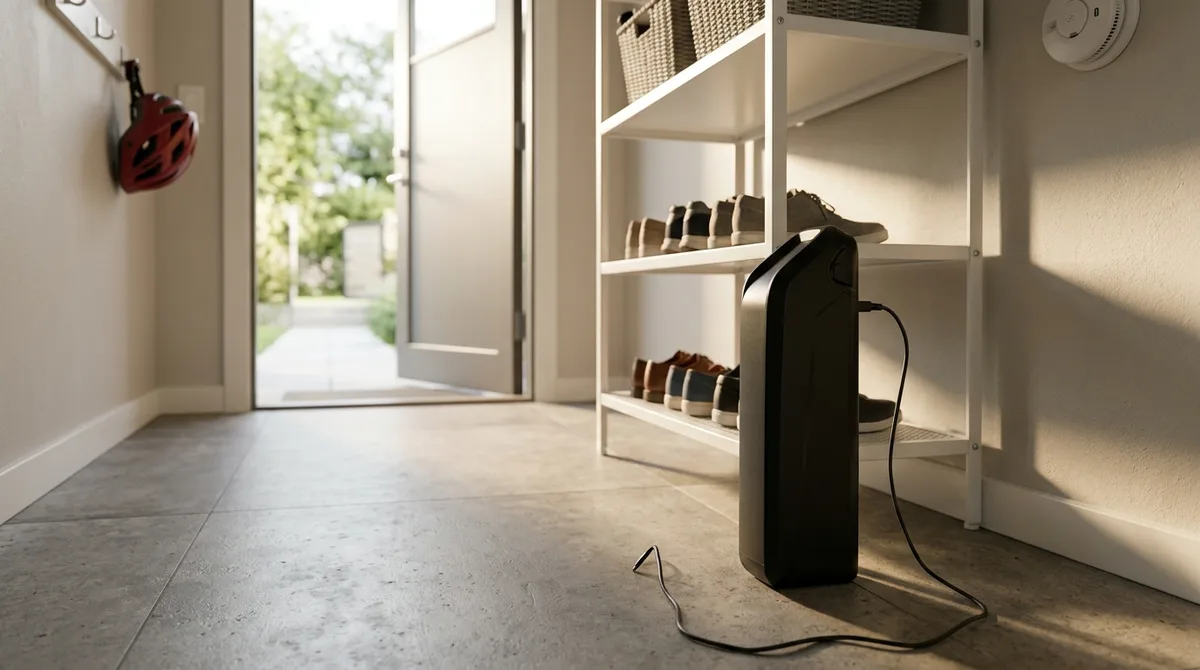
Keep your e-bike battery where a fire would never block your way out, and ideally in a separate shed or garage. The UK government’s battery safety guidance for e-cycle users is clear that you should not charge or store an e-cycle anywhere a fire could block an escape route.
That same guidance recommends a separate shed or garage if you can manage one. The reason is simple. A detached building keeps a battery fire away from your bedroom, your sofa, and the stuff you sleep next to. Whatever space you use, keep the pack away from paper, cardboard, fabric, and other combustible materials. That old box of bills, the laundry basket, and the stack of dry firewood all need to be somewhere else.
Most apartment dwellers don’t have a shed, and that’s where the real trouble starts. Hallways, stairwells, and shared garages are escape routes for everyone who lives in the building, not just you. A battery fire in one of those spaces can fill the exit with smoke and trap the neighbors on every floor. Don’t park a battery there, and don’t charge it there, not even for one night.
Look for a spot that avoids these common mistakes:
- Hallways, stairwells, and landings
- A closet under the stairs with no second way out
- Beside a bed, a sofa, or a pile of paper
- Shared garages and bike rooms in apartment buildings
Smoke alarms matter more than most people think. Test every alarm near the room where the battery sits once a month, and replace any that fail the test. A working alarm is the early warning that gives you time to act.
Now plan your escape, and include the bike in it. Pick two ways out of the room where the battery sits, such as the door and a window, and walk both routes in your head. Then walk them for real, in the dark, so you know where the furniture and cords are. Decide ahead of time that the bike stays behind. Wheeling a smoking battery through a smoky hallway is exactly how people get hurt, so leave it, close the door, and get out.
Storing a battery in one spot and charging it in another doesn’t make the storage spot safer. The rules apply to the pack parked by the door just as much as the pack plugged into the wall.
What Warning Signs Mean Your Battery Is Failing?
Any battery showing one of the signs below is failing, and the safe response is the same every time: stop using it and stop charging it. Run this quick checklist on your pack, and treat any single match as a stop sign.
- Extreme heat: the pack gets hot to the touch during use or charging, well beyond normal warmth.
- Swelling or bulging: the case looks puffed up, or it no longer sits flat.
- Lumps: you can feel bumps or hard spots under the casing.
- Leaks: you see fluid, residue, or wetness around the pack.
- Hissing or cracking: you hear a sound from the pack, or see cracks in the housing.
- Unusual smells: any sharp, chemical, or burnt odor coming from the battery.
- Longer charge times: the pack takes noticeably longer to fill than it used to.
- Smoke: any smoke at all, even a thin wisp.
Longer charge times are the sneaky one. The pack may look perfect, but a slower fill can mean the cells inside are struggling. Don’t talk yourself out of it just because the battery still works.
When a sign shows up, unplug the pack from the charger right away. Move it onto a hard, bare floor, away from anything that burns and away from your exits. Then stop riding on it. Don’t keep testing it to see if the problem goes away.
A drop or a crash is its own warning. The impact can crack cells inside a case that looks spotless. The rule is blunt: a battery suspected of damage after a drop or crash should not be charged or used, and should be replaced. Don’t gamble on a quick charge to check it.
Don’t try to repair a damaged pack yourself. Opening the case, rewiring cells, or wrapping a cracked pack in tape puts your hands on the exact part most likely to burn.
Think a bad pack is a rare problem? In April 2024, the CPSC’s warning told people to stop using UPP U004 and U004-1 conversion batteries. Those packs had 13 U.S. overheating reports, including seven fires, and they had sold for $280 to $730.
Are Conversion Kit Batteries Riskier Than Factory Packs?
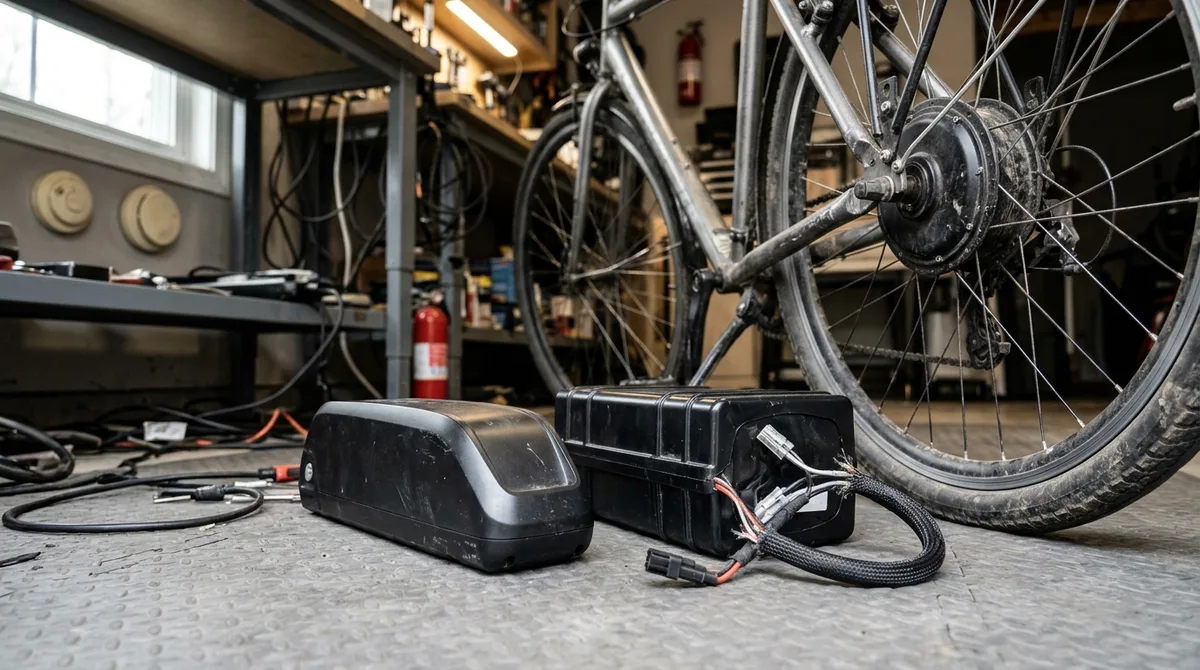
Yes, they can be, because a conversion kit gets put together after the bike leaves the factory. A factory bike ships with a battery, charger, and electronics built to work as one system. A conversion kit bolts a motor and pack onto a bike that was never designed for them, and the battery often comes from a different company than the charger.
The UK numbers show why this matters. Of the 170 e-bike fires reported in 2024, 77 were confirmed post-market conversions, or 45% of the total. Those are regular bikes made electric later, which puts conversions front and center.
Price tells you what someone was willing to pay, not whether the cells inside were built right.
Here’s the catch: fakes look real. Copied labels, matching housings, and the same logo can hide cheap cells inside. You can’t judge a pack by how it looks, so you have to check the paperwork.
Before you buy, run this check:
- Get the exact model number. A vague listing like “e-bike battery” is a warning sign on its own.
- Ask for certification paperwork for that model. If the seller can’t produce it, walk away.
- Confirm the charger. Make sure the charger is the one the maker lists for that exact pack.
- Compare the price. Check the maker’s own price for the same model. A pack priced far below it is a red flag, not a bargain.
The CPSC is moving on this, but slowly. In June 2026, it proposed a rule that would apply modified UL requirements to micromobility electrical systems and to replacement battery packs sold separately, including components in conversion kits. That sounds like a fix, but it’s only a proposal. It would take effect 180 days after a final rule is published, so it does not protect the pack on your bike today.
What Do UL 2849 and UL 2271 Actually Cover?
UL 2849 and UL 2271 are safety standards that test the parts most likely to start a fire: the electrical system and the battery. Think of them as a report card for the electronics, not the whole bike.
UL 2849 covers the e-bike electrical system. That includes the drive unit, the battery, the battery management system (the electronics that watch over the cells), the interconnecting wiring, the power inlet where the charger plugs in, and the dedicated charger. The UL Standards listing for UL 2849 spells out that full list.
Here’s the gap. UL 2849 does not generally cover the bike’s frame or mechanical structure. A strong electrical rating tells you nothing about whether a weld will crack or a fork will snap, so you have to judge those parts on their own.
UL 2271 covers batteries for light electric vehicles. If you’re shopping for a pack, this is the standard to look for on the label.
New York City shows what enforcement looks like. Under Local Law 39 of 2023, effective September 16, 2023, powered bicycles offered for sale, lease, or rental must meet UL 2849, and storage batteries for powered bicycles or mobility devices must meet UL 2271 through an accredited testing lab. The city’s consumer protection guidance lays out the rule.
So how do you use all this? Ask the seller which standards the exact model was tested to, then match the model number on the label to the paperwork. If the seller dodges the question, you’ve learned what you needed to know.
What Should You Do If a Battery Starts Burning?
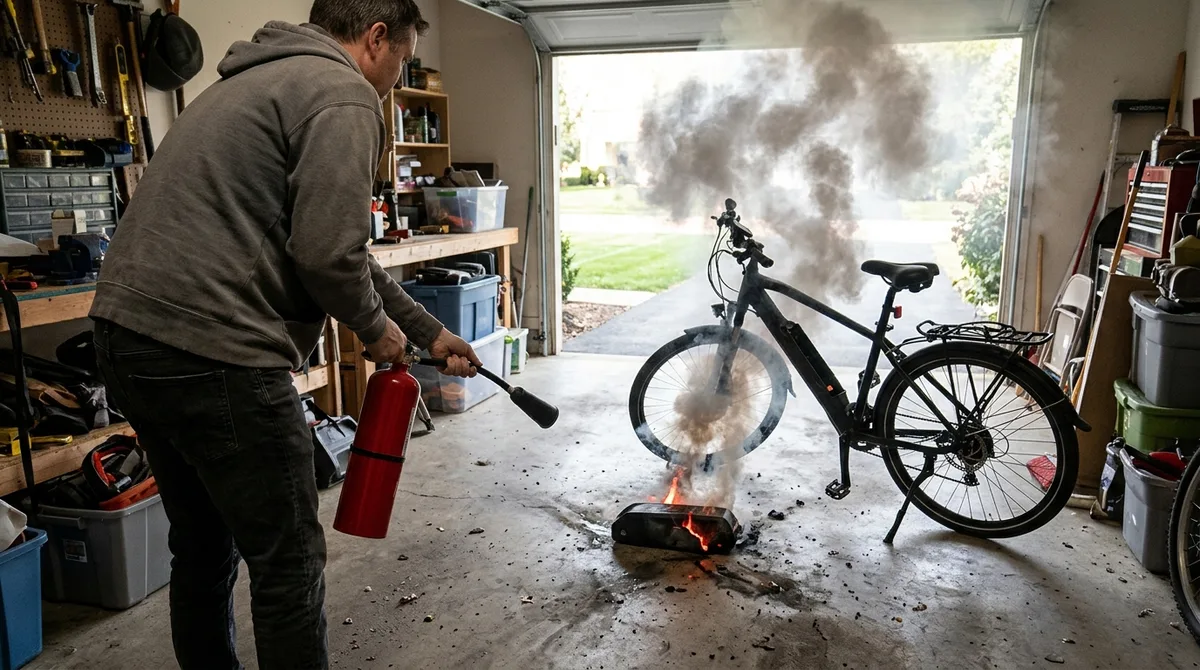
If a battery starts burning, your only job is to get out, call for help, and keep the door shut between you and the fire. Don’t play firefighter.
Battery fires move fast. Smoke and heat can fill a room in seconds, so if you see flames or smoke pouring from the pack, treat the room as lost and leave.
Follow these steps in order:
- Get everyone out first. Wake anyone who is sleeping, and move kids, pets, and neighbors toward the exit before you grab anything.
- Crawl low if the smoke is thick. The air near the floor is usually easier to breathe.
- Close the door behind you. A closed door slows the spread of fire and smoke, and it buys time for everyone else in the building.
- Call your local emergency number from outside. Give your address and say that a lithium-ion battery is on fire.
- Leave the bike and battery where they are. Don’t go back for the bike, the pack, or the charger, even if it feels like it will only take a minute.
- Wait for the fire crew to clear the building before going back in, and tell them where the bike and battery were.
Once the fire is out, or if a pack has been dropped, crashed, or shows any warning sign from the checklist above, it still needs careful handling. Don’t toss a damaged battery into the household trash.
Find a local battery recycling point or a hazardous waste service instead. Call ahead and ask whether they accept damaged lithium-ion packs, and ask how they want the pack brought in.
Until you can drop it off, set the pack on a hard surface away from heat sources, direct sunlight, paper, cardboard, and fabric. Don’t charge it, don’t ride it, and don’t wrap it in tape or bags. Keep it where it can’t tip over or get knocked around.
Your Battery Safety Checklist for Tonight
Before you go to bed tonight, do one thing: find the model number on your battery and write it down with a photo of the label. If you can’t find it, you can’t confirm the charger or the certification, and that’s your first problem to solve.
Next, look at the charger. Make sure it’s the one the maker lists for that exact pack. If you’re not sure, unplug it and leave it unplugged until you are.
Then take a quick walk through your space. Is the pack on a hard floor, clear of paper, laundry, and cords? Is it out of your exit path? Move it now, while you’re thinking about it, not tomorrow.
Tomorrow, set a recurring reminder on your phone for the first of each month to test your smoke alarms. Monthly tests only work if you actually do them.
If you’re thinking about buying a replacement pack or a conversion kit, slow down. Ask the seller for the exact model and its certification paperwork before you pay. Then read our e-bike conversion kit reviews to see what the real costs look like once you add the charger, the parts, and any extras the seller pushes at checkout.
Your next step is simple: find the label, check the charger, and clear the exits. Do that tonight, and you’ve already done more than most riders ever do.
Frequently Asked Questions
1. What should I check on a used e-bike battery before I buy it?
Start by inspecting the pack for heat, swelling, lumps, leaks, cracks, and unusual smells, and walk away if you spot any of them. Then ask the seller straight out whether the pack was ever dropped or in a crash, because a damaged cell can look fine from the outside. A seller who dodges that question, or who can’t tell you the exact model, is telling you something you should listen to.
2. Can I take an e-bike battery on a plane or train?
Most airlines and rail operators treat lithium-ion batteries as restricted items, and their rules vary by carrier and country. Airlines generally want spare lithium batteries in carry-on bags rather than checked luggage. Confirm your specific carrier’s policy before you travel, and don’t pack a battery that shows any warning sign.
3. Does a UL rule apply to an e-bike battery bought from an overseas online seller?
The New York City rule only covers powered bikes and storage batteries offered for sale, lease, or rental in that city, so it doesn’t automatically cover a battery shipped from overseas. That doesn’t mean an overseas pack is unsafe. It just means you have to check the certification yourself by matching the exact model on the label to paperwork that names it.
4. Is it safe to keep using an e-bike if the charger gets hot but the battery feels fine?
No. A hot charger is a warning sign in its own right, because it can push bad current into the pack even when the battery feels normal. Unplug the charger right away and stop charging with it until you’ve had the setup checked. Don’t assume the battery is fine just because the heat is coming from somewhere else.