
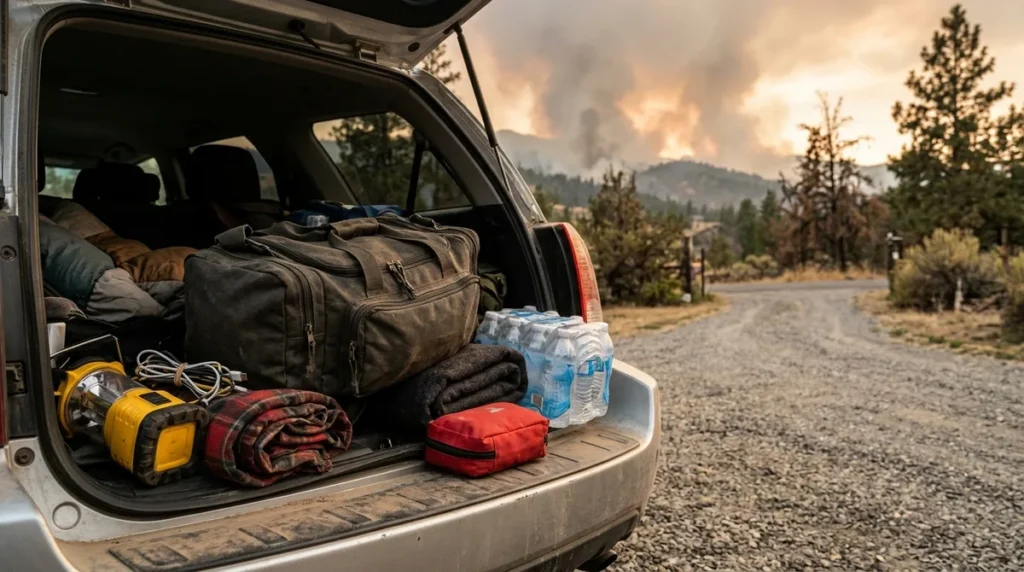
Every solid wildfire evacuation checklist starts with one rule: leave early if you’re worried. Waiting for an official order can cost you the minutes you need. Traffic, low visibility, children, pets, livestock, and physical limits can each add minutes you don’t have. The U.S. Fire Administration’s guidance says to sign up for local emergency alerts, plan a primary and an alternate route out of your neighborhood, and make sure someone outside the area knows your household plan. These steps sound boring. They’re also the ones people skip right up until the smoke rolls in.
Next, pack a go kit built around the Five Ps: People, Prescriptions, Papers, Personal Needs, and Priceless Items. Wildfire agencies recommend at least 72 hours of food and water for everyone in the house, pets and livestock included. Pack that bag before the alert, not during it, because a bag you have to hunt for is a bag you’ll leave behind. Keep your fuel tank at least half full, park facing the way out, and once you’re rolling, keep the windows up and the air conditioning on. When officials say go, go. Stay out until they say it’s safe to return.
Key Takeaways
- A voluntary evacuation notice is your cue to start loading the car, not to finish your coffee.
- Your go bag should live in one spot near your first exit, like a hall closet, so you can find it in the dark.
- Respirators like N95s only protect you when they seal tightly against your face.
- Heavy smoke can shrink the road ahead, so drivers should keep their speed low.
- Clearing dry grass away from your walls cuts off the fuel that carries fire to your door.
When Should You Leave During a Wildfire?
Leave as soon as you feel worried. Don’t wait for a siren, a knock on the door, or an official order. By the time the order arrives, the roads may already be jammed.
Why not wait? Traffic, low visibility, children, pets, livestock, and physical limits all stretch out how long an evacuation takes. Smoke can hide the road ahead, and loading a dog, a toddler, and a grandparent into the car takes longer than you think. Leaving early gives you the head start those slowdowns eat up.
Sign up for local emergency alerts before fire season, not during the first smoke plume. Learn what your alert app sounds like so you don’t swipe it away as spam. Then keep an eye on the Emergency Alert System and NOAA Weather Radio. A battery-powered weather radio at home means you still hear warnings if the power or cell service goes down.
Evacuation orders aren’t the same everywhere. They vary by state and can range from voluntary to mandatory. A voluntary notice is not a suggestion to finish your coffee. It’s your cue to start loading the car.
When you’re told to go, go promptly. Don’t stop to pack everything you own. Your go kit exists so you can grab it and move.
Some areas also plan for the moment when leaving is no longer possible. NIST’s 2025 ESCAPE update introduced Temporary Fire Refuge Areas, which are pre-designated spots meant to improve survival odds. Find out whether your community has one and where it is. NIST also reported that last-minute directions to open spaces with lower fire intensity saved more than 1,200 people during the 2018 Camp Fire in California.
Don’t go back until officials say it’s safe. Fires can flare up again after you think the danger has passed, and a quick trip home for one forgotten item is how people get hurt.
Go Bag Contents: The Five Ps and 72-Hour Supplies
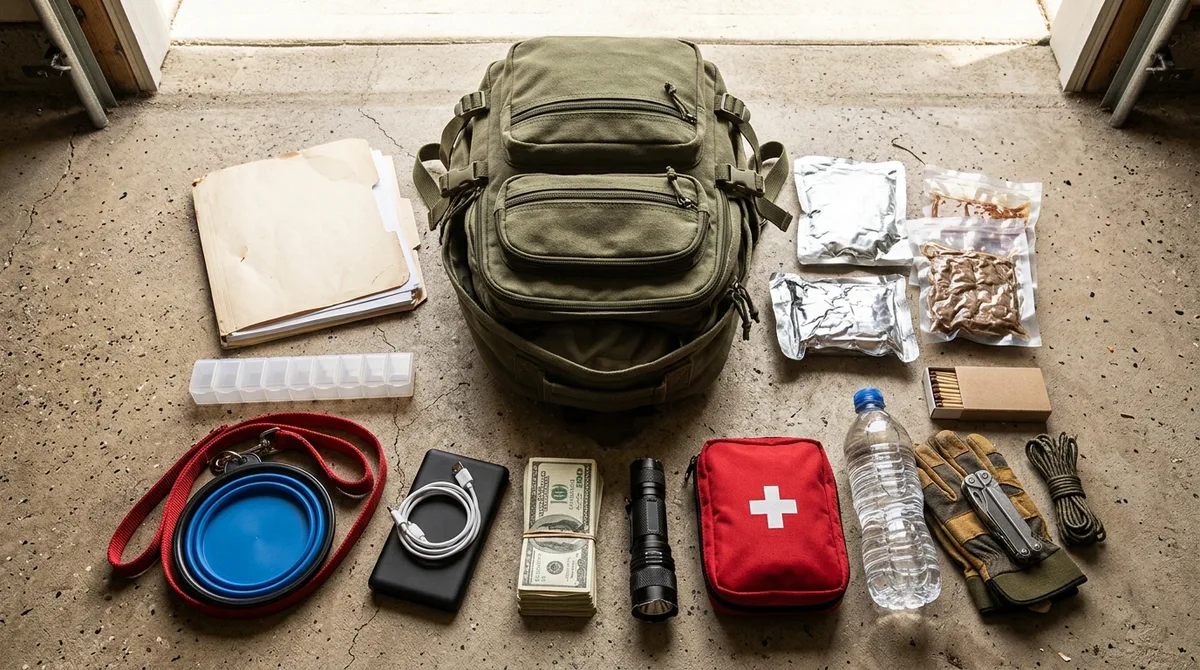
Here’s how the Five Ps break down, plus the stuff most people leave behind.
- People: Pack at least 72 hours of food and water for every person, pet, and livestock animal in the household. Texas A&M Forest Service recommends that exact window, and it covers the dog, the cat, and the goat too. Don’t forget leashes, carriers, and a few days of pet food in its original bag.
- Prescriptions: Bring enough medication for every person and pet, and keep it in a labeled bag so you can grab it in one motion.
- Papers: Keep IDs, insurance policies, and deeds in a waterproof container. Add a written list of account numbers and phone numbers for your banks, insurers, and utilities.
- Personal Needs: Include chargers, a flashlight, a battery-powered weather radio, toiletries, and a change of clothes for each person.
- Priceless Items: Grab family photos and small heirlooms that can’t be replaced. A thumb drive with scanned pictures takes up almost no space.
Glasses are the item people forget most often. Pack a spare pair, because a fire is a terrible time to squint through a headache. Then tuck a copy of each prescription in with your papers. If the bottles stay behind, that paper gives a pharmacist what they need to help you.
Your go bag only works if you can find it in the dark. Pick one spot near the exit you’d use first, like a hall closet or the bottom of the stairs, and keep it there all year. Don’t let it drift into the garage or under the bed.
Check the bag every few months. Swap out expired food, rotate the water, and confirm the medications haven’t run out. A bag that looked perfect last spring can fail you in the middle of the night.
Which Masks Actually Help With Smoke?
N95 and P100 respirators are the masks people usually reach for when smoke rolls in, and they only work if they seal tightly to your face. A loose dust mask that flaps around your nose and chin is not the same thing, no matter what the box says.
Fit is everything. Put the mask on, press it against your face, and breathe in hard. If you feel air sneaking in at the cheeks or nose, adjust the straps or try a different size. A mask with gaps is just a fancy scarf.
Age matters too. The Centers for Disease Control and Prevention says children age 2 and older can wear respirators or masks. NIOSH-approved respirators may not come in sizes that fit very young children, so toddlers need a different plan. Ask your pediatrician now, before fire season, what to do for a baby or toddler in smoke, and write that answer into your household plan.
Store your masks in the go bag with a few spares, sealed in a zip bag so they stay clean. Check the expiration date every time you rotate the food and water. An expired mask is a costume.
How Do You Get Your Car Ready to Go?
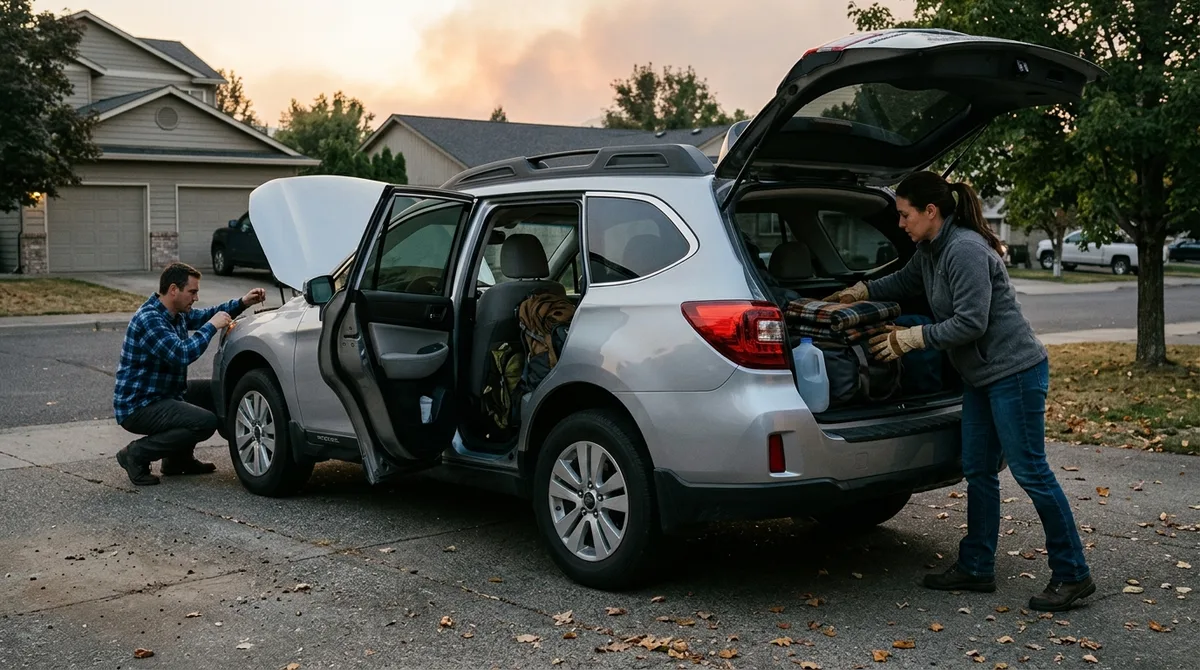
Your car is your escape route, so get it ready before the smoke shows up. Keep the tank at least half full, park facing the way out, load your go bag early, and drill the whole thing until it’s second nature.
Fuel is the detail people ignore until the gauge sits on empty and the gas station line wraps around the block. Make half a tank your floor for the entire fire season, not just the week a warning goes out. Gas stations can close or lose power during a fire, and that half tank is your buffer.
Parking matters just as much. Pull in nose-out so you can drive straight out of the driveway instead of backing down a road full of smoke with kids in the back seat.
Here’s the setup to run through every season:
- Check the fuel gauge and top off the tank before it drops below half.
- Park nose-out, facing your primary route, every single time you pull in.
- Load the go bag and your ready-to-load items into the car now, not when the alert hits.
- Clear the driveway and the path to the car of firewood, hoses, dry leaves, and anything that could block the door or catch fire.
- Hang the car keys on a hook near your exit, in the same spot every time, and make sure every driver in the house knows where it is.
- Run a timed load-out. Start a timer when you call out “go,” load everyone, the pets, and the bags, and drive to the end of the street.
- Write down your time, then try to beat it on the next drill. Run the drill on both of your routes out of the neighborhood so nobody freezes when one road is blocked.
How Do You Plan for Pets and Livestock?
Plan for pets and livestock the way you plan for people: practice it, pack for it, and decide ahead of time where they’ll go. Animals don’t read evacuation orders, so the plan has to work without an argument in the driveway.
Start with a drill. Run the whole household through it, including the dog who vanishes under the bed when the car keys jingle. Practice catching the cat, buckling the carrier, and loading the horse or goat trailer. The first time you try this should not be the real thing.
Gear goes by the exit. Keep a carrier for each cat and small pet, plus a leash or harness for each dog. For livestock, know which trailer or truck you’ll use, who can drive it, and how long loading takes. A frightened animal is much easier to move when you’ve done it once before.
Paperwork goes in the go bag. Add copies of vaccination records and enough medication for each animal, and keep a recent photo of every pet on your phone. Records prove ownership and help a shelter or boarding facility take your animal in without delay.
Look up places to take them before you need them. Identify shelters and boarding options outside your area now, and ask your veterinarian which facilities they recommend. Pick more than one option in different directions, because the closest place may be full or cut off by the fire.
If you can’t take everything, animals still come first, so decide what you’d do in that case. Leave water in open containers and keep barn gates unlocked so livestock can run. Then choose a neighbor or out-of-area contact who knows where your animals are kept, how to reach them, and how to get into the barn or yard. Write that person’s name and number on each carrier tag and in your household plan.
Building an Evacuation Plan Your Household Can Actually Follow
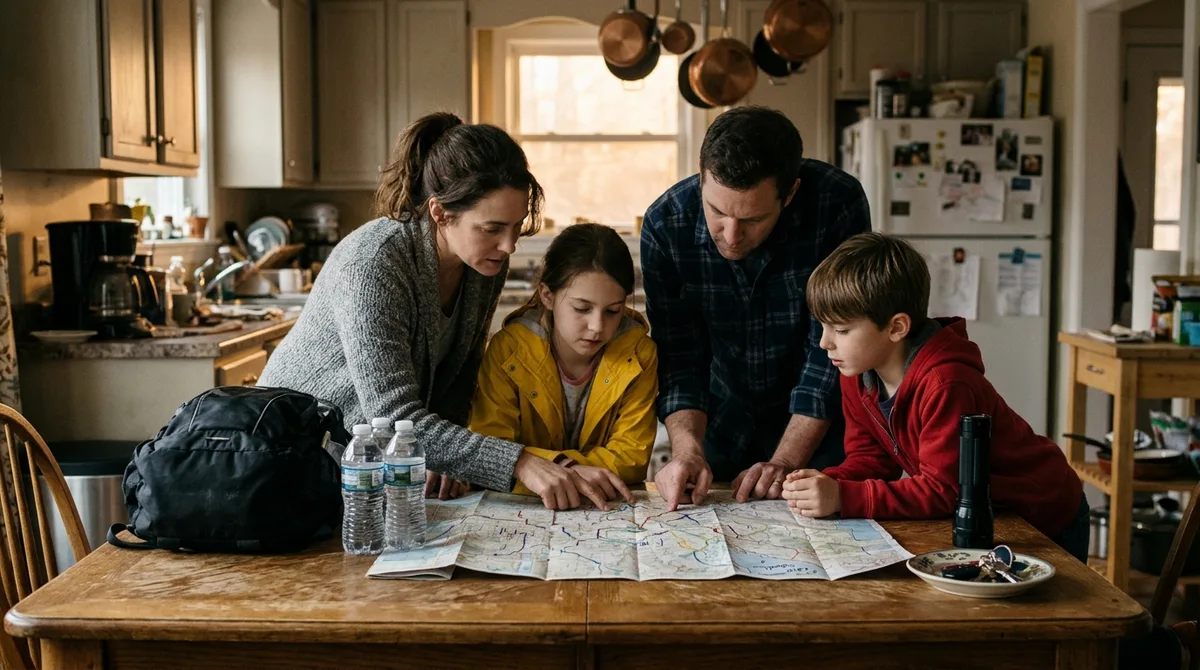
Most evacuation plans die in a kitchen drawer. A plan only works when everyone can recite it half asleep, so build it on paper first, then turn it into habit. Public health guidance says to identify several ways out and drive those routes before you need them.
Get in the car and drive both routes out of the neighborhood. Time each one twice: once on a quiet afternoon and once at the worst traffic you can find, like school pickup or the evening commute. Plan around the slow time, not the good one. Mark any spot where the road narrows, dips, or has only one exit.
Next, pick an out-of-area contact. This should be someone far enough away to be safe from the fire, and everyone in the house should know their number by heart. Give them a copy of the plan. After you leave, each person calls that contact, so one voice can track who got out and where they are.
Now fill in the template, one job at a time. Keep the answers on a single page and tape a copy inside the car visor:
- Write down who rides in which car, and name a backup driver for each vehicle.
- Assign one adult to grab the go bag, one to load the pets, and one to collect the medications.
- Name the neighbor who checks on each house, and write down what they should check for, like older residents or anyone who uses a wheelchair.
- Pick a meeting spot outside the neighborhood, plus a backup spot in case the first one is blocked.
- Mark your primary and alternate routes on a paper map and keep it in the car.
- Give your out-of-area contact a copy of the page and confirm they know both meeting spots.
Practice with everyone in the household, using at least two ways out of the neighborhood. Run the full drill with every person, including the teenager who swears they don’t need to be included. Don’t skip the one who sleeps through sirens either.
Repeat the drill at least once a year. Run it again any time the plan changes, whether you get a new car, a new driver, or a new home. A drill that worked last summer can fall apart after one small change, and you’d rather find that out on a Saturday morning than in the middle of the smoke.
What Do You Do If You’re Stuck in Smoke?
Driving through smoke is the moment that catches people off guard, so keep your speed low, your headlights on, and your windows up with the air conditioning running. Smoke can shrink the road to a few car lengths, and a sudden stop in that haze is how crashes happen.
Here’s how to handle the drive:
- Turn on your headlights so other drivers can see you.
- Keep the windows closed and the air conditioning on, with the fan set to recirculate if your car has that setting.
- Drive slowly and keep both hands on the wheel.
- Watch for stopped cars, and leave extra space in front of you.
If traffic stalls completely, don’t stop in the middle of the road. Pull off only where the car is clear of trees, tall grass, and brush, then wait for emergency crews to direct you.
Sheltering in a vehicle is a last resort, not a plan. If you have no safe way out and the fire is closing in, park away from vegetation, close every window and vent, and stay low inside the car until the fire passes. Your car is a shelter of last resort, and it works only if you stay put and keep everything closed.
You can’t count on finding a refuge area in the middle of a fire. Check with your county emergency management office or local fire department before fire season to see whether your area has one, where it is, and which route gets you there. Then drive that route once, in daylight, so you know it before the smoke makes it hard to see.
Can Home Prep Buy You Time to Leave?
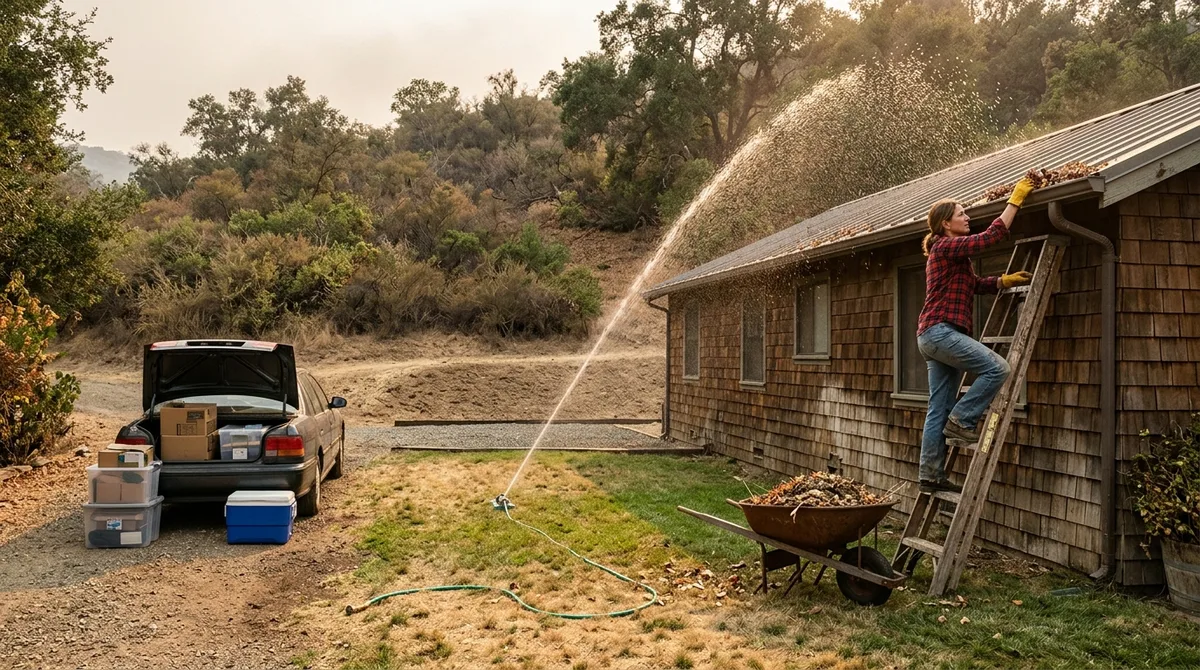
Yes, but only the cheap, unglamorous stuff does most of the work. Home prep buys you minutes when you have warning, and those minutes keep you from scrambling with the house while everyone waits in the car.
Start with defensible space. Clear dry grass, fallen leaves, and piled debris away from the walls, especially under decks and along wooden fences that run up to the siding. Dry vegetation is the fuel that carries fire to your door, and one afternoon with a rake and a few contractor bags removes more of it than you’d expect.
Then tackle the gaps. Embers blow ahead of a fire and sneak in through open vents, so cover vents and screen openings with fine metal mesh, and clear leaves out of gutters and eaves. When it’s time to replace the roof or siding, choose less flammable materials. Those bigger jobs belong on your budget list, not your weekend list.
When the alert hits, run a short sweep before you walk out:
- Close the garage door and shut the windows, so embers can’t pour into the house.
- Move patio furniture, cushions, and grills away from the house.
- Turn off the gas if you know how to do it safely.
- Grab the go bag and head for the car.
Do the cheap jobs now. Clearing brush, sealing vents, and writing a sweep list cost you an afternoon, not a paycheck. Save the new roof and siding for planning and budgeting, and put them on a schedule you can actually afford.
Your Next Step: Run the Drill This Weekend
Saturday morning: Get everyone in the house together, dog and cat included, and start a timer when you call out “go.” Load the people, the pets, and the bags, then drive to the end of the street. Write the time down. That number is your baseline, and you’ll want to beat it.
Then drive both routes out of the neighborhood at a normal pace. Note every spot where the road narrows, dips, or has only one way out. Those are the places that will slow you down when the smoke hits.
Sunday: This is the paper job, and it’s the one people skip. Call your out-of-area contact and read them the plan, including both meeting spots. Make sure they have your household’s phone numbers and know they’re the one people call after they get out.
Next, sign up for your local emergency alerts if you haven’t already, and put the alert app where your thumb can find it. Then walk to the spot you chose for the go bag and check that it’s there, zipped, and easy to grab in the dark.
Don’t wait for next spring to run this again. Put the drill on your calendar for the same weekend next year, and if your first timed run was slower than you’d like, fix the slowest step before you do anything else.
Frequently Asked Questions
1. How much does it cost to put together a wildfire go bag?
The bag itself is the cheap part. Most of the money goes into 72 hours of food and water for everyone in the house, plus pet supplies and prescription refills. Start with what you already own, like a backpack, a flashlight, chargers, and spare glasses, and buy the consumables over a few paydays so the cost doesn’t hit all at once.
2. What should I do if my gas station closes before I can fill up?
Avoid the problem by refilling when the gauge reaches half, not when it nears empty, because stations can close or lose power during a fire. If you’re already low and the station is closed or out of fuel, head for the first open station on your primary route. Don’t gamble on unfamiliar back roads just to save a stop, since a dead car in the smoke is far worse than a longer trip.
3. What if someone in my household uses a wheelchair or needs extra help leaving?
Plan their transport before any alert, with a named helper and a vehicle that can actually take their mobility device or walker. Contact your local fire department or county emergency management office now to ask whether they keep a list of residents who need evacuation help, and sign up if they do. Practice the full exit with that person included, timing how long it takes to get them loaded.
4. Is a hard-sided case better than a backpack for important documents?
A hard-sided case protects papers from being crushed and handles bumps and rain better than a soft bag. It works best if it stays by your exit, where you can grab it without hunting. If you’ll be carrying your documents on foot or across a crowded parking lot, a waterproof bag that goes inside your go bag is easier to carry and still keeps papers dry.