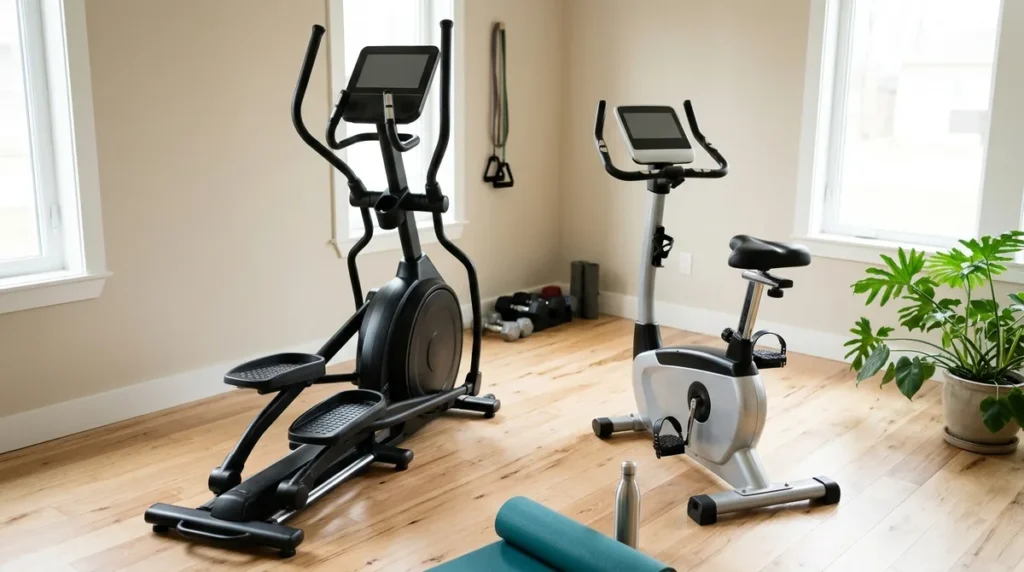
Elliptical vs. exercise bike is less about which one burns more calories and more about which one you’ll actually use three times a week. Both are low-impact cardio machines, and both can help you hit the CDC’s target of at least 150 minutes of moderate activity each week. The real differences show up in your posture, your knees, and how much floor space each one eats up.
Floor space is where the gap gets physical. Schwinn’s 130 upright bike measures 41.3 by 21.4 inches, while its 411 elliptical stretches 53.8 by 24 inches. That’s a lot of room to lose in a spare bedroom. Price is where the gap gets expensive. Schwinn’s listed upright bikes run $399 to $699, and its ellipticals run $699 to $1,499. Those are one brand’s listed prices, not market-wide ranges, so check the exact model you want before you assume anything.
Key Takeaways
- Thirty minutes of steady flat cycling, five days a week, hits the moderate goal, so that ride is a real workout.
- Don’t assume the elliptical is kinder to your knees, because a 2024 study of 12 healthy men found higher peak knee torque on it.
- Seniors and beginners should start on a seated bike, since an elliptical asks you to balance while moving your legs and arms in sync.
- Before paying, factor in delivery, assembly, and warranty terms, because the sticker price is rarely your final bill.
- Buy the machine you’ll actually climb on three times a week, because a bike gathering dust burns zero calories.
How Much Cardio Do You Actually Need Each Week?
You need at least 150 minutes of moderate activity each week, or 75 minutes of vigorous activity. You can also mix the two, as long as the total adds up.
Think of it in daily chunks. Thirty minutes, five days a week, covers the moderate version. Push harder and 15 minutes a day, five days a week, covers the vigorous one.
Here’s the part that surprises people. Riding a bicycle on level ground or with few hills counts as moderate-intensity activity. A steady flat ride is a real workout, not a lazy one.
Intensity still depends on you. The same 30 minutes can feel like a stroll to a fit rider and a grind to someone just starting out. Effort is personal, so the number on the screen matters less than how hard your body is working.
That means an elliptical and an upright bike can both hit the goal. Pick a pace where you can talk in full sentences but can’t sing, and you’re in the moderate zone on either machine.
So the target doesn’t pick the machine for you. Comfort, fit, and whether you’ll actually climb on it three times a week are what decide it. Both machines can count. The real question is which one you’ll keep using.
Which Burns More Calories, an Elliptical or a Bike?
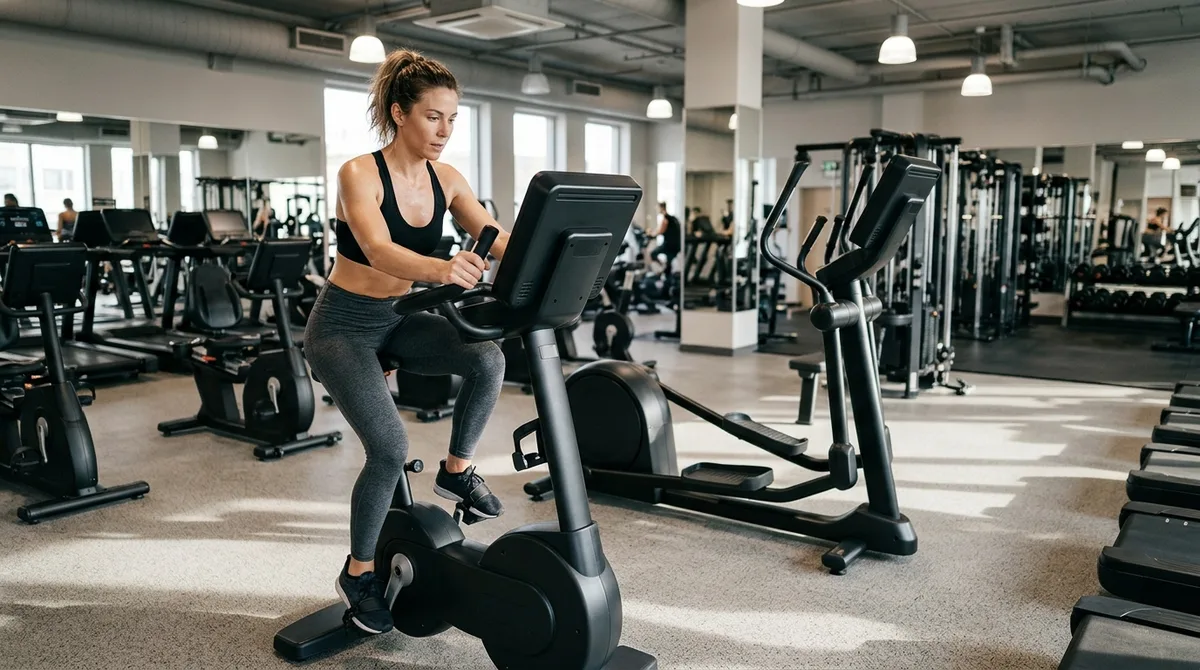
No single machine wins on calories. The research shows that results shift with the machine, the effort, and the person on it, so the headline number doesn’t tell you much.
Start with the smallest test. A 2016 study of 14 participants compared an elliptical with a cycling trainer. At similar relative power output, the elliptical cost the body more energy. The cycling trainer could go higher, though, with top aerobic power of 237 ± 88 W versus 151 ± 51 W. One machine was tougher per unit of effort, and the other had a bigger ceiling.
The next test was bigger, but still narrow. A 2024 study had 30 recreationally active men do 12-minute bouts at a perceived exertion rating of 17, which is a hard effort. The elliptical averaged 12.82 kcal/min and the upright bike averaged 11.94 kcal/min. The authors noted that every participant was male, so treat that gap as a men-only answer.
Here’s who showed up in each test:
- 14 participants in the 2016 comparison
- 30 recreationally active men in the 2024 bouts
- 32 physically inactive adults in the 2014 test
Each group is small, and none of them is a perfect match for you unless you happen to fit one of those profiles.
The 2014 study went in a different direction. Its 32 inactive adults used a compact elliptical at a self-selected intensity, with a median energy expenditure of 179.1 kcal/hour. That was 87.9 kcal/hour more than sitting. Impressive for people starting from the couch, but it only tested one elliptical, with no bike in the comparison.
Put the three together and the lesson is simple. Results shift with the machine, with how hard you push, and with who is doing the pushing. Effort moves the needle far more than the name on the box. A tired rider on a bike will burn less than a focused one on an elliptical, and the reverse is true too.
So stop chasing the calorie crown. Pick the machine that lets you work hard enough to breathe harder while still holding a conversation.
Is an Elliptical Easier on Your Knees Than a Bike?
Not automatically. The 2024 biomechanics study is the best place to start, and it suggests the elliptical isn’t the easy choice for your knees.
In that study, 12 healthy men worked out at 50 and 70 rpm on one elliptical and one stationary bike. The elliptical produced higher peak knee-joint torque, which is the twisting force on the joint at its hardest moment. The peak also landed at different knee angles on each machine.
That’s a small group of healthy men, tested on one model of each machine. Your knees on your own machine may feel different, especially if you have arthritis or an old injury.
Your back is the other big difference. The upright bike has a padded, contoured seat that supports your lower back, which matters if it’s already sore. The elliptical has no seat. You stand the whole time, so your back and core do all the holding. Some riders love that freedom. Others end up hunched and worn out before the session is over.
Hips work differently too. On a bike, your hip stays in a seated, fixed range of motion. The elliptical stride pulls your hip through a longer arc with every step. If your hips already complain, that longer arc can feel smooth or pinchy, and you won’t know which until you try it.
So test before you buy. Ask whether the gym or store lets you try both, then do a short session on each. Pay attention to how your knees, hips, and lower back feel afterward, not just during. A machine that leaves you sore is the wrong machine, no matter how good the price looks.
Which Machine Works More Muscles and Your Upper Body?

The elliptical is the machine that gives your arms and core a job, while an upright bike keeps most of the work in your legs.
On an elliptical, you stand on footplates and, on many models, grab handlebars that move with your stride. Schwinn’s 411 elliptical has both moving and stationary handlebars, so you choose how much your arms do. Hold the stationary bars and your upper body stays quiet. Push and pull the moving ones and your shoulders, back, and core start pulling their weight.
An upright bike is simpler. You sit, you pedal, and your legs do most of the heavy lifting. The padded, contoured seat is the main comfort feature to check. A seat that doesn’t fit you will end your ride early, no matter how smooth the pedals feel.
Recumbent bikes flip the setup. You sit in a reclined seat with back support, and your hands rest on handlebars in front of you, so there’s very little upper-body work. If your lower back is the problem, start your search here. Your legs push forward instead of down, so expect a different feel.
So ask yourself one question: do you want your arms involved, or do you want to sit down and pedal? If you want a full-body session, the elliptical with moving handlebars fits. If you want to sit back and grind out the miles, go upright or recumbent.
How Much Floor Space Does Each One Really Take Up?
The elliptical needs more floor, and the box size only tells you part of the story. The extra length is what hurts in a narrow spare room, because it eats the wall space you need to walk around the machine. Compare the 130 upright bike and the 411 elliptical against your actual room, not against each other on paper.
Don’t stop at the frame, though. Measure the full area you need. An elliptical needs room to step on and off the footplates, and a bike needs room to swing your leg over the frame. Both need clearance to reach the handlebars without smacking a wall, a dresser, or the dog.
Thinking about an under-desk model? Both styles come in compact versions, but the rule stays the same. Check the model’s footprint and confirm it fits under your desk before you buy. Measure the desk height and the space your knees need, too.
Noise matters just as much in a shared room or apartment. The drive system is what makes the racket, so don’t assume one style is quieter than the other. Instead, read reviews of the exact model you’re considering and look for:
- Squeaks or creaks from the frame or pedals
- Thumps or rattles through the floor
- Complaints about the drive system getting louder with age
Ask your neighbors or roommates what they think of a demo session if you can. A machine that sounds fine in a showroom can sound very different at home.
What Will Each One Actually Cost You Over Time?
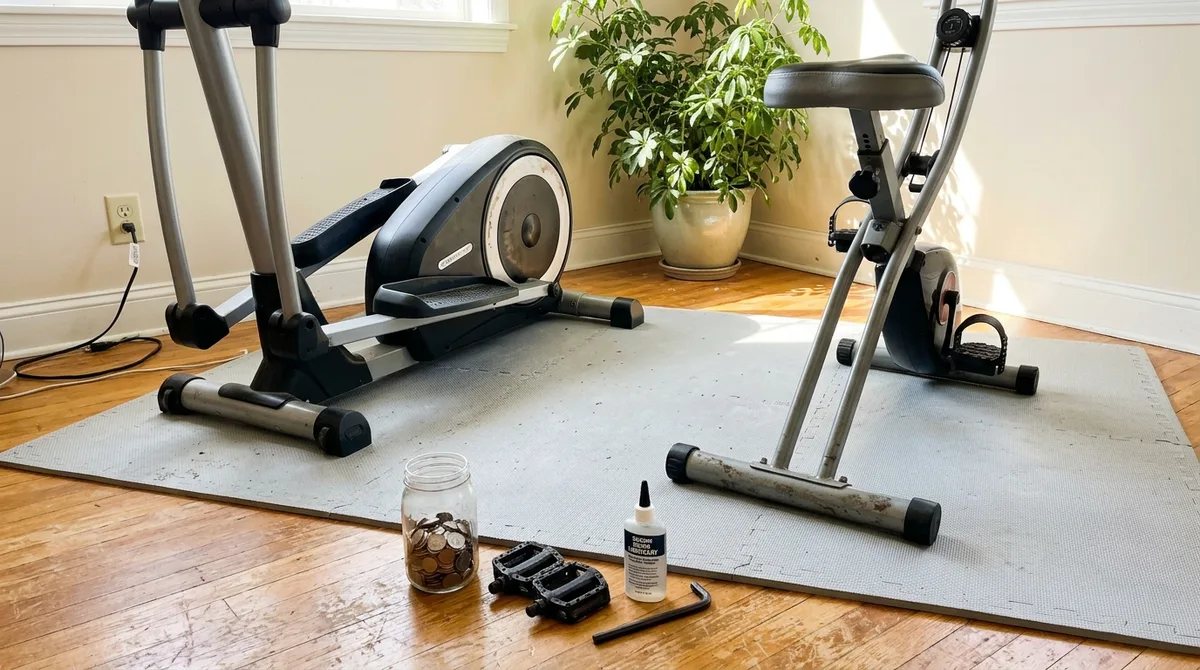
Your real cost starts at checkout and keeps running for years. Schwinn’s U.S. collection pages list upright bikes at $399 to $699 and ellipticals at $699 to $1,499. Those are that brand’s listed prices, not market-wide ranges, so use them as a starting point, not a shopping average.
The sticker is rarely the final bill. Before you pay, add up the extras:
- Delivery, especially for a heavy frame that has to reach an upstairs room
- Assembly, which can eat an evening and usually needs a second pair of hands
- Warranty terms, including what is covered, for how long, and whether labor is included
- Replacement parts, like pedals on a bike or footplates and handlebar parts on an elliptical
Warranty is where the fine print hides. Footplates and pedals take the most abuse, so ask how you would get a replacement and who pays for shipping.
Build quality is where standards come in. ISO 20957-9:2016 sets safety requirements and test methods for elliptical trainers. ISO reviewed it and confirmed it was still current in 2022, so check the spec sheet for it.
For bikes, ISO 20957-10:2017 covers fixed-wheel or no-freewheel exercise bicycles with inertia greater than 0.6 kg·m². ISO marks it for revision from 2025-02-27, so ask the seller which edition the model was built to.
Maintenance is where cheap turns expensive. Follow the manufacturer’s schedule for each machine instead of assuming they cost the same to keep running. A bike and an elliptical have different moving parts, so the service checks and replacement intervals can differ. Save the manual and set a reminder for every check it lists.
Which One Is Better for Seniors and Beginners?
For most seniors and beginners, a seated bike is the easier place to start, because it takes balance out of the equation. An elliptical asks you to stand, shift your weight, and move your legs and arms in sync. That’s a lot to coordinate when you’re new to exercise or your balance isn’t what it used to be. An upright bike lets you sit, pedal, and focus on your breathing and pace.
Ease of use matters more than the category. Seat height and step-on height decide whether you can get on and off without a struggle, and that’s true for both machines. Before you buy, test the entry and exit yourself. Swing a leg over the upright bike, then step onto the elliptical’s footplates. Notice whether you need to grab something to steady yourself.
Recumbent bikes are the option for readers who want a seated, back-supported position. You sit in a reclined seat with a backrest, and your legs push forward. The feel is different from an upright bike, so try one before you assume it’s the same.
If you’re just starting out, keep sessions short and the pace comfortable. Build up slowly, adding time only when a session feels manageable, not when your legs are already shaking. Consistency beats punishing workouts you dread.
Have any health conditions? Ask your doctor before you start, and bring the specific model you’re considering. Also ask the seller or store:
- Can I get on and off without a step or a grab bar?
- Is the seat padded and adjustable?
- Can I do a short demo before I commit?
Pick the Machine You Will Actually Use
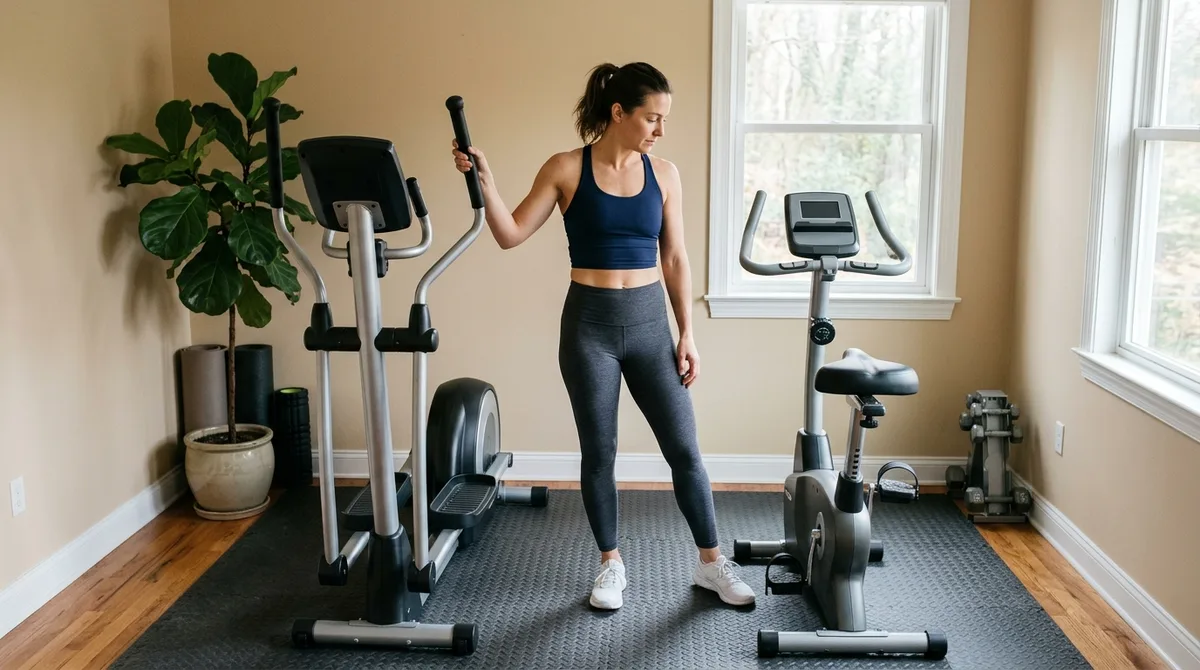
Here’s the verdict, no fence-sitting. Buy an upright or recumbent bike if you want a padded seat, a smaller footprint, or a setup that’s easier on a sore back. If your lower back is already complaining, the recumbent is the one to try first.
Buy an elliptical if you want a standing stride with your arms in the game, and you have both the room and the budget for it. A frame that size needs a real open corner, not a leftover nook.
Skip any machine you won’t use. The best cardio equipment is the one you keep using, and a bike gathering dust in the corner burns zero calories. Ask yourself honestly whether you’ll climb on it three times a week once the novelty wears off.
Before you pay, test the exact model you plan to buy. Check these three things:
- Footprint: measure the full clearance you need, not just the frame.
- Listed price: compare the specific model, not the brand’s overall range.
- Maintenance schedule: get the manufacturer’s service list before you check out.
A machine you enjoy beats a machine you’re impressed by.
Choosing the Machine You Will Stick With
Start tonight with a tape measure and a notebook. Mark out the floor area each machine needs, including room to swing a leg over a bike or step onto an elliptical’s footplates. Write those numbers next to the frame sizes you found above.
Next, pick your top two models and pull up the listed price and the manufacturer’s maintenance schedule for each. Save both pages. The listed price is only the starting point, and delivery and assembly can change the real total fast.
Then book a short demo on each. A short session on a machine will tell you more than any spec sheet. Adjust the seat or handlebars if you can, and pay attention to your knees, hips, and lower back the next morning, not just while you’re pedaling or striding.
Last, set your own test before you buy. Commit to three sessions a week on the machine you choose. If you’re still showing up once the novelty wears off, you’ve found your machine. If you keep skipping sessions, sell it or return it before it turns into a very expensive coat rack.
Frequently Asked Questions
1. Can I alternate between an elliptical and an exercise bike in the same weekly routine?
Yes, switching machines is a smart move if you want to keep workouts from getting stale. Riding a bike one day and using an elliptical the next also gives your knees and hips a different motion to handle. Expect the feel to change between machines, so start at a comfortable pace on the one you use less.
2. Is a used elliptical or exercise bike a safe buy?
A used machine can save you real money, but check the frame and moving parts before you pay. Push on the frame to look for wobble, and wiggle the pedals or footplates to spot play in the joints. Look for cracks near welds and worn seats or handlebar grips, and ask the seller for the exact model number so you can find its maintenance schedule and confirm replacement parts are still available.
3. What is the difference between a spin bike and a regular upright exercise bike?
A spin bike is built for hard, class-style riding, with a heavy flywheel that keeps the pedals turning smoothly. Most spin bikes offer a wider range of seat and handlebar adjustment than a basic upright bike. A regular upright bike is usually geared toward steady, comfortable sessions rather than intense interval work.
4. Can I use an elliptical or exercise bike with a knee or ankle brace?
You can usually ride or step on either machine with a brace, as long as it fits without rubbing or blocking the pedal or footplate. Clip-in pedals and tight straps can hold your ankle in one fixed position, which is harder on an injured joint. Start with light resistance and short sessions, and check with your doctor or physical therapist before adding time.
5. Do under-desk machines burn enough calories to help with weight loss?
Under-desk machines burn fewer calories per minute than a full session on a standard elliptical or upright bike, so they rarely work as a weight-loss tool on their own. Their real strength is breaking up long stretches of sitting and adding light movement to your day. If weight loss is the goal, pair one with regular sessions on a full-size machine.