
CADR rating meaning comes down to one number: how much cleaned air a purifier pushes out every minute, measured in cubic feet per minute (cfm). Clean Air Delivery Rate tells you how fast a unit pulls particles like smoke, dust, and pollen out of the air. The higher the number, the faster it works and the bigger the room it can handle. The U.S. EPA’s home air cleaner guide lays out the basics. Read it before you trust any box’s marketing.
Here’s the fine print the box won’t shout. CADR is usually measured at the highest fan speed, so that number is the best case, not what you get on the quiet setting at 2 a.m. It also covers particles only. If you want a purifier to tackle cooking smells or chemical fumes, CADR says nothing about that. For sizing, EPA’s chart calls for at least 65 cfm in a 100-square-foot room with an 8-foot ceiling, and taller ceilings push you toward a bigger unit. Use CADR to match a machine to your room, not as proof of everything it removes.
Key Takeaways
- Before you buy, check the smoke CADR on the spec sheet and make sure it is at least two-thirds of your room’s square footage, so a 300-square-foot room needs a smoke CADR of at least 200 cfm.
- Know that a purifier’s CADR is usually measured at its highest fan speed, so you should size up if you plan to run your air purifier on a quieter setting at night.
- Don’t expect a high CADR to handle cooking smells or fumes, because CADR only measures particle removal and you need an activated carbon filter for gases and odors.
- Size up for rooms with ceilings above 8 feet, since a 150-square-foot bedroom with a 10-foot ceiling holds 25 percent more air than the same room with an 8-foot ceiling.
- Treat ENERGY STAR and Department of Energy labels as proof of standardized testing and energy performance, and nothing beyond that.
What Does CADR Stand For and What Does It Measure?
CADR stands for Clean Air Delivery Rate, and it tells you how much filtered air an air cleaner pushes back into a room every minute. It’s reported in cubic feet per minute, or cfm, and that unit is the key to reading it.
Think of cfm as a flow rate, like water coming out of a hose. A purifier rated at 100 cfm sends out 100 cubic feet of cleaned air every minute. A cubic foot is a box of air one foot long, one foot wide, and one foot tall. So the number answers a simple question: how much of your room’s air does this machine clean each minute?
Why does that matter? Air only gets cleaned when it passes through the filter. The more air a unit can push through that filter each minute, the faster the room’s air gets scrubbed of particles. A higher cfm means faster particle removal and a bigger space the unit can handle.
Let’s put numbers on it. A 100-square-foot room with an 8-foot ceiling holds 800 cubic feet of air. A unit rated at 65 cfm would move all of that air through its filter in roughly 12 minutes. Double the cfm, and you cut that time roughly in half. Same room, same air, faster cleaning.
Here’s the catch. CADR only measures particles. It says nothing about gases, odors, or fumes, so a high number won’t fix a kitchen that smells like last night’s dinner.
Don’t stop at the front of the box. Flip it over and find the CADR figure on the spec sheet, because the big marketing headline rarely tells you the cfm.
What Is a Good CADR Rating for My Room?
A good CADR rating for your room is at least two-thirds of the room’s floor area in square feet, measured on the smoke score. EPA recommends that rule for portable air cleaners. It’s the fastest way to tell whether a box can keep up with the space you actually have.
Start with the math. Multiply the room’s length by its width to get the square footage. Then take two-thirds of that number. In a 300-square-foot room, two-thirds is 200, so you want a smoke CADR of at least 200 cfm. A unit rated at 150 cfm looks fine on the box, but it falls short for that room.
EPA’s sizing chart gives you a simpler cross-check. For a 100-square-foot room with an 8-foot ceiling, the minimum is 65 cfm. The chart and the two-thirds rule point the same way: a small room needs a small number, and a bigger room needs a bigger one. Here’s a quick reference for rooms with 8-foot ceilings:
- 150 square feet: smoke CADR of at least 100 cfm
- 300 square feet: smoke CADR of at least 200 cfm
- 450 square feet: smoke CADR of at least 300 cfm
Check the square footage before you shop, not after. Plenty of people get to the checkout page, see a line like “covers up to” followed by a big number, and never ask whether that means a bedroom or a wide-open living room. Measure first, do the math, then compare spec sheets with a real target in mind.
Ceiling height changes the picture. If your ceiling runs higher than 8 feet, EPA advises sizing the unit for a larger area than the floor alone suggests. More height means more air to cycle through the filter, so step up to the next size instead of squeezing a small unit into a tall room.
Open floor plans are trickier. A giant combined kitchen and living area only counts as one room if air can move freely to the unit. Walls, closed doors, and furniture that blocks the airflow all shrink the space the machine really serves. Measure the zone the cleaner will actually work in, not the entire floor plan on the listing photo.
Why Smoke CADR Matters More Than Dust and Pollen Scores
Flip the box over and you’ll often see three CADR numbers instead of one. Many labels list a separate score for tobacco smoke, dust, and pollen. Each one tests a different particle size, and that’s where shoppers get tripped up.
Here’s how the three break down:
- Smoke CADR: the smallest particles, the kind in tobacco smoke and other fine haze.
- Dust CADR: medium-sized particles, the everyday dust that settles on your shelves.
- Pollen CADR: the largest particles, like the grains that make your eyes itch in spring.
Federal air-quality guidance treats smoke CADR as the most relevant of the three when you’re comparing how well a unit removes small particles. Tiny particles stay airborne longer and are harder to catch, so a purifier that handles them well has earned a closer look.
This is the trap. A unit can post a strong dust or pollen score and still be weaker on smoke-sized particles. Picture two machines. Unit A lists 300 cfm for dust and 180 cfm for smoke. Unit B lists 260 cfm for dust and 240 cfm for smoke. Unit A wins the headline battle, but Unit B is the stronger pick if fine particles are your main worry. Same box style, very different story.
So compare smoke to smoke. Put the smoke CADR of each unit side by side, then check that number against your room size. Ignore the dust and pollen scores unless you’re shopping for those specific problems.
Tip: If a label shows only one CADR number and doesn’t say which kind it is, don’t guess. Ask the seller directly, or read the spec sheet from the manufacturer. A vague number on the front is a sign to dig a little deeper before you pay.
Does CADR Tell Me How Well an Air Purifier Removes Gases?
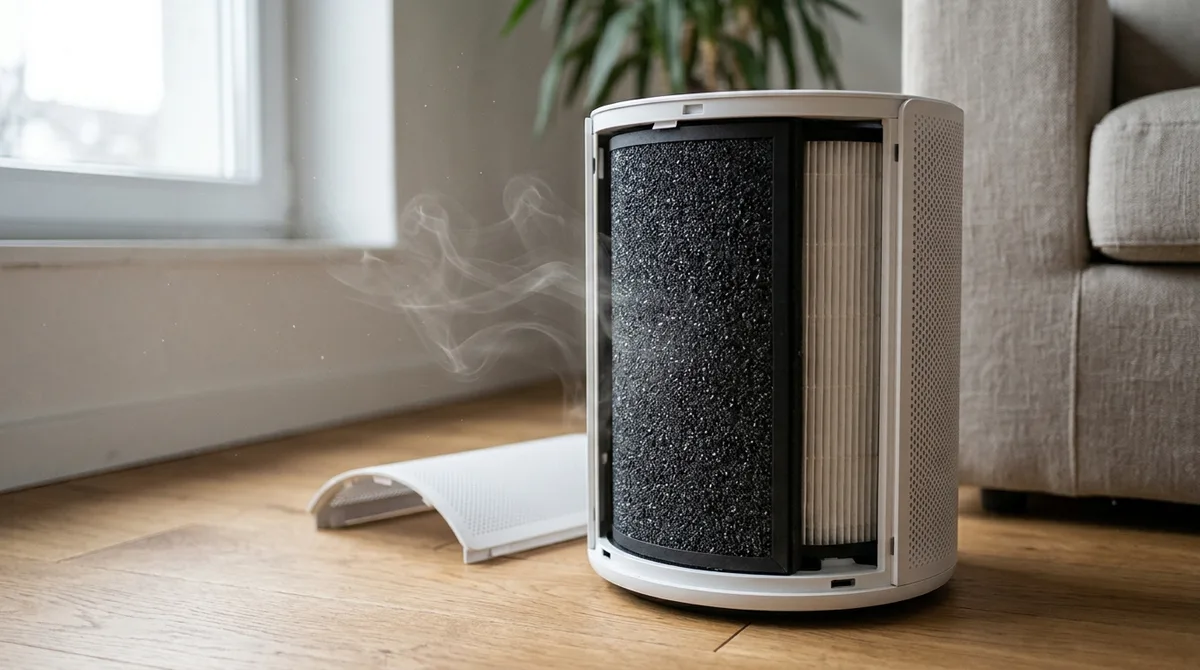
No, CADR doesn’t tell you how well a purifier handles gases, odors, or fumes. It rates particle removal and nothing else. If a box implies one number covers everything, that’s smoke and mirrors.
Federal air-quality guidance is clear on this point. CADR measures how well a unit pulls particles out of the air. For gases, the guidance points you to a different feature: activated carbon or another gas-removal filter. A unit can post a strong smoke CADR and still do almost nothing about the smell of burnt toast or fresh paint.
So if odor control is your goal, the carbon specs are the main event. Here’s what to check:
- A named gas-removal filter: Look for “activated carbon” in the filter list, not just a vague phrase like “odor technology.”
- How much carbon: The spec sheet should give an amount. A thin carbon layer and a deep carbon bed don’t do the same job, and the front of the box won’t tell you which one you’re getting.
- Which odors it targets: Good manufacturers say what the filter handles, such as cooking smells or pet odors. If the claim is fuzzy, treat it as a red flag.
- Smoke CADR: Keep this for particles only, and check it against your room size.
Some shoppers assume a high CADR must help with smells too, since the unit is clearly moving a lot of air. It doesn’t work that way. The filter’s mesh traps particles, but gas molecules are far smaller and pass right through unless a carbon layer grabs them.
Next time you shop, read the filter section before the big number. If the carbon details are missing, ask the seller directly. A silent spec sheet on odor control usually means the unit wasn’t built for it.
How Fan Speed and Ceiling Height Change the Real Numbers
Here’s where the fine print bites. EPA says portable air cleaner CADR is typically measured at the unit’s highest speed, so the number on the box describes the machine running flat out. A higher rating does mean more particle removal and a larger area served, but only when the fan is spinning that fast.
Run the same purifier on its quiet setting and the airflow drops. Less airflow means slower cleaning. A unit that handles your bedroom on high may leave the air dirtier on low, and that’s the setting many people reach for at night. You’ll get a quieter room and a slower scrub, and the box won’t mention the trade.
Ceiling height adds another layer. Take a 150-square-foot bedroom with an 8-foot ceiling. That’s 1,200 cubic feet of air. Raise the ceiling to 9 feet and the same floor holds 1,350 cubic feet, 12.5 percent more air for the unit to cycle through. Go to 10 feet and you’re at 1,500 cubic feet, which is 25 percent more than the 8-foot version. EPA advises sizing for a larger area than the floor alone suggests when ceilings go above 8 feet, so don’t let the square footage on the listing settle the question.
Some shoppers try to solve this by buying the cheapest unit that technically covers the floor. That’s a shaky plan. A unit that barely meets the target on high has no cushion, and any time you dial it down, it falls short.
Here’s the practical move. Pick a unit whose rating covers your room at a speed you’ll actually run. Check the spec sheet for the CADR tied to the setting you plan to use. If it only lists the top-speed number, assume the quieter settings move less air and size up accordingly. If you know you’ll run it on medium most of the time, shop for a unit that handles your room comfortably at medium, not one that just scrapes by on high.
What Do Energy Rules and ENERGY STAR Labels Say About CADR?
Federal energy rules and ENERGY STAR criteria mention CADR because they use it as a yardstick for testing and energy use. Think of them as rules about how a machine is tested and how much power it uses, not a report card on your lungs.
The U.S. Department of Energy sets minimum energy-efficiency scores for conventional room air cleaners with a PM2.5 CADR between 10 and 600 cfm. PM2.5 is the test for fine, smoke-sized particles, so these rules focus on the same particles you care about most. The bar rises with the CADR band:
- Below 100 cfm: a minimum score of 1.9
- From 100 to below 150 cfm: a minimum score of 2.4
- 150 cfm or more: a minimum score of 2.9
Tier 2 compliance begins December 31, 2025, which is the date that makes those higher minimums matter. A bigger unit has to clear a tougher energy bar, so a stronger machine isn’t automatically a free pass on power use.
ENERGY STAR takes a similar path. Its Room Air Cleaners and Purifiers Specification Version 3.0 took effect October 9, 2025, and it requires CADR to be measured under the latest ANSI/AHAM AC-1 standard. That test method, maintained by the Association of Home Appliance Manufacturers, is what lets one brand’s 200 cfm mean roughly the same thing as another brand’s 200 cfm.
That’s the useful part. Energy rules and ENERGY STAR criteria cover energy performance and standardized testing, and a certified label reflects exactly that. It tells you the unit was tested the same way as its rivals and met the energy standard. Use that as a fair starting point for comparing specs, then do the room math yourself.
Reading a CADR Label Before You Buy
Before you add anything to your cart, run the label through four checks. Grab a tape measure and the spec sheet, then work down the list.
- Measure the room and note the ceiling height. Multiply the length by the width to get the floor area, then write down the ceiling height. If the ceiling is over 8 feet, shop for a bigger unit than the floor area alone suggests.
- Find the smoke CADR and check the two-thirds rule. Take two-thirds of your square footage. For a 240-square-foot room, that’s 160, so the smoke CADR needs to be at least 160 cfm. Skip the dust and pollen numbers for this test.
- Check the speed the rating was measured at. Confirm that the CADR matches the top setting. Then ask yourself honestly whether you’ll run it that high at night. If you won’t, size up so the quiet setting still covers your room.
- Look for a gas-removal filter if odors matter. Confirm that the spec sheet lists activated carbon and says how much is in the unit. If you’re buying to fight cooking smells or fumes, a strong smoke CADR won’t do that job on its own.
Here’s the verdict. Skip any unit that hides its CADR, buries it in fine print, or gives you one vague number with no particle size and no speed attached. Those sellers want you to trust the box instead of the data. A unit that passes all four checks, with a smoke CADR that covers your room at the speed you’ll actually run, is worth the money. Anything less is just noise.
Checking the Label Before You Check Out
Your next step is to pick the room you want to clean first, probably the bedroom where you sleep, and measure it tonight. Write the square footage and the ceiling height on a sticky note and stick it to your phone or your notebook. You’ll need both numbers before you open a single product page.
Then shop with those numbers in hand. Look for units whose smoke CADR clears two-thirds of your room’s square footage at the fan speed you’ll really use at night. If a listing never says which CADR it’s quoting, skip it and move on to the next one.
Thinking about a DIY setup, like a box fan with a filter strapped to the back? Pump the brakes. EPA says the CADR of a DIY air cleaner is typically not known, so you can’t check it against the two-thirds rule. You’d be guessing how much air it moves, and that’s a poor bet for the air you breathe.
If you’re still on the fence, send the seller one question before you pay: “What’s the smoke CADR on the quiet setting?” A straight answer means they’ve read their own spec sheet. A runaround means you should keep scrolling.