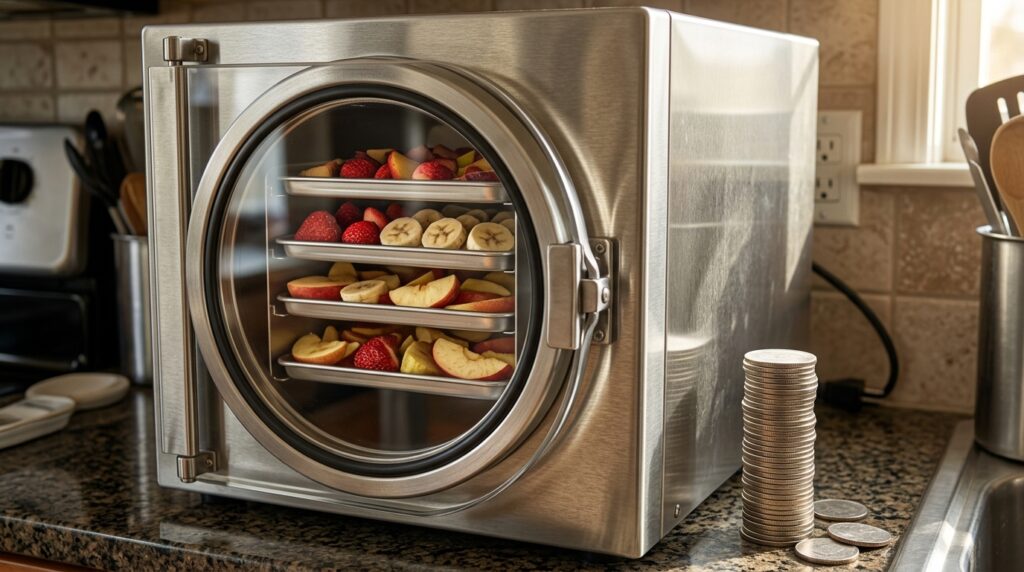
Listed Harvest Right home freeze dryer prices range from $1,795 for a small model to $4,995 for an XL bundle. But the cost doesn’t stop at checkout. Your pump choice, packaging, electricity, and the time each batch takes can all add to the bill. A separate listed price has also appeared at $1,895 on sale beside a $2,495 regular price, so don’t assume every listing covers the same model or bundle. Check the machine size and included pump before comparing prices.
Running costs deserve the same scrutiny. A Utah State University Extension guide gives an older estimate of $2–$5 in electricity per batch, based on 2018-era information, and says typical batches take 20–40 hours. Treat those figures as context, not a current estimate for your utility bill. Local rates, batch length, and the food you process all matter. Frequent use may make the purchase easier to justify, but advertised capacity alone doesn’t guarantee savings. Your actual batches, food costs, and storage supplies determine whether the numbers work for you.
Key Takeaways
- Harvest Right home freeze dryers are listed from $1,795 for the small model to $4,995 for an XL bundle; a separate listed price has appeared at $1,895 on sale beside a $2,495 regular price. Match the model, tray count, and pump before comparing listings.
- A 2018-era estimate puts electricity at $2–$5 per batch and typical runs at 20–40 hours, so use your local power rate and the machine’s energy use for a full run instead of treating those older figures as a current bill estimate.
- Your full setup and running costs include more than the machine: listed pumps range from $895 for a Premier pump to $1,695 for an oil-free scroll pump, and you should also budget for packaging and any pump upkeep.
- A home freeze dryer makes financial sense only if your realistic batch schedule and food, electricity, packaging, and maintenance costs compare well with similar food you would otherwise buy, since the advertised 1,800-pound annual capacity assumes four batches a week for 50 weeks.
How Much Does A Home Freeze Dryer Cost?
Listed Harvest Right home models range from $1,795 for a small unit to $4,995 for an XL bundle with an XL Premier pump.
| Harvest Right home model | Listed price |
|---|---|
| Small, 4 trays | $1,795 |
| Medium, 5 trays | $2,495 |
| Large, 6 trays | $3,095 |
| XL, 7 trays, with XL Premier pump | $4,995 |
These are listed prices, not a promise that every retailer or listing has the same price today. Store pages and promotions can change, so treat each figure as a snapshot. The model size and included pump matter. A small unit and a larger bundle aren’t like-for-like comparisons, even when both listings say “Harvest Right home freeze dryer.”
A separate listed price has appeared at $1,895 on sale beside a $2,495 regular price. It is distinct from the model prices above, so check the model, tray count, and included pump before comparing it with another listing.
The pump can make a real difference to the package you’re comparing. For example, a listed XL model includes an XL Premier pump, while another listing may describe a different pump or leave the pump details unclear. A lower sticker price alone won’t tell you whether two packages contain the same machine and pump. Read the model name, tray count, and pump description together.
A useful comparison starts with matching the full package, not just the brand name. A 4-tray small model and a 7-tray XL bundle are different configurations. Don’t treat the price attached to one as the price of the other. If a listing leaves the model or pump unclear, the price alone isn’t enough for a fair comparison.
Ruckus Reviews is a publication that informs readers, not a seller of Harvest Right equipment. The listed figures here can change, and the exact listing determines which model and pump a quoted price refers to.
What Is Included In The Price?
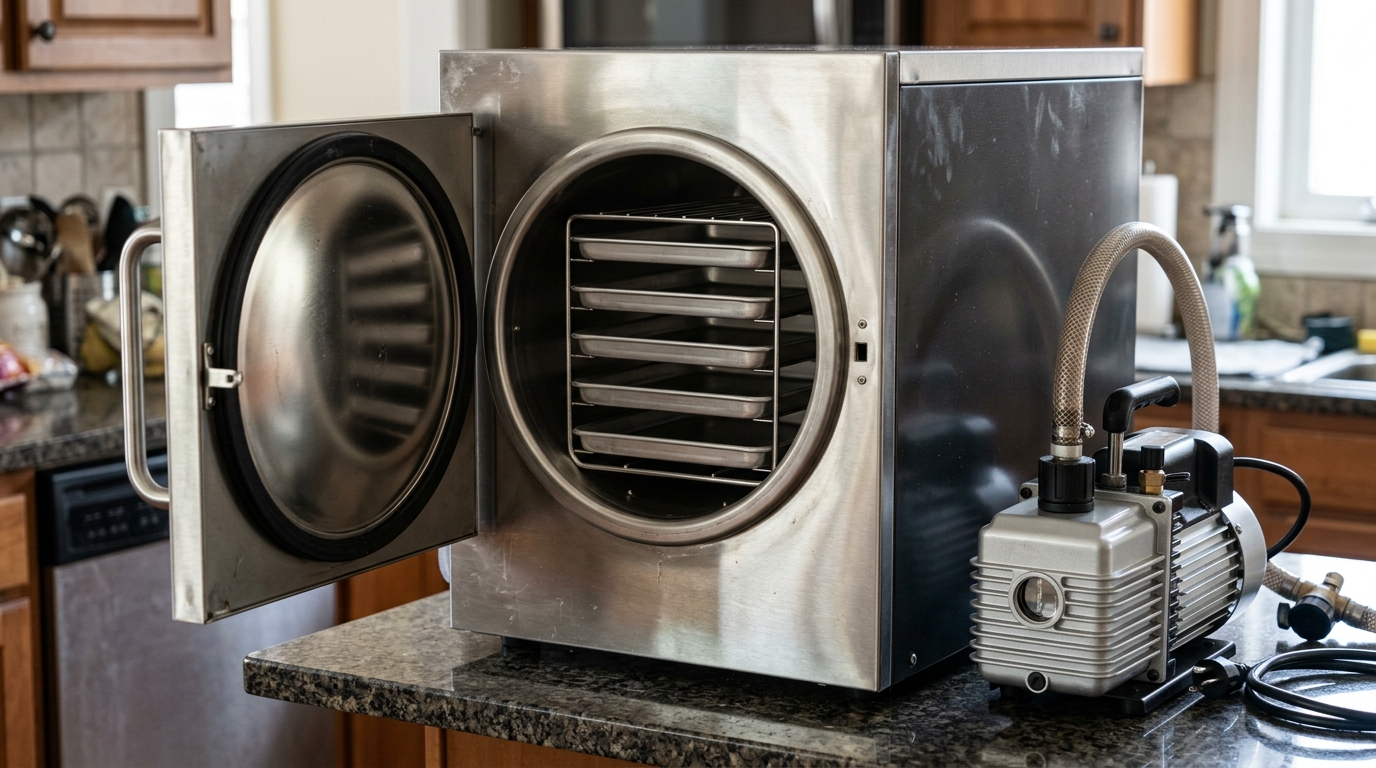
A quoted home freeze-dryer price may cover the machine and some components. Check whether it includes the vacuum pump, trays, and other accessories, then budget separately for packaging and recurring supplies.
General listed figures put an oil-free scroll vacuum pump at $1,695 and a Premier vacuum pump at $895. A package with the scroll pump can therefore have a much higher initial price than one with the Premier pump, even before you consider the machine itself. Don’t compare two listings until you know which pump each includes.
Check the tray count and accessory list, too. One listing may bundle trays or other items, while another quoted price may leave some components out. If the listing doesn’t clearly say whether the pump, trays, and accessories are included, the advertised total may not tell you what you’ll need to spend to get the setup you want.
Packaging is another part of the ownership budget. Freeze-dried food needs suitable storage materials, including bags and oxygen absorbers, and you may need to buy more as you process and pack food. An October 2018 example priced 60 one-gallon Mylar bags plus 60 300-cc oxygen-absorber packets at $24. That’s an old example, not a current quote. Use it to understand the types of supplies involved, not as today’s expected price.
Pump upkeep can add recurring costs, too. The small model’s instructions recommend replacing vacuum-pump oil every 20–30 batches. That recommendation gives you a maintenance interval, not the current price of oil. Include the possibility of repeat purchases, but don’t treat an unsupported amount as part of your cost estimate. An oil-free pump avoids that particular oil-replacement task, but its listed purchase price is higher than the Premier pump’s.
Read the warranty terms closely before deciding what the bundle is worth. The small model has a three-year limited warranty. “Limited” matters: check the written terms for what’s covered, what’s excluded, and what steps you must follow if a problem comes up. Don’t assume the same warranty applies to every model or that it covers accessories and supplies.
Keep your price comparison grounded in the exact package: machine size, pump type, trays, included accessories, warranty terms, and the supplies you’ll need to run and store each batch. A low sticker price can leave out components, while a higher one may include a different pump or bundle. Packaging and pump maintenance remain separate budget considerations, even when the machine price looks like the whole bill.
How Much Does It Cost To Run?
Running a home freeze dryer costs more than electricity alone. Your operating expenses also include pump oil and packaging, while the power bill depends on your local rate, the length of each run, and the food you process.
A published estimate puts electricity at $2–$5 per batch, based on Intermountain West consumers. That estimate dates to 2018, so it’s historical context, not a current universal rate or a reliable prediction of your bill. Your local electricity price and the machine’s actual energy use can make your cost different.
The 2018-era guidance gives typical batch times of 20–40 hours. Fresh pineapple may take 48–52 hours, based on manufacturer information from that period. A longer cycle can mean more electricity, but the food itself matters, too. Food type and moisture can affect how long a batch takes, so two loads may not use the same amount of power.
To estimate your electricity cost, multiply the machine’s energy use for a run, measured in kilowatt-hours, by your local price per kilowatt-hour. Use the rate on your utility bill and the machine’s energy-use information. If you only have an estimate for part of a run, treat it as a partial-run estimate, not the cost of a full batch. For a better batch estimate, use energy consumption for the full run. Extending a partial-run figure in proportion to the run time is only a rough estimate, since power use may vary during a cycle.
Electricity is just one line in the running-cost ledger. Pump oil is a recurring expense for an oil pump, while an oil-free pump avoids that oil-replacement task. Packaging adds another cost when you seal finished food in Mylar bags with oxygen absorbers. Those supplies are separate from the machine’s electricity use, and the amount you spend depends on how much food you pack and how you store it.
Keep the comparison specific to the batch you plan to run. A short cycle for one food may have a different power cost from a longer cycle for a wetter food, even if the machine and local utility rate stay the same. Likewise, an electricity estimate for a day shouldn’t be presented as the cost of processing, packaging, and storing a complete batch. The clearer your energy-use figure and local rate, the less guesswork goes into estimating the power portion of your operating cost.
What Drives The Long-Term Cost?
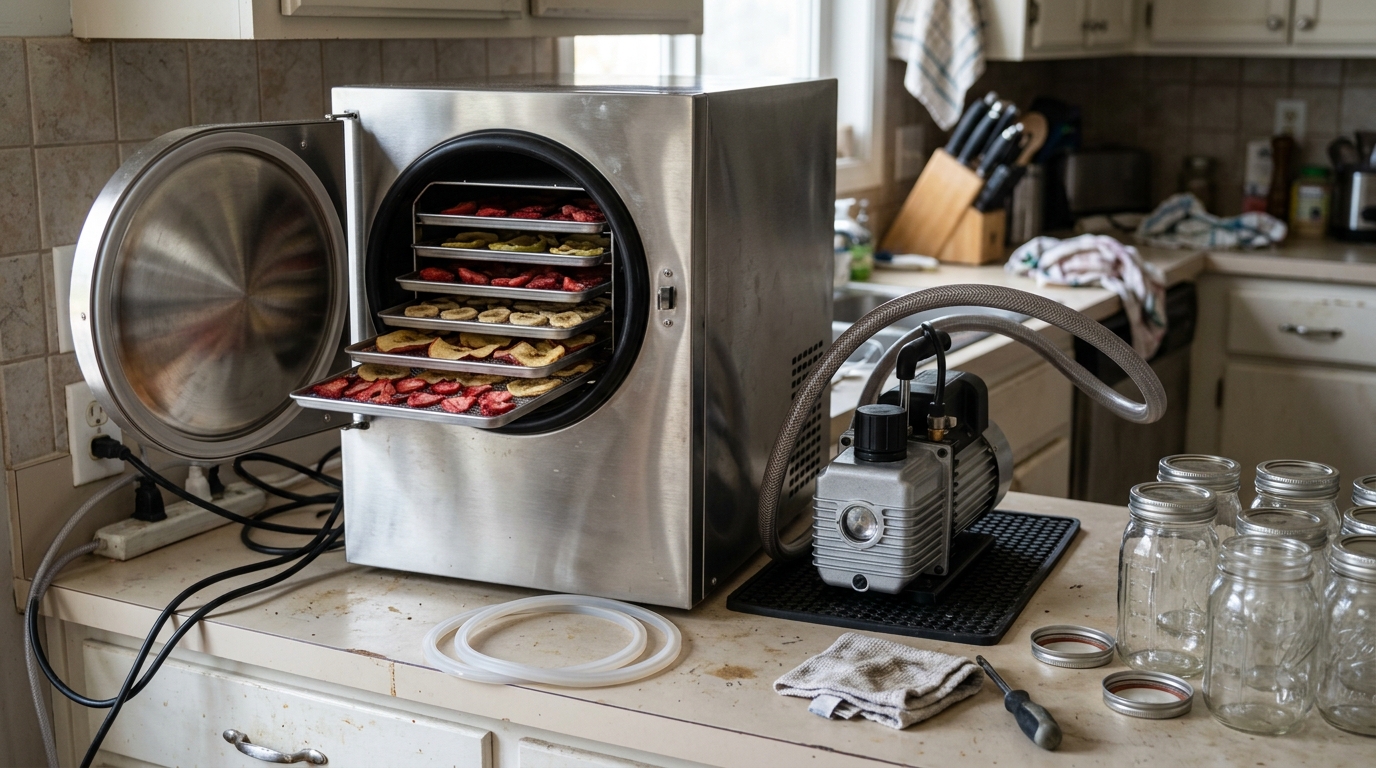
The long-term cost depends on how often you run the machine, how much food you actually preserve, and what each batch costs, not on maximum capacity alone. Harvest Right says its small model processes 6–10 pounds of fresh food per batch and can handle up to 1,800 pounds per year. That annual figure assumes four batches a week for 50 weeks, so it describes a steady, heavy-use schedule, not a typical household guarantee.
A household that runs batches only when the garden produces a surplus, or when suitable food is available, may process far less over a year. With fewer batches, you spread the machine’s purchase cost across less preserved food. The same machine can therefore have a very different cost per batch depending on how regularly you use it.
A payback estimate also depends on the price of the machine and pump, batch frequency, the cost of the food you process or whether it’s homegrown, packaging, pump upkeep, local electricity rates, and the price of comparable food you would otherwise buy. Homegrown food may reduce what you spend on ingredients, but it doesn’t remove the machine, power, packaging, or maintenance costs. Comparing your finished food with a store-bought alternative only helps if the foods and amounts are genuinely comparable.
Use a simple worksheet based on your own routine. Record the same details over a realistic stretch of use, then compare your total with the cost of the alternative food you would actually buy.
- Estimate your annual batches using the schedule you expect to keep, rather than assuming four batches a week.
- Track how much food you preserve, noting the amount going into the machine and the finished food you store.
- Add the machine and pump price to your worksheet as the upfront cost you’re trying to spread across your preserved food.
- Record food costs for each batch, or note when the food is homegrown, so your estimate reflects what you really spend.
- Total the operating and packaging costs, including electricity at your local rate and any pump upkeep or storage supplies.
- Compare your results with the price of comparable food you would otherwise buy, using the same kind of food and a useful amount for your household.
The worksheet won’t promise a payback date. It shows whether your own use and costs make the machine more or less economical than your alternative. If your batch count changes from year to year, your result will change, too. A busy harvest season and a quiet one may produce very different totals. The useful signal is your tracked cost per amount of food preserved, compared with what that food would have cost you otherwise.
Is A Home Freeze Dryer Worth The Money?
A home freeze dryer is worth the money mainly when you expect to use it regularly, know what food you’ll process, and have a clear plan for packaging and storing the results. If you can’t picture a steady flow of batches or a place for the finished food, the purchase is hard to justify.
A planned harvest can make the machine valuable even when it doesn’t beat store prices. If your garden produces more food than you can eat fresh, preserving that harvest may matter to you on its own. That personal value is real, but it doesn’t prove the machine will pay for itself.
The financial case depends on your actual workload and the food involved. Your total includes the purchase price, food costs and source, packaging, electricity, and maintenance. Then compare that with what you would otherwise buy, using genuinely comparable food and amounts. Homegrown produce may lower ingredient costs, but it doesn’t erase the other expenses. No single payback date applies to every household, and a calculation based on your own routine isn’t a promise of savings.
If you expect occasional batches, be skeptical of advertised maximum throughput. A capacity figure based on a demanding schedule isn’t a realistic household result unless you can actually supply, process, pack, and store food at that pace. Compare the batches you expect to run with the full purchase cost before treating the machine as a bargain.
Long-term storage also needs a reality check. The University of Minnesota Extension says information on the shelf life of home freeze-dried foods is limited, while commercially prepared freeze-dried foods can last up to 25 years. Don’t assume your home-packed food will match a commercial product’s storage life when estimating its value. A storage plan should include suitable packaging, a place to keep the food, and a sensible idea of when you expect to use it.
The blunt test: Price the full setup, estimate the batches you’ll actually run, and count the food, packaging, electricity, maintenance, and storage effort. Buy only if the resulting cost and work fit your food-storage goals.
What Are The Downsides Of Freeze Drying?
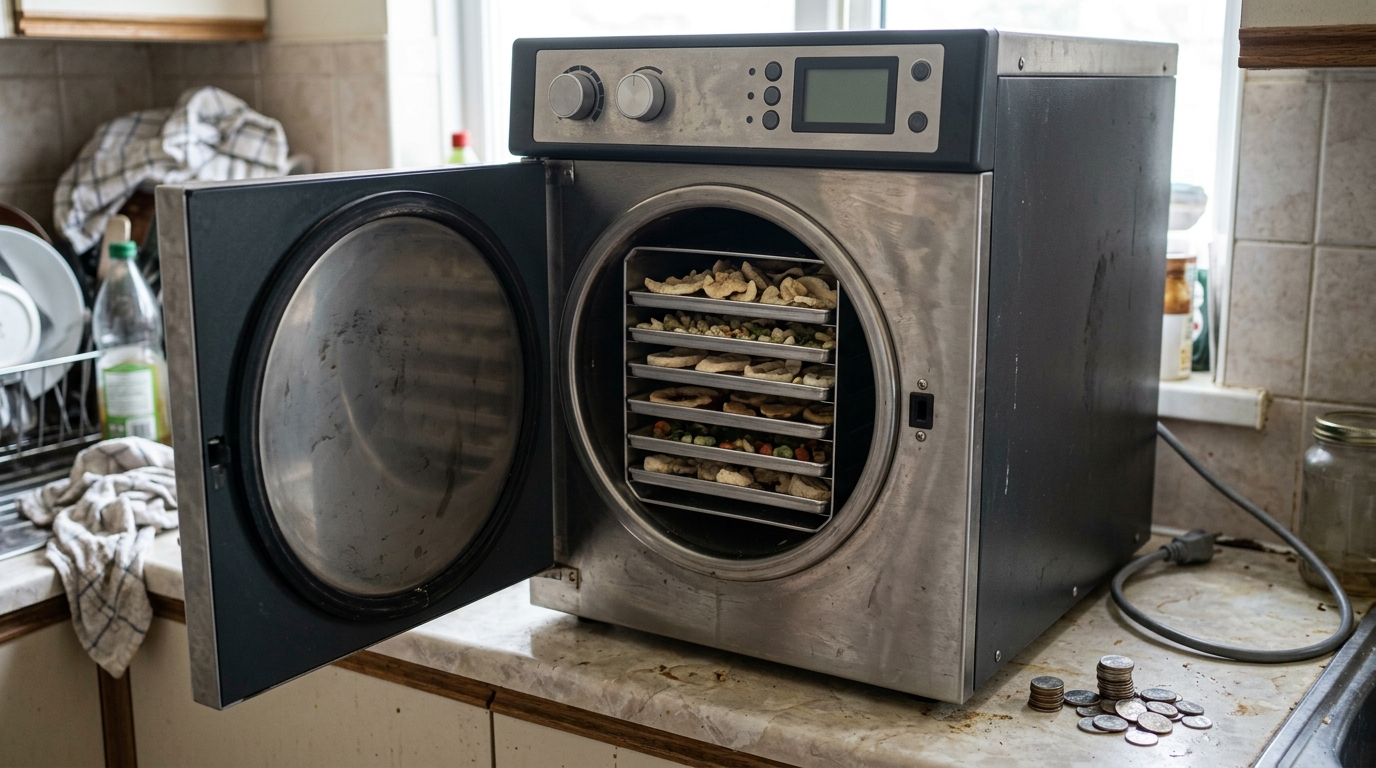
The main downsides are long runs, work before and after each batch, and no automatic guarantee that the food is safe or will last for a particular length of time.
Freeze-drying removes water from frozen food through sublimation: the ice changes directly into vapor without becoming liquid first. That process can make food lighter and easier to store, but it doesn’t make the food sterile. It doesn’t kill illness-causing microorganisms, so a home freeze dryer can’t replace safe food handling. The machine changes the food’s moisture; it doesn’t erase risks from how the food was grown, prepared, or handled.
A typical batch takes 20–40 hours, based on an older estimate. That’s a long stretch to have the machine occupied, especially if you have more food waiting to process. Plan around the full run, not just the time it takes to load the trays. A change in plans or a longer-than-expected batch can push back the next one.
The work doesn’t stop when the cycle ends. You still need to prepare food, load and unload trays, check that the food is dry, and package it for storage. Mylar bags and oxygen absorbers add supplies to manage, and the finished food needs a suitable place to be stored. If you want to process a large harvest, the machine’s capacity is only one part of the job. You also need time to handle the food going in and coming out.
Shelf life is another point where sales claims can outrun what you can confidently count on at home. Information on how long home freeze-dried food lasts is limited. Commercially prepared freeze-dried food can have a shelf life of up to 25 years, but that figure isn’t a promise for food processed and packed in your kitchen. Your packaging and storage conditions matter, and the equipment alone can’t set a reliable expiration date.
That uncertainty matters when you’re weighing the price as an investment. A home machine doesn’t guarantee safe handling, a particular shelf life, or a financial return. If you run it less often than planned, spend more on food and storage supplies than expected, or can’t use the stored food as intended, the cost per useful batch rises. Long runs and post-batch work can also make the machine a poor fit if you have little time to process and pack food.
How Should You Compare Models And Listings?
Compare models by listed price, the batches you realistically expect to run, and the exact pump and accessories included, not by tray count or a search snippet alone.
| Model | Listed price | How to match it to your use |
|---|---|---|
| Small, 4 trays | $1,795 | The only listed capacity reference is 6–10 pounds of fresh food per batch. Consider it if that batch size fits your food supply and planned routine. |
| Medium, 5 trays | $2,495 | Consider the higher price only if the configuration suits the batches you expect to run. No matching capacity figure is available here. |
| Large, 6 trays | $3,095 | The listed price is higher; compare it with your planned workload rather than assuming a pounds-per-batch figure. |
| XL, 7 trays | $4,995 | This is the highest listed price and includes an XL Premier pump. It may suit a heavier planned workload, but no matching capacity figure is available here, either. |
The small model’s 6–10-pound figure can help you test whether a batch plan is realistic; it doesn’t tell you the capacity of the medium, large, or XL. Tray count helps identify the configuration, but it isn’t a substitute for a stated food capacity. If you expect occasional batches, a higher-priced model may be hard to justify. If you expect frequent runs, make sure you can regularly supply, prepare, package, and store the food.
Then compare the pump line by line. A separate Premier pump is listed at $895, while an oil-free scroll pump is listed at $1,695. The XL listing includes an XL Premier pump, but its price shouldn’t be treated as the price of a pump-free XL or as a direct comparison with a different bundle. Check the pump model and every included accessory before judging which listing costs less.
Warranty and upkeep need the same scrutiny. The small model has a three-year limited warranty, and its pump-oil replacement recommendation is every 20–30 batches. Confirm the written warranty for the exact model you’re considering, and don’t assume the small model’s terms apply to every size. If a listing doesn’t spell out pump maintenance or warranty coverage, get those details before comparing totals.
For retailer-related searches, compare the model, pump, included accessories, and listed price on the product page before judging the cost of different configurations.
– Batch plan: Choose the model around the batch size and frequency you can sustain. – Complete setup cost: Include the machine, pump, trays, and needed accessories. – Recurring supplies: Budget for bags and oxygen absorbers. – Pump upkeep: Check the pump type, oil needs, and maintenance instructions. – Operating-cost estimate: Use your local electricity rate and expected run time. – Storage plan: Make sure you have a suitable place for the packaged food.
Make The Cost Test Before You Buy
Before you buy, open the exact Harvest Right listing you’re considering and write down the model, pump, included trays, and accessories. Then list the foods you expect to process from a real harvest or shopping routine, not an idealized stockpile. If you can’t name likely foods and when you’ll have them, your batch estimate is still guesswork.
Build one sample-batch calculation using your local electricity rate, the machine’s energy-use information, the amount you spend on ingredients, and the Mylar bags and oxygen absorbers needed for that food. Add any pump upkeep that applies. Keep the machine’s purchase cost separate, then divide the batch costs by the amount of food you expect to store and use. Compare that amount with a genuinely similar food you would otherwise buy. A different food or serving size can make the comparison misleading.
Now test the result against your likely schedule. If the numbers work only when you run the machine far more often than your food supply, time, and storage space allow, pause the purchase. If the estimate still fits your routine, check the written warranty and pump details for that exact configuration before committing. Keep the listing and your calculation together, and revisit the estimate if the seller changes the bundle or price.
Frequently Asked Questions
1. Can you rent or share a home freeze dryer instead of buying one?
Renting or sharing a home freeze dryer may reduce the upfront commitment, but rental availability depends on your area. Before sharing, agree on machine access, cleaning, packaging costs, and responsibility for pump maintenance.
2. Does freeze-drying work for every type of food?
Freeze-drying isn’t equally straightforward for every food. The food and its moisture level can affect how long a batch takes. Check the machine’s food-preparation guidance for the specific food you plan to process.
3. How much freezer space should you plan for before starting a batch?
The freezer space you need depends on how much food you plan to process and how it’s prepared and arranged. Plan room to freeze the food for your intended batch, and check the machine’s loading guidance rather than assuming tray count tells you how much freezer space to set aside.