
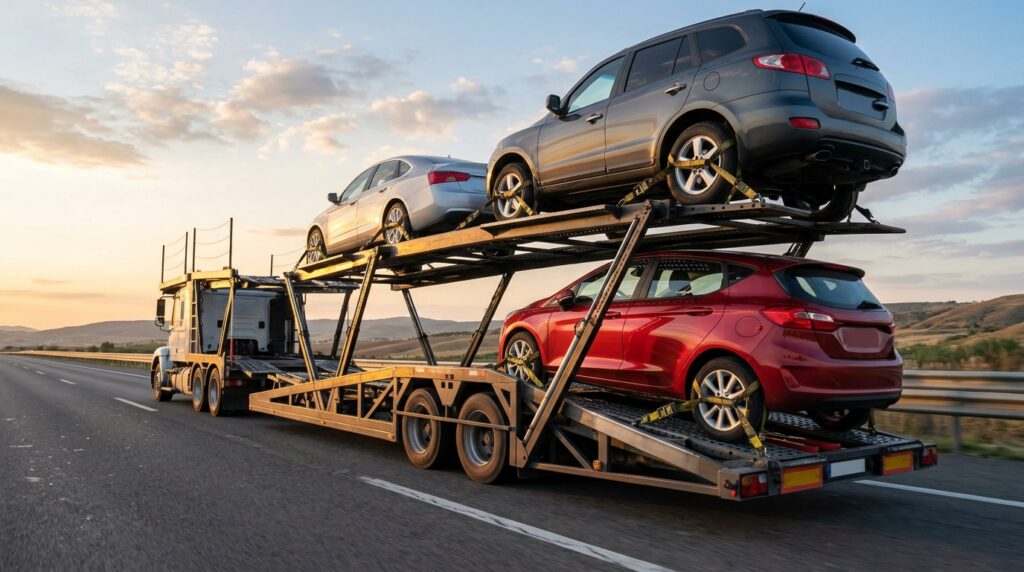
Car shipping for a standard sedan on an open carrier usually runs $540 to $1,100 for trips under 500 miles, and $1,050 to $3,000 or more once you pass 1,500 miles, based on FreightWaves Checkpoint’s 2026 estimates. Those numbers are a planning map, not a guaranteed quote. Route length, vehicle size, transport method, and timing can push your final bill up or down. Sound like a wide range? It is. Anyone promising one flat price without asking about your car and your pickup and drop-off cities is selling you smoke and mirrors.
Here’s where the money really moves. Enclosed transport costs more across the board. On a 1,000-mile trip, the same FreightWaves data puts open shipping at $650 to $800 and enclosed at $1,000 to $1,200. Short hops hit harder per mile, too. The Auto Transport Insider Q2 2026 index found routes under 700 miles averaging $1.54 per mile, compared with $0.54 per mile for coast-to-coast runs. Bigger vehicles add cost on top of that. And don’t forget the calendar, because pickup scheduling can eat days before the truck ever leaves town. Sound too good to be true? Usually it is. Let’s break down every line item so you know exactly what you’re paying for and where a padded quote is hiding.
Key Takeaways
- For a standard sedan on an open carrier, expect roughly $700 to $1,800 for a 500 to 1,500 mile move, so any quote far outside that band deserves a clear explanation from the company.
- Enclosed transport costs more than open transport at every distance, so you should pay that premium only when your car truly needs protection from weather, road debris, or a high-value finish.
- Short routes under 700 miles average $1.54 per mile, compared with $0.54 per mile for coast-to-coast runs, so you’ll pay more per mile on a short hop even though the total bill is smaller.
- Before you pay any deposit, check the broker’s or carrier’s MC Docket and USDOT numbers in FMCSA’s public records and confirm the company that will physically load your car.
How Much Does Car Shipping Cost Right Now?
A standard sedan on an open carrier usually lands somewhere between a few hundred dollars and a few thousand, and the bill climbs as the miles pile up. For a 500 to 1,500 mile move, expect a benchmark band of roughly $700 to $1,800. Past 1,500 miles, the same benchmarks run $1,050 to $3,000 or more.
Those bands are planning benchmarks, not guaranteed quotes. No chart can see your exact car, your pickup address, or your drop-off date. Benchmarks also disagree because sources measure differently. Some track live market rates as carriers post them. Others summarize quotes collected for one specific vehicle from a sample of companies. Neither approach is wrong, but they answer different questions, so a number from one source won’t always match another.
Live rates move, too. The Auto Transport Insider Q2 2026 index, built on open-carrier pricing for standard sedans across 15 U.S. routes, reported an average shipment price of $1,108. Rates in that index were about 8% higher than in Q1 2026. If you shopped last spring and got a number you liked, that number may already be stale.
Now for the distance math. Short hauls cost the most per mile, and the rate drops as the route stretches. In the broader market, the average cost per mile looks like this:
- Intra-city moves: about $5.14 per mile
- Intra-region moves: about $2.35 per mile
- Inter-region moves: about $1.82 per mile
- Long-haul moves: about $0.85 per mile
Here’s the catch. The per-mile rate falls, but your total still climbs, because you’re buying more miles. A short hop costs less in total than a cross-country run, yet it hits your wallet harder per mile. Don’t let a cheap-looking long-haul rate fool you into thinking a long trip is a bargain. It’s just a bigger bill spread over more road.
Ignore any site shouting “starting at” a rock-bottom price. That’s noise. A starting price usually assumes the cheapest route, an easy pickup, flexible dates, and a car that runs and rolls without help. Your car, your cities, and your calendar decide where you land inside the range. A starting price tells you the floor exists. It doesn’t tell you what you’ll pay.
So how do you use these numbers? Find the band for your distance, then check whether your quote lands inside it. Way above the top? Ask the company to explain every line. Way below the bottom? Ask what got cut, because cheap quotes often hide a slow pickup, a thin insurance story, or a carrier that’s hard to track down later. Benchmarks won’t name your price, but they will tell you when a number looks off.
Open or Enclosed: Which Option Costs More?
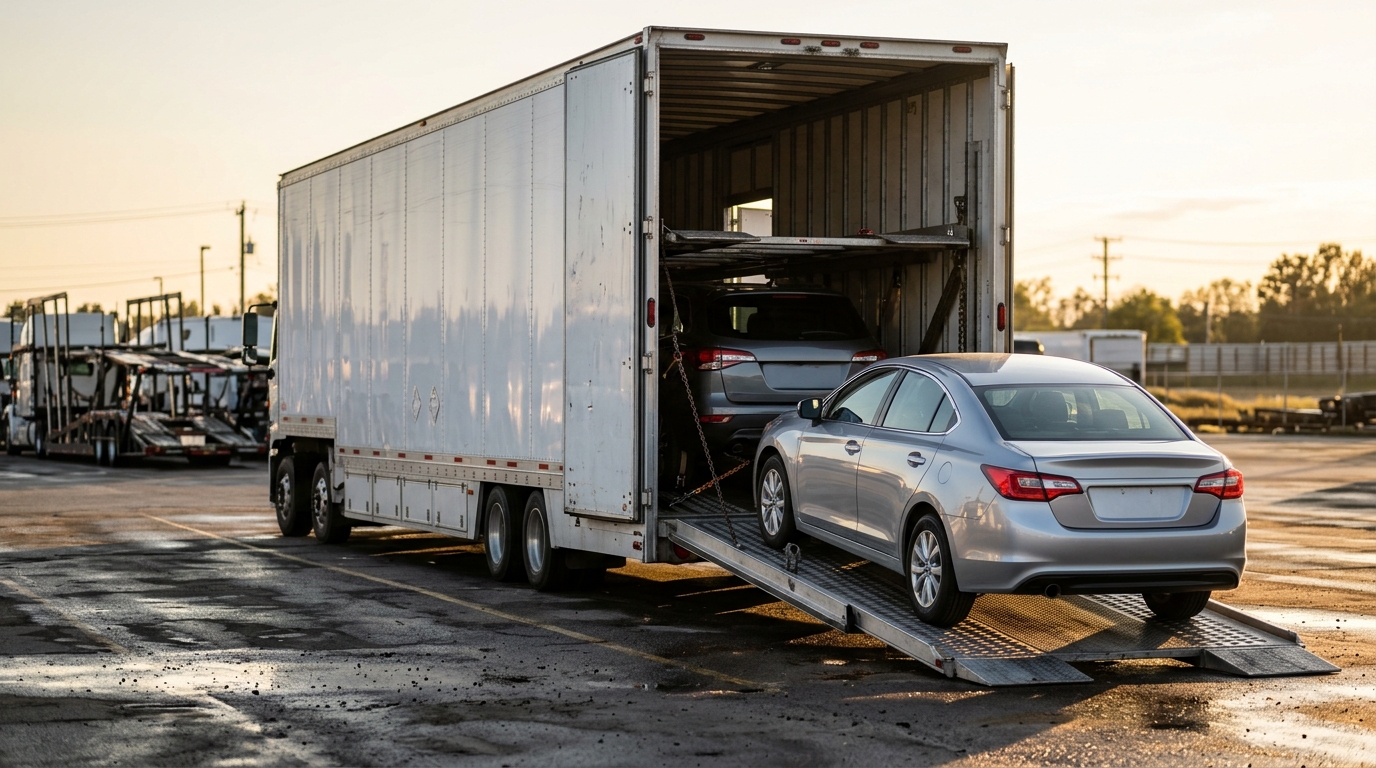
Enclosed transport costs more than open transport at every distance shown, so the premium is a trade-off you choose on purpose. Open carriers are the common, lower-cost option, and most cars ride on them without trouble.
Here’s the side-by-side view from the 2026 benchmarks:
- 500 miles: open $600 to $700, enclosed $850 to $1,000
- 1,000 miles: open $650 to $800, enclosed $1,000 to $1,200
- 2,000 miles: open $1,200 to $1,400, enclosed $1,700 to $2,000
Look at the edges. At 1,000 miles, the cheapest enclosed quote is still more than the most expensive open quote. At 2,000 miles, the enclosed floor of $1,700 sits well above the open ceiling of $1,400. The gap doesn’t shrink as the miles stack up. It just gets bigger in dollars.
So what does the extra money buy? An enclosed trailer is a closed box. Your car stays out of rain, road grit, highway spray, rock chips, and the stares of people at truck stops. An open carrier is a double-decker rack, and your car gets the same weather and road dirt as everything else on the truck. Enclosed trucks also usually haul fewer cars per load, and fewer cars spread the cost across fewer vehicles. That’s a big part of why the price climbs.
Enclosed is worth it when:
- You own a classic or collector car whose paint, chrome, or original parts you can’t afford to lose.
- You’re moving a luxury or exotic car with low ground clearance, a fresh respray, or a value that makes one stone chip hurt.
- Your car is a show car or a convertible you’d rather keep dry and clean.
- You’re shipping during a season with heavy rain, snow, or road salt along the route.
Enclosed is just fluff when:
- You’re shipping a commuter sedan that already has door dings and a cracked bumper. A closed trailer won’t fix old damage. It only guards against new damage.
- You want it to arrive faster. A closed trailer doesn’t shorten the wait for pickup or the time on the road.
- You’re paying for the word “premium” on a sales page instead of a real need for protection.
Here’s the blunt truth. For a daily driver on a dry route, open transport is a sensible buy, and the car will almost always arrive fine. Paying the enclosed premium for that car is money spent on peace of mind you don’t need. For a car where a single scratch would wreck its value, the extra few hundred dollars can be the cheapest insurance you ever buy. Know your car’s real risk before you commit, because the trailer doesn’t care about your feelings.
Does Distance Change the Price Per Mile?
Yes, distance changes the price per mile, but your total and your per-mile rate move in opposite directions. Every extra mile adds to your bill, yet each individual mile costs less the farther the car travels.
Short trips look brutal on paper. The Q2 2026 index found routes under 700 miles averaging $1.54 per mile, while coast-to-coast routes over 2,500 miles averaged $0.54 per mile. The gap is even wider across the broader market, where intra-city moves run about $5.14 per mile and long-haul moves come in around $0.85 per mile.
Why? Some costs don’t care how far the car travels. A driver has to get to the pickup address before the car can roll. Someone has to schedule the pickup window, handle the paperwork, and coordinate the drop-off. Those fixed costs show up on every job, whether the trip is a short hop or 2,500 miles. On a long haul, they’re spread across a big pile of miles. On a short hop, the same costs land on a small number of miles, so each one looks expensive.
You can check this yourself. Take any benchmark total, divide it by the miles, and compare the results.
- Step 1: Write down the low and high price for your route.
- Step 2: Divide each price by the number of miles.
- Step 3: Compare the two per-mile results.
Using the 2026 open-carrier figures, 500 miles at $600 to $700 works out to $1.20 to $1.40 per mile. 2,000 miles at $1,200 to $1,400 works out to $0.60 to $0.70 per mile. The math looks like this: 600 ÷ 500 = 1.20, 700 ÷ 500 = 1.40, 1,200 ÷ 2,000 = 0.60, and 1,400 ÷ 2,000 = 0.70.
Notice what happened. The 2,000-mile trip costs more in total, but roughly half as much per mile. That’s the whole pattern in one example.
Don’t use the per-mile number as a bargain detector, though. A $0.60 rate on a long run still produces a bigger check than a $1.40 rate on a short one. Compare totals for your actual route first, then use the per-mile math to see whether a quote makes sense for the distance. If a short move quotes at a high per-mile rate, ask the company what that fixed-cost share covers. A fair answer names the driver’s trip to your pickup and the handling at both ends, not vague talk about “premium service.”
Do SUVs and Trucks Cost More to Ship Than Sedans?
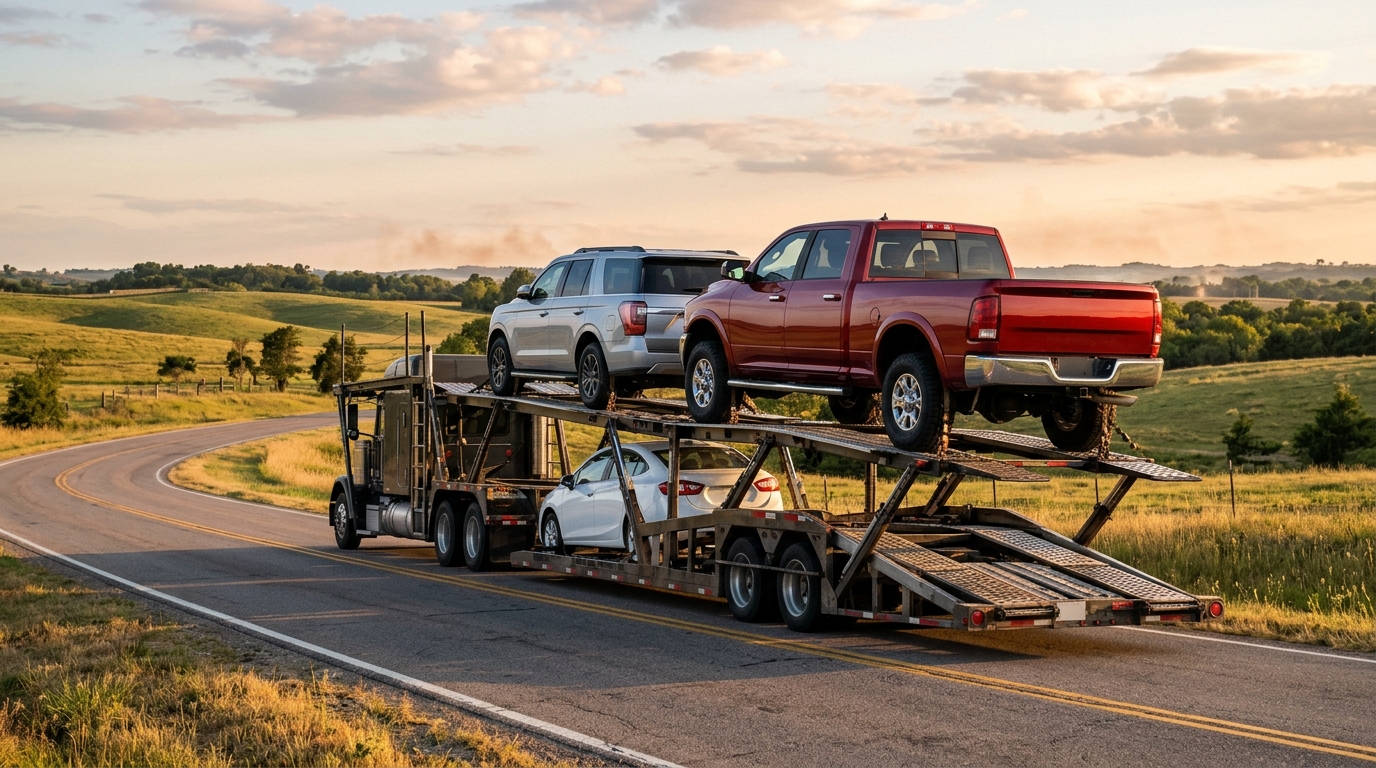
Yes, SUVs and trucks usually cost more to ship than sedans on an open carrier, and the gap grows as the route gets longer. The difference is smaller than many shoppers expect, though, so don’t assume a big vehicle means a big surprise.
Compare the 2026 benchmarks side by side. Under 500 miles, an SUV runs $600 to $1,100 and a truck runs $650 to $1,150, compared with $540 to $1,100 for a sedan. Past 1,500 miles, the SUV band is $1,200 to $3,200 or more, and the truck band climbs to $1,300 to $3,400 or more. The sedan band tops out around $3,000 on the same long routes. Notice how much the bands overlap. A large SUV can land in the same range as a small sedan, so vehicle type is only one piece of the price.
Why does size matter? An open carrier has limited deck space, and every car needs its own spot. A tall SUV or a full-size pickup takes more length and height than a compact sedan, so the driver can fit fewer of them on a load. Fewer vehicles per trip means the cost gets split across less. Weight matters too, because the driver has to balance the trailer and plan each load around what it carries.
Here’s the tip that saves you grief. Measure and weigh your vehicle honestly before you request quotes. Quotes built on a smaller, lighter car can get adjusted once the carrier sees the real vehicle. Gather these details first:
- Exact length, height, and width, including any roof rack or cargo box
- Curb weight, found in your owner’s manual or the manufacturer’s spec sheet
- Modifications like lift kits, oversized wheels, or a bed cover
- Whether the vehicle runs and rolls under its own power
Tell the company these facts up front, and ask them to confirm in writing which size and weight they used. A quote built on accurate numbers is far less likely to grow at pickup, when you have the least leverage.
Can Timing and Shipping Several Cars Lower Your Bill?
Timing and bundling can lower your bill, but only if you work with the market instead of betting on a magic date. Rates shift over the year. The Q2 2026 index from Auto Transport Insider reported an average shipment price of $1,108 with a 6.4-day transit, and rates were about 8% higher than in Q1 2026. If you waited for prices to fall, you may have been waiting the wrong way.
Demand also rises and falls with the calendar. When more people want to move at the same time, carriers have more pickups to choose from and fewer open spots, and that tightness shows up in quotes. You don’t need a crystal ball to use this. You just need to notice when your move lands in a busy stretch and ask whether a nearby week would work better.
Flexible pickup windows can help. If you tell a company “any day in the next two weeks” instead of “Tuesday only,” the dispatcher has more room to fit your car onto a truck that’s already rolling. That flexibility sometimes shows up in the price. It won’t reliably deliver a specific seasonal discount, though, so don’t reschedule a move around a rumor that next month is cheaper.
Now the bundling angle. Shipping several vehicles together is where the math gets interesting. Per-unit prices for shipments of at least three vehicles ran roughly 30% lower in 2025, while single-vehicle prices climbed during the same year. Spreading the cost across a load is the whole trick.
But bundling has a catch. Multi-vehicle discounts only work when the cars are on the same route. A carrier fills a truck along a corridor, so two cars going from Dallas to Atlanta can share a load. A car headed from Dallas to Seattle can’t ride with them without a long detour. Splitting a load across different destinations usually kills the discount and can cost you more than shipping separately.
So how do you use this without gambling? Try these steps:
- Pick your pickup and drop-off cities first, then check whether other vehicles are headed the same way.
- Keep your dates flexible by a few days or a week if your schedule allows.
- Ask each company whether it offers a lower per-vehicle rate for a group move on your exact route.
- Compare the per-car total, not the headline price, so you see whether bundling actually saves money.
Bundling helps most when your cars share an origin and destination. Flexibility helps most when you can give a carrier room to work. Neither one is a guarantee, but together they give you more control over the number on the quote.
Do Brokers and Carriers Change What You Pay?
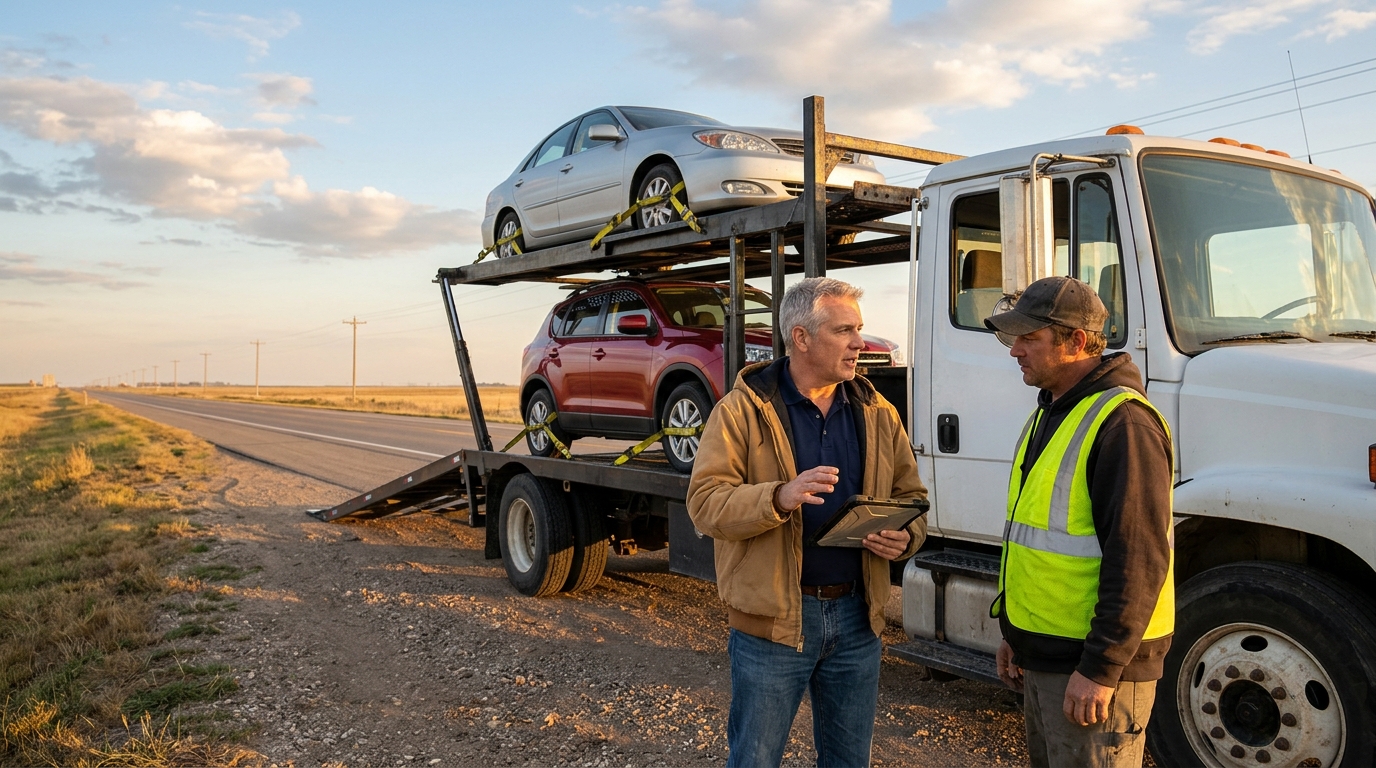
Yes, the company you call first can change your bill, because it may be a broker rather than the company that drives your car. Here’s the setup. The Federal Motor Carrier Safety Administration, or FMCSA, defines a broker as an intermediary that arranges transportation between a shipper and a motor carrier, but does not itself transport the property or operate the vehicles.
The carrier is the company that owns the truck, employs or contracts the driver, and actually loads your car. The broker finds that carrier, books the spot, and quotes you a price that includes its own margin on top of what the carrier gets paid. That margin is how brokers make money. It isn’t a scam on its own, but it means the broker’s number and the carrier’s number are rarely the same.
So ask the blunt question: who is actually moving my car? A straight answer is a good sign. A dodge is your first warning.
Next, check the paperwork. FMCSA’s automobile-transporter advisory says interstate brokers and carriers must register with the agency, and it tells consumers to verify that registration. Look for:
- The MC Docket number, which both brokers and carriers carry
- The USDOT number, which identifies the transporter that moves vehicles
- Whether the registration is active, not just printed on a slick website
Look up both numbers in FMCSA’s public records before you pay a deposit. A company that stalls on giving you those numbers has already answered your question.
Brokers also have to back their promises with money. FMCSA requires property brokers to hold a $75,000 surety bond on Form BMC-84, or a trust fund agreement on Form BMC-85. Ask which form the broker filed, and check it on the registration record. Also, new broker financial-responsibility rules took effect on January 16, 2026. An old-looking filing or a broker still quoting under outdated rules deserves a second look.
Why does all this matter? Because when a car gets scratched, delayed, or lost, the paperwork decides who answers for it. Before pickup, get the name of the carrier in writing, and confirm that its USDOT number matches what you found in the records. If the broker can’t name the carrier, you don’t know who has your car.
When you compare quotes, line up like with like. A broker quote and a direct carrier quote can describe the same car on the same route and still differ, because one carries a middleman’s margin. Ask each company who will physically move your car, then compare totals with that answer in hand. A slightly higher quote from the actual carrier can end up cheaper than a low broker price that gets passed through layers.
How Long Does Pickup and Delivery Really Take?
Pickup scheduling and time on the road are two separate clocks, and you need to budget for both. Move.org’s analysis of more than 50 car-shipping companies recommends setting aside about five days for pickup on top of transit. That puts a trip under 500 miles at roughly seven total days, and a 1,000 to 1,500 mile trip at about 11 days.
Why does pickup take so long? A carrier doesn’t drive to your door on a whim. The driver builds a load along a route, and your car has to fit into a truck that’s already rolling somewhere else. The driver might need several days to reach your city, even if the drive itself is short.
Pickup delays can stretch the timeline even when the drive is quick. Imagine a medium-length route where the truck itself needs only a short stretch on the road. If the truck is still two states away when your pickup window opens, your car sits in your driveway while the whole schedule slides. Always ask the company which pickup window it’s quoting, not just the delivery date.
Flexibility is your best tool here. If you tell a dispatcher “any day in the next two weeks,” it’s easier to slot your car onto a truck already heading your way. That flexibility can make it easier to find a carrier at a reasonable rate. Tight, single-day requests shrink your options, and fewer options usually means a higher price or a longer wait.
Work backward from your deadline. If you need the car in a new city by a specific date, start with the pickup allowance, add the transit days, and then add a cushion of a few days. Rigid deadlines cost you twice: once in the quote, and again if you have to pay for a hotel or a rental car while you wait for your vehicle. A little schedule flexibility is often the cheapest budget item you can control.
How to Get a Fair Quote Without Overpaying

Most bad quotes don’t look bad at first. They look cheap, fast, and friendly, right up until the final invoice shows up. The fix is to make every company answer the same questions so you can compare apples to apples.
Follow this process in order and you’ll catch padding before it costs you.
- Send every company the same details: exact pickup and drop-off cities, the vehicle’s year, make, and model, and whether you want open or enclosed transport.
- State whether the car runs and rolls under its own power, because a car that needs a winch changes the price.
- Give a pickup window, such as “any day in the next two weeks,” and ask each company to quote that exact window.
- Ask whether the quote is a carrier price or a broker price, and get the name of the company that will physically load your car.
- Collect at least three quotes and put them side by side, with the same route, the same car, and the same dates.
- Ask whether the total includes insurance, fuel, and any pickup or delivery fees.
- Check the registration numbers in FMCSA’s public records and confirm they’re active before you pay a deposit.
Watch closely for the “starting at” trap. That headline number usually assumes an easy pickup, flexible dates, and the cheapest route. It’s a floor, not a promise. Ask for the price on your car, your cities, and your calendar.
Vague line items are another red flag. Charges labeled “service fee” or “premium handling” with no explanation mean the company hasn’t earned your trust yet. A fair quote tells you what you’re paying for, from the driver’s trip to the handling at both ends.
Here’s the verdict. A fair price lands inside the benchmark band for your distance and vehicle type, and the company can explain every line without getting defensive. Far above the band? Make them justify it. Far below? Find out what got cut.
Compare at least three quotes before you commit, just as you would when pricing a home project like a rainwater harvesting system. Walk away if anyone pushes you to pay a deposit today, dodges your registration numbers, or won’t put the total in writing. “This price expires tonight” is a sales tactic, not a shipping rule. A legitimate quote will still be there tomorrow.
Your Next Move: Compare Quotes and Check the Carrier
Your next move is simple. Open a blank spreadsheet or grab a notebook, and write down your exact pickup city, drop-off city, and the year, make, and model of your car. Then find the benchmark band for your distance. For a standard sedan on an open carrier covering 500 to 1,500 miles, expect roughly $700 to $1,800. Anything far outside that band needs an explanation.
Next, send the same details to at least three companies. Ask each one the same two questions: “Is this a carrier price or a broker price?” and “What is the name of the company that will physically load my car?” Write the answers next to each total, along with the pickup window they quoted.
Then check the company before you pay a dime. Ask for the MC Docket number and the USDOT number, look both up in FMCSA’s public records, and confirm the registration is active. If the company is a broker, ask whether it filed a $75,000 surety bond on Form BMC-84 or a trust fund agreement on Form BMC-85, and check that filing too.
Hold your deposit until the carrier name, the USDOT number, and the written total all line up. If one of them won’t match, move on to the next quote. Your car is worth more than a fast “yes.”
Frequently Asked Questions
1. How much does it cost to ship a car from Virginia to Texas?
Virginia to Texas is a long interstate haul, so start with the benchmark bands for distance: roughly $700 to $1,800 for a standard sedan on an open carrier covering 500 to 1,500 miles, and $1,050 to $3,000 or more past 1,500 miles. Your exact cities, vehicle size, and pickup window will decide where your quote lands in that band. Get at least three quotes for the same cities and dates so you can see where your price really falls.
2. What documents do I need to ship a car?
Most carriers ask for a government-issued photo ID, the vehicle registration, and proof that you own the car or are authorized to ship it. You’ll also sign a bill of lading, the document that records the car’s condition at pickup and delivery. If you lease or finance the car, check with the company first, because the lender or leasing firm may need to approve the shipment.
3. Can I put personal items in the car during shipping?
Most carriers don’t allow personal items inside the car, and the carrier’s insurance usually covers only the vehicle itself. Anything you pack can add weight and can get lost or damaged without coverage. Ask the company for its policy in writing, and ship valuables separately.
4. Does car shipping insurance come with the quote?
Whether insurance is included depends on the company, so don’t assume it is just because a quote looks complete. Ask for the carrier’s certificate of insurance, which shows the coverage limit and deductible. Confirm the policy belongs to the company that will actually load your car, and get the coverage details in writing before you hand over the keys.