Home gym flooring comes down to five choices: rubber rolls, interlocking rubber tiles, rubber stall mats, thicker lifting tiles, and foam or tatami mats. Each one handles cushioning, stability, and noise differently, so match the floor to what you actually lift.
Prices run from about $1.25 per square foot for thin rubber rolls up to around $3.52 for thicker ones. Shipping and local availability can change the total, so check the final number before you buy.
Key Takeaways
- Heavy lifters should skip foam, choosing thicker lifting tiles or stall mats over a firm base.
- Dropping weights calls for 3/4-inch rubber or thicker, since a 1/4-inch mat only suits light cardio and bodyweight work.
- Thick rubber cannot fully stop noise downstairs, so lower your weights or skip heavy drops on upper floors.
- Concrete slabs need a moisture test before any mat goes down, since trapped dampness breeds hidden mold.
The Main Home Gym Flooring Types Compared
Start with the workout, not the floor. Yoga, stretching, and floor work need cushioning, and foam or tatami mats nail that job. They’re light and soft, but they’re not suitable for heavy machines or dropped weights. A rack set on foam will wobble, and that’s a safety problem, not a comfort problem.
For machines and heavy lifting, pick from the rubber options:
Rubber rolls: One continuous sheet with a clean, seamless look. It’s a solid base for heavy equipment, but it’s harder to lift, move, and cut.
Interlocking rubber tiles: Snap-together squares that fit odd-shaped rooms and can be rearranged whenever you move your gear.
Rubber stall mats: Thick, wide mats, the same kind you’ll see in barns and garages. They cover big lifting areas fast.
Thicker lifting tiles: Dense rubber built to take dropped weights and rack loads. Heavy lifters, start here.
Are Interlocking Tiles Better Than Rubber Rolls?
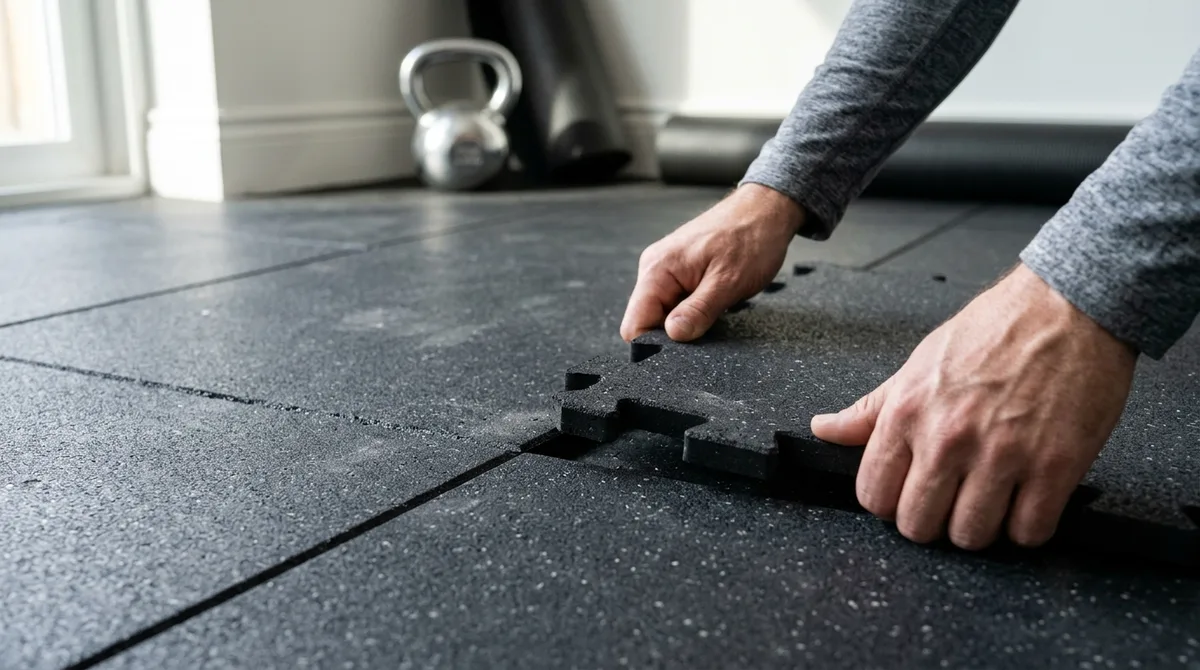
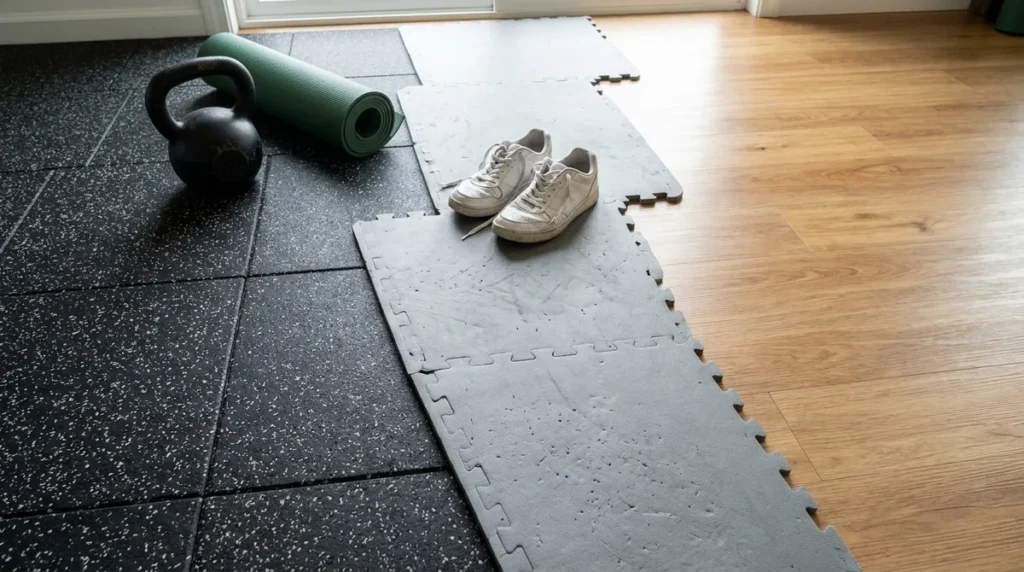
Not always. Tiles win on install and repairs, while rolls win on a clean, seamless look. Interlocking tiles go down without glue, and a torn or stained square can be lifted out on its own. Rolls mean a bigger job: you may need to cut out and patch a large section. The catch with tiles is the seams. Every joint can collect sweat and dust, and under heavy machines the edge tiles can shift unless the joints are tight. Rolls need a sharp knife and careful trimming. Room size and wall straightness decide how hard either one is to fit.
How Much Does Home Gym Flooring Cost?
Expect to pay about $1.25 to $3.52 per square foot, depending on material and thickness. Thin 1/4-inch rubber rolls sit at the cheap end, impact-foam tiles run around $2.54, and 7/8-inch tatami foam mats come in near $2.65. Thicker 3/4-inch rubber rolls reach roughly $3.52. Lifting tiles are priced per pair, with a 24-by-24-by-1.5-inch rubber tile usually listing around $85 a pair and sometimes dropping to about $65 on sale.
Those are retailer figures, not universal material costs, so treat them as a starting point. To get your real number, multiply the price per square foot by your room’s area, then add:
- Delivery or freight fees
- Trim pieces for edges and corners
- Adhesive, if your floor needs it
A 10-by-12-foot room is 120 square feet, so 3/4-inch rubber rolls come to about $422 before shipping. Heavy rolls are the sneaky cost, because freight charges can climb fast and local stock can change the total.
Thickness Needed for Heavy Equipment and Lifting
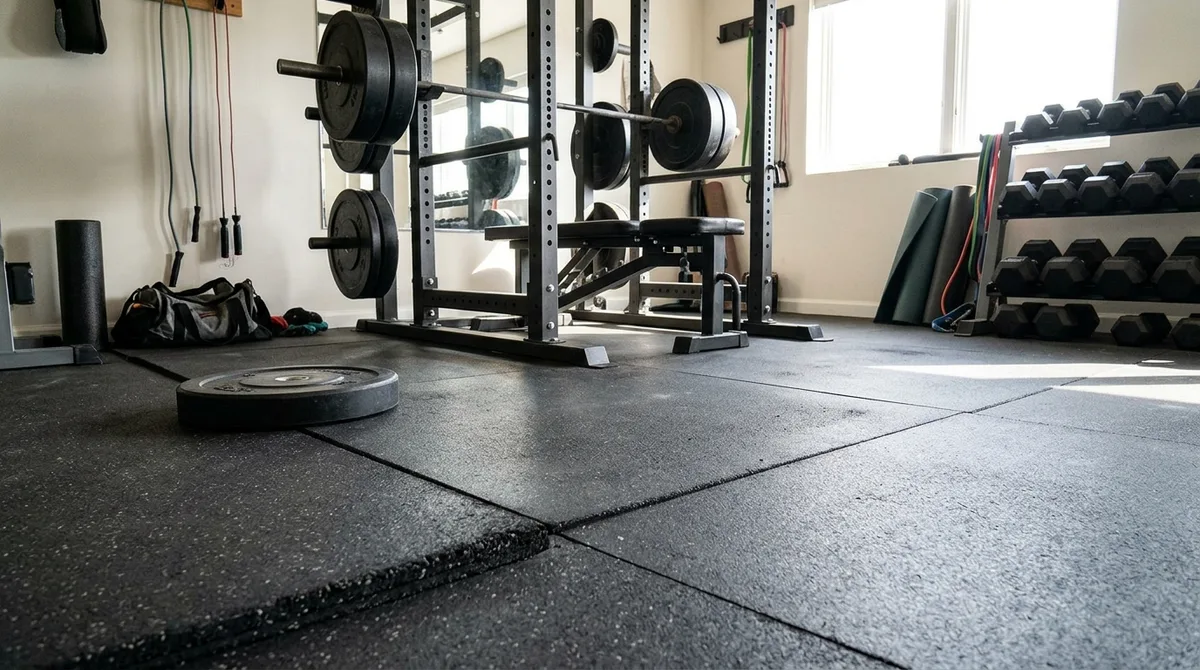
Thickness is where people either overspend or underprotect. A 1/4-inch mat works for light cardio and bodyweight training, like push-ups, squats, and jump rope. Once you start dropping weights, you need more give. Go with 3/4-inch rubber or thicker, which soaks up impact and takes stress off your knees and lower back.
Heavy racks and cardio machines need the opposite: a firm, stable base. Soft foam compresses under a loaded rack, and the whole setup can wobble mid-set.
For a rough load check, the 2021 International Residential Code sets minimum live loads of 40 pounds per square foot for most rooms and 30 for sleeping areas, in places that adopt that edition. Treat that figure as a general guide, not approval for your gym. For shock absorption, ASTM F2772-24 covers athletic performance of indoor sports floors and makes useful background when you compare mats.
Will Home Gym Flooring Stop Noise Downstairs?
Not completely. Thick rubber soaks up much of the thud from a dropped weight, but sound still travels through the joists and ceiling below. The mat is one layer of the system, not the whole fix.
Lab testers measure impact sound with a standardized tapping machine under ASTM E492-25, which covers floor-ceiling assemblies in a controlled room. Real houses are tested in the field under ASTM E1007 instead, because the building itself changes the result.
Here’s the warning sign. At the 2025 ACOUSTICS conference, researchers saw a lightweight floating floor jump during a 100-kilogram barbell drop, with springs popping out of their rubber mounting cups. Spring-isolated and floating systems can behave differently under heavy drops, so don’t assume a thicker mat solves everything. If noise matters, lower the weights, use a lifting platform, and skip heavy drops on upper floors.
Can You Put Gym Flooring Over Concrete or Carpet?
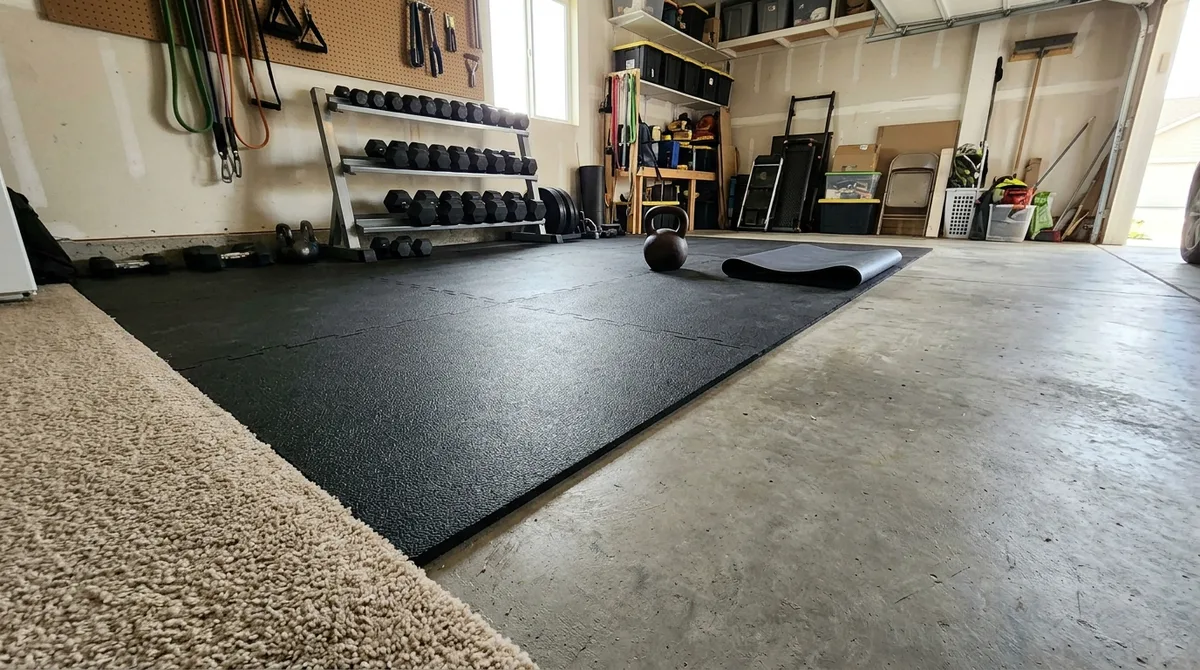
Yes, but only over a dry, sound floor. Concrete and basement slabs can hold moisture even when they look clean, so check before anything goes down. ASTM F710-26 says concrete should be tested for moisture regardless of age or grade, and tested for pH before resilient flooring is installed.
Trapped moisture is the real danger. Under a mat, damp air has nowhere to go, and mold and mildew can grow out of sight. In a damp basement, use a vapor barrier or leave gaps for airflow.
Carpet is a poor base for heavy equipment. Compressed carpet gives uneven support, so a loaded rack can sit lopsided. Pull it up or flatten it before you set anything down.
Rubber mats are generally a good fit on sealed concrete when the surface is dry.
Slip, Stains, and Cleaning: Daily Floor Care
Once sweat starts dripping, grip matters. Textured surfaces give better traction for barefoot or sweaty workouts than smooth rubber.
Watch out for vinyl. Armstrong Flooring warns that some rubber can chemically react with flexible vinyl and cause yellow staining. Buy non-staining rubber for vinyl, and test a small patch for a few days before you cover the whole room.
Keep it simple:
- Vacuum or sweep weekly to clear grit.
- Wipe sweat with mild soap and water.
- Skip harsh solvents, which break down rubber over time.
Colors range from plain black and gray to speckled, branded, or custom designs. Color rarely changes performance, so pick the look you like.
Picking Your Floor Before You Buy
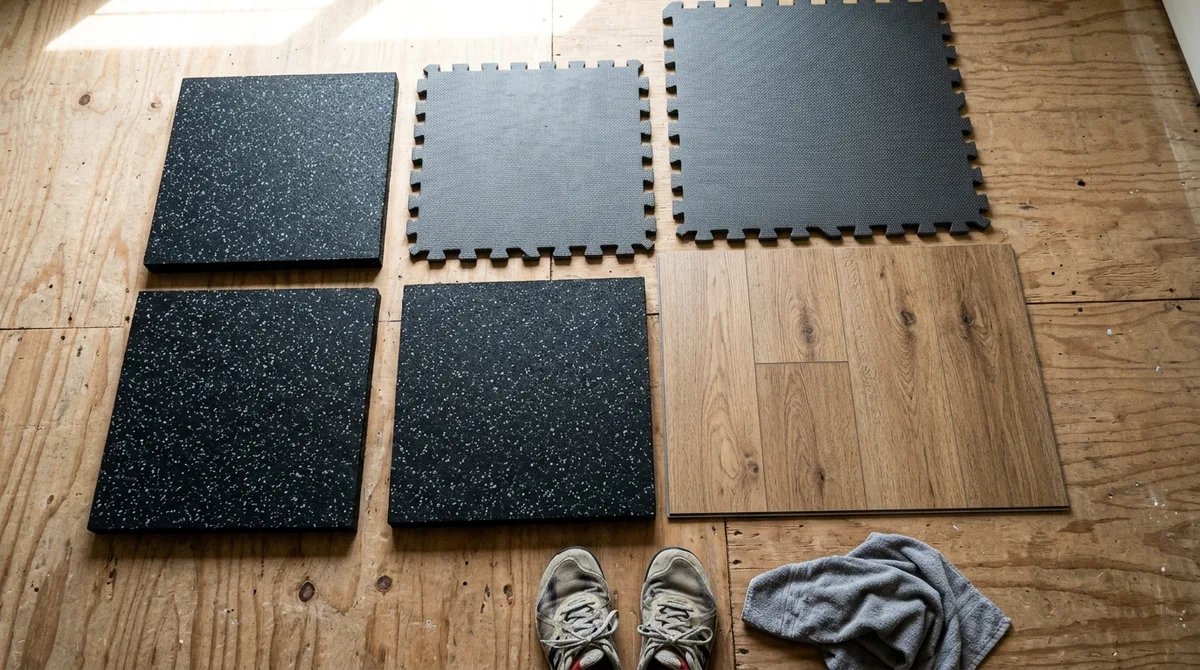
Pick your floor by workout. For yoga and light training, foam or tatami mats win. For general strength and cardio, go with interlocking rubber tiles or rolls, and choose 3/4 inch if you drop weights. For heavy lifting and racks, use thicker lifting tiles or stall mats over a firm base.
Before you buy, measure the room, check the concrete for moisture, and add shipping to the price.
Verdict: If you lift heavy, buy thicker lifting tiles and skip the foam. If you mostly do yoga, cardio, and light training, foam or tatami is the smarter, cheaper pick.
Your Last-Minute Buying Checklist
Start with a tape measure. Measure the length and width of the room, then multiply them for square feet. Next, check what’s underneath. Concrete, especially a basement slab, needs a moisture check before anything goes down. Got vinyl? Buy non-staining rubber and test a small patch for a few days first.
Then run the real numbers. Multiply your square footage by the price per square foot, and add the freight quote before you compare totals. A rubber roll that looks cheap per foot can cost more than foam tiles once shipping lands on your doorstep.
Pick your category, get the final price, and only then hit checkout.
Frequently Asked Questions
1. How many interlocking tiles do I need for a two-car garage gym?
Measure only the bay area you plan to train in, not the whole garage, since storage and parking space don’t need cover. Each 24-by-24-inch tile covers 4 square feet, so divide your total square footage by 4. Order a few extra tiles for edge pieces and the odd cut, because a short count is harder to fix than a spare tile on the shelf.
2. Can I put a rubber gym floor over hardwood without damaging it?
Rubber can go over hardwood, but a mat that sits flat for months can trap moisture and leave marks or discoloration on the wood finish. Lift a corner now and then to check the boards and keep the area dry, since sweat can seep into seams. If your hardwood has an older or delicate finish, ask the flooring maker whether its rubber is safe for that surface before you install it.
3. How long do rubber gym floors last before they need replacing?
No single lifespan fits every rubber gym floor, because wear depends on how often you train, how heavy your drops are, and how clean the surface stays. Grit trapped in the surface works like sandpaper, so a cleaner floor usually lasts longer. Replace sections that crack, crumble, or stay permanently flattened under your lifting zone, because those spots no longer cushion or hold a rack steady.
4. What is EPDM gym flooring?
EPDM is a synthetic rubber, short for ethylene propylene diene monomer, that holds up well to weather and aging. Some gym mats are made from it, so you may see it in product listings alongside standard rubber. The rubber type alone doesn’t tell you how well a mat handles dropped weights, so check the thickness and density before you buy.