
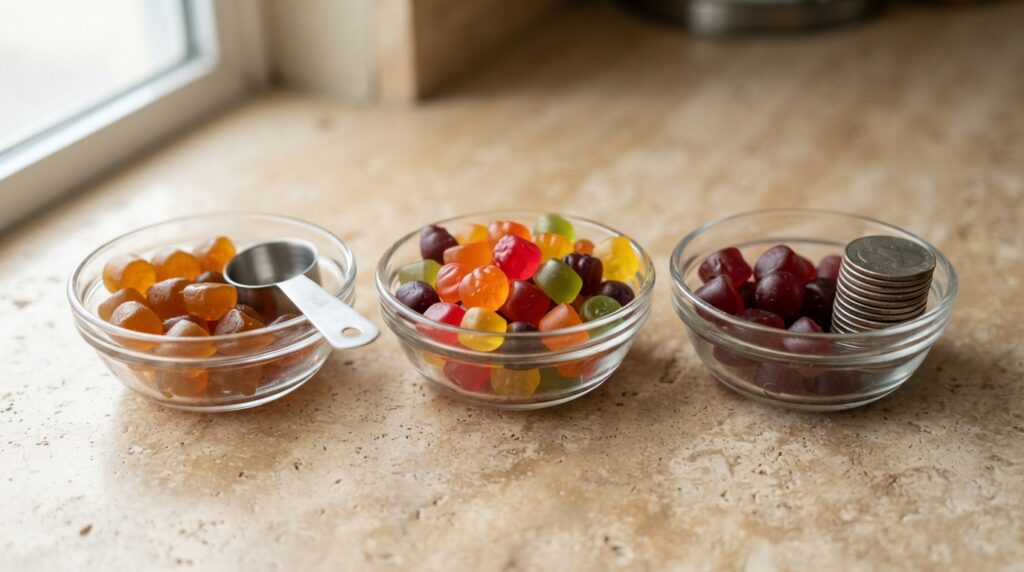
A creatine gummies comparison shows that gummies can provide a familiar 5 g dose in a convenient format, but they are not automatically more effective than powder. The trade-off is often cost: September 2026 figures put one gummy option at about $1.14 per serving, compared with about $0.33 for a 5 g serving of powder. Optimum Nutrition’s product listing lists 5 g of creatine monohydrate in three gummies, so check how many pieces make up a full serving before comparing prices. A lower bottle price can hide a higher cost per dose, and extra sugars or ingredients may affect which option suits your routine.
The evidence-backed benchmark is straightforward: the International Society of Sports Nutrition describes 3–5 g of creatine monohydrate per day as a typical maintenance amount after muscle stores are saturated. A gummy with a clearly labeled dose may be a practical way to take creatine, but the format alone does not prove better results. Serving size, ingredient details, flavor options, and cost vary across products. This comparison uses disclosed product and price information, not personal taste tests, so you can weigh the label facts against what you’ll actually take consistently.
Key Takeaways
- Creatine monohydrate is the best-supported form, and the ISSN position stand lists 3–5 g per day as a typical maintenance amount after muscle stores are saturated, so check the dose in the full serving.
- Force Factor lists 5 g per serving in five gummies, while Create Wellness lists 4.5 g in three gummies; check the full serving size before comparing doses. Force Factor’s product details show its serving information.
- The September 2026 examples put gummies at about $1.10–$1.42 per serving versus about $0.33 for a 5 g serving of Evlution Nutrition powder, so weigh convenience against the extra cost.
- Creatine gummies are a convenient way to take creatine, but the format does not prove better results; compare sugar, added ingredients, serving size, and cost, and treat the 10-week study of 32 female beach-volleyball athletes as limited evidence rather than a promise for every product. The PubMed study record describes the trial.
Which Creatine Gummies Stand Out?
Creatine gummies stand out when they make a useful daily dose easy to take, but they are not automatically more effective than powder. The best fit depends on the dose, a manageable serving size, and whether the added cost and ingredients make sense for you. This comparison covers disclosed product facts, not personal testing.
The dose benchmark comes from the International Society of Sports Nutrition: after muscle stores are saturated, 3–5 g of creatine monohydrate per day is a typical maintenance amount. The same ISSN position stand calls creatine monohydrate the most extensively studied and clinically effective form for muscle uptake and high-intensity exercise capacity. That makes the amount of monohydrate on the label more useful to compare than bold claims about flavor or format.
Force Factor lists 5 g of creatine monohydrate in a five-gummy serving. The number of pieces matters: compare the full serving, not just the creatine amount. Force Factor’s product details also show that its serving includes other ingredients.
The price gap is real. September 2026 figures put the cited gummy examples at about $1.10–$1.42 per serving, while a cited 5 g Evlution Nutrition Creatine5000 powder serving costs about $0.33. A gummy’s convenience may be worth paying more for if the format helps you stick with a routine, but a higher price does not prove better results. A high dose claim does not prove that a product works better than another one, either.
The useful distinction is fit, not a universal winner. Force Factor discloses a full 5 g serving, while Create Wellness comes close at 4.5 g. The number of gummies and the price per serving also differ. Check whether you’re comfortable taking the full labeled serving, and consider whether the product’s other ingredients suit your preferences. Force Factor’s product details disclose its serving information. Flavor names can hint at the experience a brand is aiming for, but they do not prove how a product tastes or performs.
For a clear comparison, treat the label as the signal and the marketing as noise. A listed dose tells you what the serving provides. It does not prove that gummies outperform powder, that a flavor will appeal to you, or that one brand delivers better results. The strongest options are those whose disclosed dose, piece count, ingredients, and cost line up with what you’ll actually use.
How Do The Gummies Compare On Dose And Cost?

The products differ in creatine dose, gummies per serving, servings per container, and cost. The cited powder serving costs less than the gummy servings. Here are the disclosed figures side by side:
| Product | Creatine per serving | Gummies per serving | Servings per container | Listed price | Cost per serving |
|---|---|---|---|---|---|
| Optimum Nutrition Creatine Monohydrate Gummies | 5 g | 3 | 35 | $39.99 | $1.14 |
| Force Factor Creatine Monohydrate Gummies | 5 g | 5 | 30 | $32.99 | About $1.10 |
| Create Wellness Orange | 4.5 g | 3 | 15 | $21.24 | About $1.42 |
| Lemme Creatine Gummies Sour Apple | 5 g | 4 | 15 | Not provided | Not provided |
| Evlution Nutrition Creatine5000 powder | 5 g | Not applicable | 60 | $19.99 | About $0.33 |
The serving count affects how practical a dose is. Optimum Nutrition delivers 5 g in three gummies, while Force Factor requires five gummies for the same amount. Create Wellness provides 4.5 g in three. If taking several pieces feels like a hassle, the dose alone won’t tell you whether a product fits your routine.
Optimum Nutrition’s product listing gives the 5 g dose, three-gummy serving, 35 servings, and $39.99 price. That works out to $1.14 per serving. Optimum Nutrition’s listing provides the product details.
A September 2026 market figure puts the Force Factor gummy serving at about $1.10. The product label lists 5 g of creatine monohydrate per five-gummy serving, 30 servings, 25 mg of AstraGin, 12 g of carbohydrate, and 6 g of total sugars per serving. Force Factor’s product page discloses these serving details.
A September 2026 market figure puts Create Wellness Orange at about $1.42 per serving. Three gummies provide 4.5 g of creatine monohydrate. The available figures do not provide a full label comparison with every product in the table. For example, they do not include complete ingredient details for Optimum Nutrition or Create Wellness.
Lemme’s Sour Apple label lists 5 g of creatine monohydrate in four gummies, with 15 servings per container. Its price is not provided in the available figures, so there is no supported cost-per-serving comparison for Lemme. Lemme’s product page shows the disclosed serving information.
The September 2026 market figure for Evlution Nutrition Creatine5000 powder is $19.99 for 60 servings, with 5 g per serving, or about $0.33 per serving. That makes it the lowest-cost option among these cited examples, not proof that powder is cheapest across every brand or retailer. Prices can change. These examples do not represent every product or seller.
Keep the verdict tied to the figures, not the hype: the cited powder costs less per serving, and Force Factor has the lowest listed cost per serving among the gummy examples with prices. Cost per serving does not account for differences in serving size, ingredient lists, or how many pieces you prefer to take. The available figures also do not support a normalized cost-per-gram comparison for Lemme, so its price ranking remains unknown.
Do Creatine Gummies Work?
A 2026 randomized trial assigned 32 collegiate and professional female beach-volleyball athletes to 5 g per day of creatine monohydrate gummies or a control group for 10 weeks. The study reported improvements in jump height and change-of-direction performance in the creatine group, with no significant interaction for lean body mass or reaction time. The PubMed study record describes the trial and its results. Those findings are a useful signal, not a universal verdict: the trial involved a small, specific group and does not show that all gummy products produce the same outcomes or establish equivalence to powder or another gummy brand. For a product-level comparison, start with the amount of creatine monohydrate per full serving. A stated dose gives you a concrete amount to assess, but it does not guarantee a specific result. Research on creatine monohydrate is not the same as research on every gummy formula. Product-specific claims still need product-specific evidence.
What Should You Check On The Label?

Check the creatine form and dose, gummies per serving, servings per container, sugars, carbohydrates, added ingredients, and any certification you can verify. These details show what you’re actually getting, while bold claims and flavor names can leave out the useful stuff. Use this label check to separate the signal from the sales pitch:
- Confirm the creatine form and amount. Look for “creatine monohydrate” by name and a specific amount per serving. The International Society of Sports Nutrition describes monohydrate as the most extensively studied and clinically effective creatine form. The ISSN position stand supports comparing the stated monohydrate dose, not a vague claim about a “creatine blend.”
- Count the gummies in one serving. The amount per serving tells the full story only when you know how many pieces you need to eat to get it. For example, Force Factor lists 5 g of creatine monohydrate in five gummies, while Lemme lists 5 g in four. A larger serving may work for you, but it is not the same as getting the dose in fewer pieces.
- Check servings per container. The U.S. Supplement Facts panel generally states serving size, servings per container, and the amount of each dietary ingredient per serving. Compare the container count with the gummy count per serving to see how many full servings the bottle provides. The FDA’s supplement questions and answers explain what this panel generally includes.
- Read the sugar and carbohydrate lines. Gummies can contain carbohydrates and sugars along with creatine. NSF’s Certified for Sport registry lists Create Wellness Creatine Gummies Orange with a three-gummy serving, 8 g of carbohydrate, 5 g of sugar, and 60 calories. The NSF registry entry gives those details for that specific product.
- Separate added ingredients from the creatine dose. AstraGin and other extras are separate ingredients, not additional creatine. Force Factor lists 25 mg of AstraGin per serving, while Lemme lists 50 mg. Assess those ingredients on their own. Their presence does not prove that the gummy is more effective.
- Verify what a certification actually covers. Search the certifier’s registry for the exact product name and check that the listing matches the product you’re considering. A listing can help confirm a specific product’s registry status, but it does not prove better taste, lower cost, or superior results.
- Keep FDA oversight in perspective. The FDA does not approve dietary supplements before they are marketed. Manufacturers, packers, and holders must follow current good manufacturing practices, but that requirement is not the same as FDA approval of a finished product or a guarantee of its results. The FDA’s explanation of supplement oversight lays out that distinction.
Gummies Versus Powder For Home Training
At home, the convenience gap is less about travel and more about routine. Gummies are ready to eat, with no scoop, shaker, or mixing step to fit around a workout. Powder takes a little preparation, but the process may already fit your kitchen routine if you use a scoop and mix a serving with a drink.
The gummy serving size still matters. Optimum Nutrition’s product listing gives its 5 g dose in three gummies. A bottle can look simple on the counter, but taking several pieces may feel less convenient than the word “gummy” suggests.
Powder’s solid form is not a drawback for storage or routine use. The International Society of Sports Nutrition says creatine is stable in solid form and describes its degradation to creatinine in solution. That chemistry does not mean ordinary powder use is unsafe, and it does not prove gummies are better. It’s a reason to keep the comparison practical: powder is stored dry and mixed when you take it, while gummies are already portioned. The ISSN position stand explains creatine stability.
The cost difference is hard to miss. In the cited September 2026 examples, gummy servings cost about $1.10–$1.42. A 5 g serving of Evlution Nutrition Creatine5000 powder cost about $0.33. Those figures come from specific listings, not a guarantee of current prices or a complete market average. In these examples, a gummy serving costs noticeably more for a labeled dose, even before you decide whether the convenience is worth it.
For a home-training routine, ask whether the format makes a daily serving easier to take consistently. A tub and scoop may be no hassle if your powder is already near your shaker. Measuring and mixing may become an extra task if they keep interrupting your routine. Gummies skip that step, but a serving can mean several pieces, and the cited prices put a premium on that ready-to-eat format.
Neither format wins simply because you train at home. If you reliably take powder, the lower price in the cited comparison is a clear practical advantage. If a pre-portioned gummy serving makes daily use simpler, you may decide to pay more for that convenience. The decision is about your routine and budget, not a claim that one format builds more muscle.
How Do Taste, Sugar, And Extras Compare?

The labels disclose flavor names, sugar and carbohydrate amounts, and added ingredients, but they cannot tell you which gummy tastes or feels best. That difference matters: a flavor list is a product description, not a taste test, and your preferences may not match the name on the bottle. Force Factor advertises grape, watermelon, orange, and lemon-lime flavors. Its five-gummy serving lists 12 g of carbohydrate and 6 g of total sugars, along with 25 mg of AstraGin. These are distinct label details: carbohydrate is not the same measure as total sugars, and the Force Factor product page does not tell you how sweet or chewy the gummies are. Compare the exact wording each label provides rather than treating differently worded sugar terms as identical measurements. Flavor names do not prove flavor strength, sweetness, texture, or aftertaste. Read the extras with the same skepticism: their presence does not show that a gummy delivers a stronger creatine effect. More ingredients do not automatically mean a better formula, just as more flavor options do not prove a better-tasting gummy. Keep the creatine dose, sugar wording, and extras in separate columns when you compare labels. Don’t let a flashy flavor list do the heavy lifting.
What Does The Research And Testing Prove?
Creatine research supports creatine monohydrate, but it does not prove that every gummy brand performs the same or offers better value. The useful signal is narrower: a clearly labeled serving tells you how much creatine you get, while a study of one gummy formula cannot settle claims about all formulas.
The International Society of Sports Nutrition describes 3–5 g of creatine monohydrate daily as a typical maintenance amount after muscle stores are saturated. Its position stand also describes an optional faster loading approach of about 0.3 g per kilogram of body weight each day for 5–7 days, followed by 3–5 g daily. Loading is an option in the position stand, not a requirement for every buyer. The ISSN position stand identifies monohydrate as the best-established form.
A 2026 randomized trial studied 32 collegiate and professional female beach-volleyball athletes over 10 weeks. The group taking 5 g per day of creatine monohydrate gummies showed improvements in jump height and change-of-direction performance, but the study did not establish equivalence across gummy brands or results in every population. It also found no significant interaction for lean body mass or reaction time. The PubMed study record describes the trial and its limits: a small, specific group does not provide a universal verdict.
Labels give you product-specific facts, not proof of results. U.S. supplement rules require label information such as serving size, servings per container, and generally the amount of each dietary ingredient per serving. Manufacturers, packers, and holders must also follow current good manufacturing practices. Those requirements do not amount to FDA premarket approval of supplements, as the FDA guidance explains.
A listing in NSF’s Certified for Sport registry is another checkable fact: it shows that a specific product appears in that registry. For example, the NSF registry entry for Create Wellness Creatine Gummies Orange lists its serving and nutrition details. Registry status does not prove that a product delivers better performance, tastes better, or offers better value.
Before choosing, compare the full serving and its cost, not just the bottle or a bold dose claim:
- Creatine monohydrate dose per full serving
- Number of gummies needed for that serving
- Sugar and other ingredients
- Servings per container
- Current price and cost per serving
- Whether the convenience is worth the premium to you
The verdict is straightforward: compare the full serving dose and price first, then choose the format that fits your routine and ingredient preferences.
Choose The Format You Will Take Consistently
Before choosing, write down the full serving you’ll take and the price per serving you’re willing to accept. Check the exact product’s Supplement Facts panel, count the gummies in a full serving, and divide the current bottle price by the number of servings. That gives you a personal cutoff instead of letting a bright flavor name or sale banner make the decision for you.
If scooping powder already fits your home-training routine, stick with powder and place it where you prepare your usual drink. If mixing is the step you tend to skip, consider gummies only if the full serving size feels manageable every day. Force Factor, for example, lists five gummies per serving, so check its product label details before deciding whether that format actually feels convenient.
Now pick one format and connect it to a daily cue you already follow, such as preparing your workout drink or finishing breakfast. Keep the container beside that routine, then check whether you’re taking the complete labeled serving and staying within your price limit. If the format creates friction or the cost feels wrong, switch formats instead of relying on motivation to overcome a setup you dislike.
Frequently Asked Questions
1. Can you take creatine nitrate and creatine monohydrate together?
The evidence here does not establish whether combining creatine nitrate and creatine monohydrate is safe or more effective. Creatine monohydrate is the best-established form, so ask a healthcare professional before combining forms or adding a nitrate product.
2. Can you take creatine while taking spironolactone?
The evidence here does not establish whether creatine is appropriate to take with spironolactone. Check with the clinician who prescribed spironolactone or a pharmacist before starting creatine, and share the product label with them.
3. Can creatine gummies cause stomach discomfort?
The product labels and study cited here do not establish whether creatine gummies cause stomach discomfort or how often it may happen. If you develop symptoms after taking them, stop and ask a healthcare professional whether to continue or try a different product.