
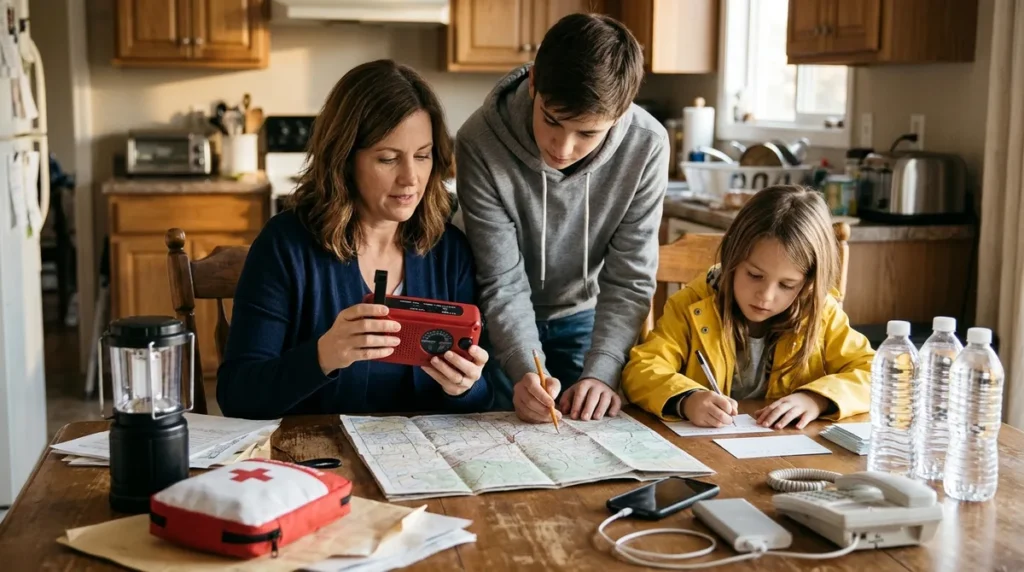
A family emergency communication plan is a short, written set of steps that tells everyone in your household how to reach each other, where to go, and who to call when local phone lines jam. It sounds simple, and it is. Federal guidance boils it down to a few hard facts: one out-of-area contact, set meeting spots, and contact details reviewed at least once a year. The problem is that most families never write it down. The plan lives in one person’s head until the power dies and that person is stuck at work across town.
Start with the federal basics. Ready.gov tells households to pick an out-of-state contact, someone far enough away that the local network crunch won’t touch them, and to decide on meeting spots before anything happens. Then review those contact details at least once a year, because numbers change and old plans fail quietly. Here’s the part people miss: when the network is overloaded, your call may not go through on the first try. The FCC advises waiting 10 seconds before redialing, and says texts and other data messages may be more likely than voice calls to get through during congestion. “More likely” is not “guaranteed,” so your plan needs a backup.
Key Takeaways
- Keep your family emergency communication plan to one page and store copies in at least two places, like the fridge and a backpack or glovebox, because a plan trapped in a dead phone helps nobody.
- Choose an out-of-area contact who is reliable, reachable, and outside the same disaster zone as your home, then ask them directly and send a test text to confirm they got it.
- When a call fails on a jammed network, wait 10 seconds before redialing, and send short check-in texts instead, since texts are more likely than voice calls to get through but are not guaranteed.
- Check whether your local 911 center accepts texts before you need it, because text-to-911 is only a backup and call 911 should always come first.
- Review your family emergency plan at least once a year, because phone numbers change and an outdated plan can fail without anyone noticing.
What Goes Into a Family Emergency Communication Plan?
A family emergency communication plan is a written set of who to contact, where to meet, and how to send check-ins when normal routines break down. It should fit on one page, and every person in the house should be able to find it.
Most plans need four core parts:
- One out-of-area contact who lives far enough away that local congestion won’t touch them.
- Meeting places for inside the home, the neighborhood, somewhere outside the neighborhood, and a spot out of town.
- A contact list with an ICE (in case of emergency) entry for every family member.
- A check-in rule, such as “send a short text saying where you are and that you’re safe.”
The fillable family card Ready.gov published in June 2025 uses this same structure, with blanks for an ICE contact, an out-of-town contact, and the four meeting spots. It’s a good starting point, but a card in a drawer doesn’t help anyone.
Keep copies in at least two places. Print the plan and tape it to the fridge, then slip a copy into each kid’s backpack and the glovebox. Save it on every phone too, but never let the phone be the only copy. Phones die, get lost, or crack, and a plan trapped inside a dead battery is just a locked screen.
A plan in one person’s head fails the moment that person is stuck in a meeting, asleep, or out of range. A sheet on the fridge works for the babysitter, the grandparent, or the teenager who grabs the car keys on the way out.
Ready.gov gives you the baseline. The rest is making it work in your house. Figure out which number your teenager actually answers, which meeting spot is closest to school, and whether Grandma knows she’s the out-of-town contact before she has to be.
Who Should Be Your Out-of-Town Contact?

Pick one adult who lives outside your local area, answers their phone, and is unlikely to be hit by the same storm, flood, or outage as you. Ready.gov tells households to choose an out-of-state contact before anything happens, and there’s a good reason. When a regional event jams local lines, a person in another area can often relay messages when calls at home fail.
Look for three things. The person has to be reliable, meaning they will pick up at 2 a.m. and remember what they promised. They have to be reachable, with a phone that works, a habit of checking texts, and no trouble with the signal where they live. And they should not be in the same disaster zone. A sister across the river is a bad pick if the river floods. A cousin two states away on a different power grid is a much better one.
Once you’ve picked someone, ask them directly. Don’t assume. Say what the job is, and make sure they say yes. A “sure, I guess” from someone who isn’t ready to answer the phone is not a plan.
Then get the number into everyone’s hands. Write it on the paper plan, put it on the family card, and save it in every phone under a clear name like “FAMILY OUT-OF-TOWN.” Give the number to the kids too, since a teenager who only has it in a dead phone is in the same spot as everyone else.
The role itself is simple. Your family checks in with this person using a short message, like “I’m at school and I’m safe.” This person then passes updates along, telling the others who’s safe and where everyone is meeting. They don’t have to solve anything. They’re the relay, not the rescue team.
Test it once before you need it. Send a text to your out-of-town contact, ask them to reply, and confirm it arrived. That small test tells you whether the plan works before the network is under strain.
Where Should Your Family Meet If You Get Separated?
Pick four meeting spots, one for each distance: indoors, in the neighborhood, outside the neighborhood, and out of town. The June 2025 fillable card from Ready.gov lists all four, so you can copy its structure and fill in your own answers. The trick is choosing spots that still work when the power is out and streets are blocked.
Here’s how to pick each one:
- Indoor spot: A room or corner everyone can reach fast, like the hallway by the back door. Don’t pick a spot that only works if one particular person is home.
- Neighborhood spot: A landmark everyone knows, such as the park at the end of your street or the school’s front entrance. Walk there together once so the kids can find it without help.
- Out-of-neighborhood spot: A place farther away, like a public library or a relative’s street, in case your block is closed off.
- Out-of-town spot: A location outside your area where the family can regroup if local travel is impossible.
Write down the full street address, city, and ZIP code for every spot. “The library” means nothing to a teenager who has never been inside the one across town.
Next, decide what happens when a spot fails. Plans break at this exact point, so your rule should be simple enough to remember while you’re scared:
- If the indoor spot isn’t usable, move to the neighborhood spot.
- If the neighborhood is closed off or unsafe, head to the out-of-neighborhood spot.
- If you can’t get anywhere local, go to the out-of-town spot only if the route is safe. If it isn’t, stay put and text your out-of-town contact instead.
Don’t make a rule that says “wait until someone comes for you.” Someone might never come. Make the next step obvious.
Last, tell everyone the plan out loud. Ask each person to repeat the spots and the order back to you. If they can’t name the second choice, the plan isn’t finished yet.
Should You Text or Call When the Network Is Jammed?
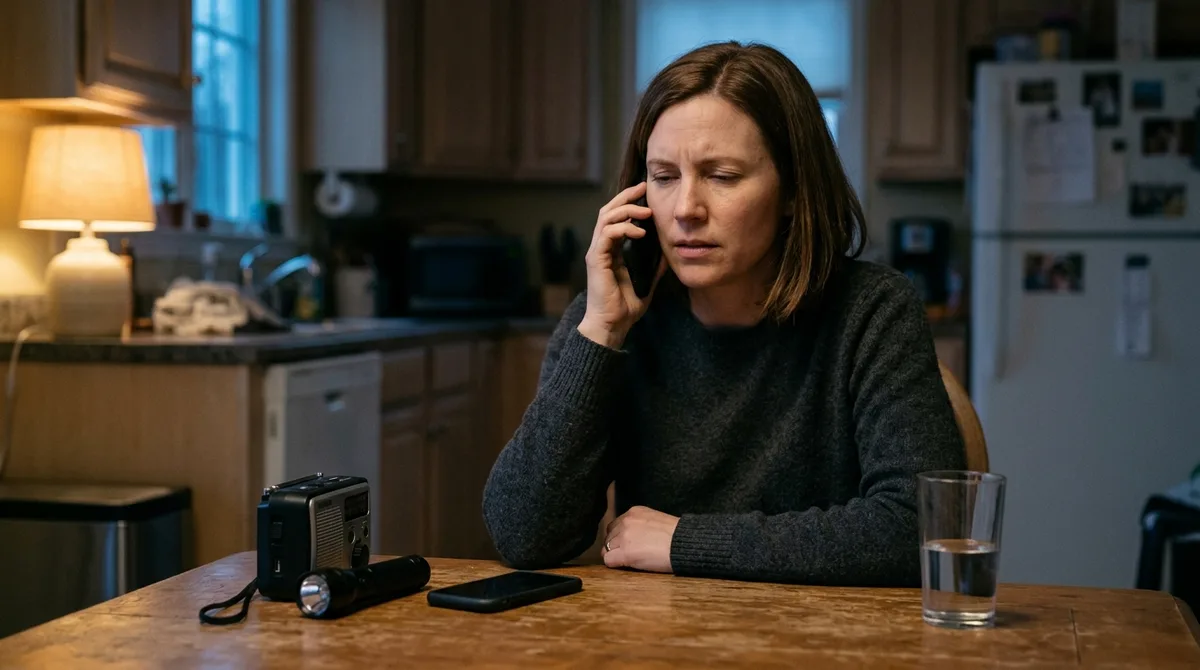
Text first, and keep it short. When too many people try to use the network at once, voice calls are usually the first thing to fail, while text and other data messages have a better shot at getting through.
Federal disaster guidance says the same thing. It recommends text, email, or social media for non-emergency updates because data messages are less likely to run into congestion. That’s why your check-ins should go out as texts, not calls. Don’t treat a text as a guarantee, though. Messages can still be delayed or lost, so every check-in is a maybe until someone confirms it.
If a cell call fails, wait a full 10 seconds before you redial. Hammering the button adds to the jam and doesn’t get you through any faster.
Build your check-in texts around a few simple rules:
- Keep each message to one or two short sentences that cover who you are, where you are, and whether you’re safe.
- Send the same message to your out-of-town contact and to the family group thread at the same time.
- Ask for a short reply like “Got it” so you know the message landed.
- If no reply comes back, send the message again instead of assuming it went through.
Don’t wait for an emergency to learn this. Pick one line everyone can copy, such as “Safe at work, heading home by 6,” and have each person send it on an ordinary Tuesday. Practice on normal days so the habit kicks in automatically when the network is jammed and nobody has time to think.
Older family members may need a different approach. If someone in your house isn’t comfortable typing, teach them to send a single word or a thumbs-up emoji to the group, and make sure they know how to reply to a message from you.
Can You Text 911 Where You Live?
Only if your local 911 center accepts texts, and you can’t count on that everywhere. Federal guidance is clear: call 911 if you can, and text only if a voice call is not possible. Texting is the backup, not the first move.
Here’s the catch. In 2021 data, more than half of Public Safety Answering Points, the local centers that answer 911 calls, were enabled for text-to-911. That still leaves many places without it, and availability varies considerably from state to state. Your sister two states away might be able to text 911 while you can’t. The National 911 Program’s FAQ lays out the basics.
So check before you need it. Look up your county or city 911 center and confirm whether it accepts texts. Then write the answer on your family plan. If the answer is no, the plan should say “call 911 first, and if you can’t, use the next step,” not “text 911.”
Your phone may also give you a warning. FCC rules require covered text providers to send an automatic bounce-back when a text to 911 cannot be delivered because service is unavailable. The FCC’s rule requires that message to tell you to use another way to contact emergency services. Treat that bounce-back as a signal, not a formality.
If you get one, act right away. Don’t keep resending the same text and hoping it sneaks through. Try a voice call if the network allows it, and if that fails, move to the backup step your plan already lists. Show every family member what a bounce-back looks like, so nobody sits there waiting for a reply that will never come.
Is a Priority Phone Service Worth It for Your Household?
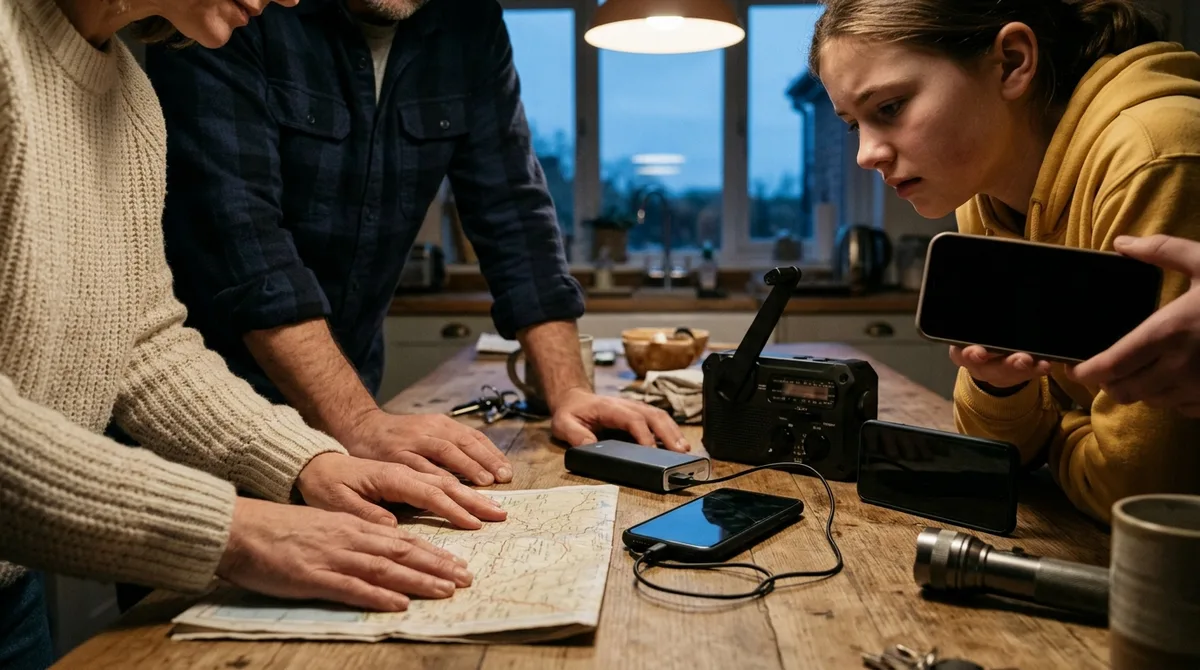
For most households, no. A priority phone service isn’t worth the hassle. Government Emergency Telecommunications Service (GETS) and Wireless Priority Service (WPS) are meant for eligible national-security and emergency-preparedness personnel, the people whose jobs keep government and emergency response running. They are not ordinary household plans, so you can’t just sign up for a better shot at getting through.
WPS is the one most people hear about, and it isn’t free. The CISA FAQ on WPS says your wireless carrier bills the charges, which can include an initial enrollment fee, a monthly subscription, and per-minute usage fees. How those pieces add up depends on your carrier and how the service is arranged. There’s no single federal price, so be wary of anyone who quotes you one.
Then comes the upkeep. CISA’s guidance for user organizations recommends that enrolled users make familiarization calls when they first receive service and every quarter after that. That’s a recurring chore built for people who are already in the program and use it on a schedule. Most families don’t run a routine like that, and a service you never test is a service you can’t count on.
The bottom line is simple. The eligibility rules shut out most households before price even comes up, and the maintenance eats up time you could spend on the basics.
So skip it. Put your effort where it pays off: lock in your out-of-town contact, practice your check-in texts on ordinary days, and walk your meeting spots until everyone can name them without looking. Those steps cost nothing, and they work even when the network is jammed.
Planning for Home, School, Work, and the Car
Your house, your kid’s school, your commute, and your block each need their own version of the plan. The places you spend the most time are where the gaps hide.
Start at home. Walk through every room and list every way out: the front door, the back door, the garage, and any window big enough for a person to climb through. Then assign the chores people forget:
- Exits: Write each one on the plan and note which ones are blocked by furniture or stored boxes.
- Fire plan: Name the person who grabs the fire extinguisher and the person who checks the kids’ rooms.
- Pets and medication: Name one adult for the dog or cat and one for the prescriptions, plus a backup for each.
The backup matters most. It’s the person who gets the call when the first one is stuck at work.
School and work need their own questions. Ask whether the school has an emergency notification system and how it reaches parents. Ask your employer the same thing. Then figure out how you’ll reach your child or partner during a shelter-in-place, when everyone stays inside with the doors shut. Find out whether the school holds students in place or releases them, because that decides whether you drive over or wait.
Your car is a planning tool too. Keep a charged backup battery in the glovebox, along with a paper copy of the plan. Save the route to your meeting place offline, since a phone map is useless when the signal is down.
Evacuation planning means two ways out of the neighborhood, not one. Drive both on a normal day. Note where each route could get blocked by a fallen tree, a flood, or a jammed intersection, and decide what you’ll do if both are blocked. The answer should be your neighborhood meeting spot, not a guess made in a panic.
High-rise living changes the rules. Learn where the stairwells are on your floor and on the way down, and check that the doors aren’t locked. Learn the building’s elevator rule before you need it, since fire and building emergencies usually mean stairs only. Find out whether each floor has a designated meeting point, and make sure everyone knows which one is yours.
How Do You Plan for Kids, Pets, and Family Members With Special Needs?
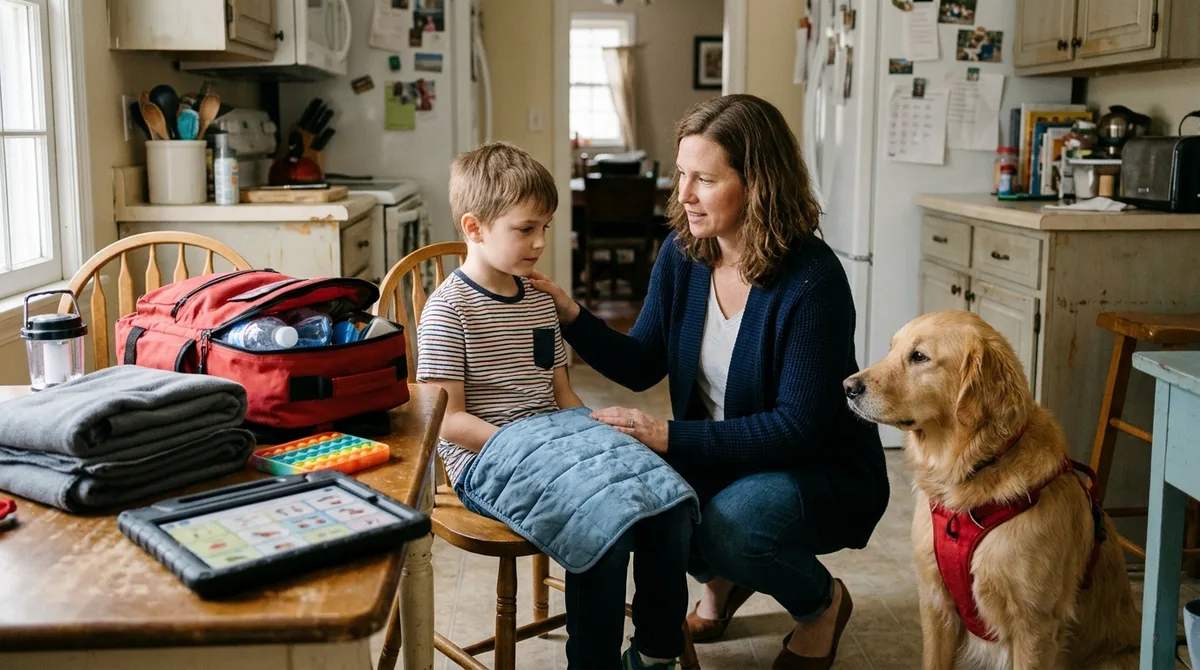
Start by writing down what each person in your home needs, then give that list to your out-of-town contact. Kids, pets, and family members with special needs often get left out of plans, and that’s where things break first.
Teach every child their full name, home address, and one or two phone numbers they can call or text. Make it a game. Have them say the address out loud in the car or at dinner until they can do it without thinking. Then practice when to call 911, such as a fire, a car crash, or someone who is hurt and not waking up. Ask each child to repeat the rule back to you, and remind them that 911 is only for real emergencies.
Kids also need the out-of-town contact’s name and number, plus the meeting spot for school and the one for home. Write those on an index card for the backpack, with the full street address spelled out. Walk the school route together once so they can find the spot without help.
Pets need their own section of the plan. Write down where each animal goes if you have to leave, which shelters or friends have agreed to take them, and what supplies they need. Keep a bag ready by the door with:
- Food and any daily medication, with the amounts written on the label
- Leashes, harnesses, and carriers
- Copies of vaccination records and a recent photo
- Water bowls and a few days of litter or waste bags
Check ahead which shelters accept animals. Many don’t take every species, and some have rules you only learn about when you’re already in a hurry.
Family members with special needs need the most detail. For each person, write their medications, their doctors or providers with phone numbers, and any equipment that runs on electricity. Be specific about the device, like a CPAP machine, oxygen concentrator, or power wheelchair, and note how each one is charged. Then share that list with your out-of-town contact so they can speak for the person when the local lines are jammed.
If people in your house read another language more easily, write the plan in that language. Add an English copy too, since first responders and helpers may need to read it. Your kids should carry their card in whatever language they speak at home.
How Often Should You Update and Practice Your Plan?
Review your plan at least once a year, and drill it often enough that everyone can run it without looking at the paper. Phone numbers change, schools switch, and a plan that worked two years ago can quietly stop working. Pick one date each year, like New Year’s Day or a family birthday, and make it your review day. Check every number, address, and meeting spot, then write that date on the family card so anyone can see how old the plan is.
Some changes can’t wait for review day. Update the plan right away after a move, a new school, a new job, a new baby, or a new phone. A new school alone can change your pickup rules and your neighborhood meeting spot.
Local emergency alerts belong in the plan too. Sign up for the alerts your county or city offers, and make sure every phone in the house can receive them. Then sit down together and explain what each alert type means and what each person should do when it arrives. A warning nobody understands is just noise.
Drills are where weak spots show up. Run one with the whole family, kids included, and time it:
- Send your check-in text to your out-of-town contact from every phone at the same moment.
- Confirm that the contact replied, and note any message that never arrived.
- Have each person walk to the neighborhood meeting spot while you time them.
- Ask each person to name the out-of-neighborhood and out-of-town spots from memory.
- Write down every failure, fix the plan, and run the drill again before you call it finished.
Your First Hour of Planning Before the Next Alert

Sound like a lot for one sitting? It’s five quick jobs, and none of them need special tools. Work through them in order.
- Fill out the fillable card. Write in your ICE contact, your out-of-town contact, and all four meeting spots, with full street addresses for each one.
- Text your out-of-town contact. Ask if they agree to be the relay, and have them reply with the phone number they check most often. Compare that number with the one on your card before you move on.
- Make paper copies. Print the plan, tape one copy to the fridge, and put another in your emergency kit. Then save a copy on every family phone, so nobody has to hunt for it during an alert.
- Stock the kit. Add a fully charged battery pack, a working flashlight, and a copy of the plan. Put the kids’ index cards in the same bag so they aren’t hunting for the out-of-town number when it matters.
- Put the dates on the calendar. Schedule your first practice drill soon, then set your first yearly review as a repeating reminder. Don’t trust your memory to remember either one.
Your Last Checks Before the Next Alert
Don’t close this tab yet. Your next step takes only a few minutes, and it starts with your phone.
Text the person you’d like as your out-of-town contact. Keep it simple: “Would you be our family’s out-of-town contact if we ever have an emergency? I’ll send you the plan, and I need you to reply when I check in.” Wait for a clear yes. If they hesitate, pick someone else tonight rather than next month.
Then grab a pen and the fillable card. Fill in the four meeting spots while you’re standing in the kitchen, with full street addresses and ZIP codes. Tape the card to the fridge where the whole house will see it every morning.
Finally, look up your county or city 911 center and find out whether it accepts texts. Write the answer on the card in pen. If the answer is no, cross out any line that tells anyone to text 911 first.
Last job: put a practice drill on the calendar soon, on a day when nobody is rushing out the door. Tell everyone what day it is and what they’ll be doing, so nobody is caught off guard when the first check-in goes out.
Frequently Asked Questions
1. What should I do if my out-of-town contact does not answer when I check in?
Don’t assume your message went through, and don’t just keep waiting. Resend your check-in after a short pause, then move to the backup step in your plan, such as texting the next person on your contact list. Pick a second relay in a different area ahead of time so one silent phone doesn’t leave your family with nobody to pass updates along.
2. Can a group chat replace the single out-of-town contact in the plan?
No, a group chat can support your plan, but it can’t replace the out-of-town contact. A group thread usually runs on the same local networks that get jammed during a regional emergency, so everyone in it may be stuck in the same place. Keep the out-of-town contact as the designated relay and use the group thread as a second channel for family members who are in the house.
3. How many numbers should go on the ICE entry for each family member?
Give each family member’s ICE entry at least two numbers, a primary phone and a backup. Good backups include a partner’s cell, a work line, or your out-of-town contact, since one number is a single point of failure, just like a dead battery. Write the name and relationship next to each number so a helper can tell who to call without guessing.
4. What do I do if our family is split between two homes after a divorce or custody arrangement?
Write a separate version of the plan for each home, with its own exits, meeting spots, and contact list, and give a copy to each parent. Agree on one out-of-town contact that both households can rely on, and note the custody schedule on the family card so anyone can see where each child should be. Update both copies whenever the schedule, address, or phone numbers change, because a plan that exists in only one house leaves half the family uncovered.
5. Does a phone’s emergency contact feature on the lock screen work as well as a paper plan?
No, a lock-screen emergency contact works well as a backup but shouldn’t replace a paper plan. It only helps if the phone is charged, working, and reachable, and it can’t show your meeting spots or check-in rules the way a printed card can. Use it to store your ICE details, and keep the printed plan on the fridge and in the car.
6. How do I plan for a neighbor or relative who is the only person who can pick up my child from school?
Add that person to the school’s authorized pickup list before you need them, since schools generally won’t release a child to someone who isn’t approved. Give them a copy of the family plan and your child’s index card, and make sure they know the school’s pickup procedures and where to wait. Name a backup pickup person too, because the usual helper may be stuck at work or unable to get across town when it counts.