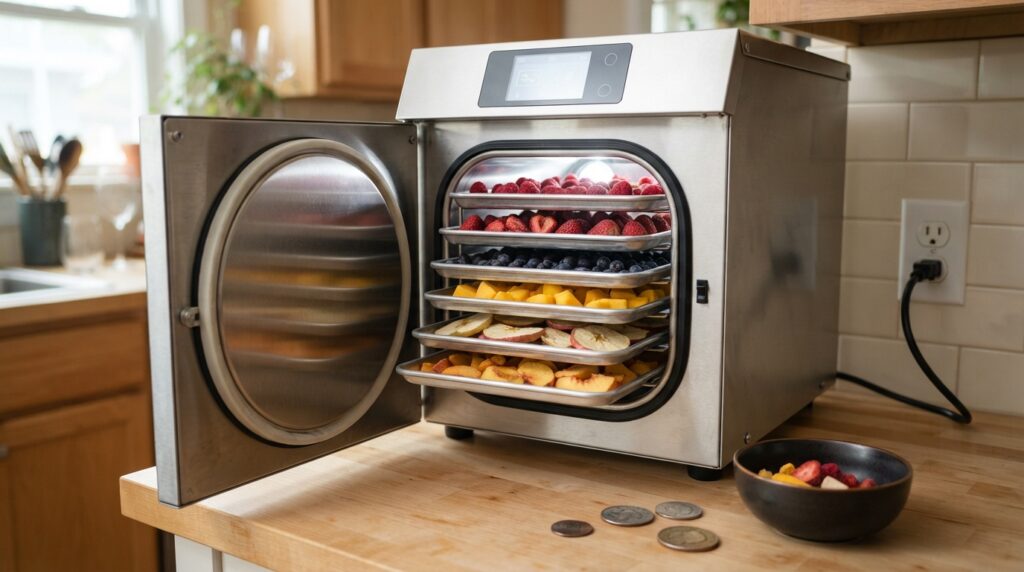
Freeze dryer prices range from $2,495 for Harvest Right’s Small to $14,795 for its HRC100, before setup and running costs. The models handle very different workloads: Harvest Right lists average fresh-food batch weights of 6 pounds for the Small, 18 pounds for the Large, and 82 pounds for the HRC100, according to its model pricing and capacity details.
Another manufacturer lists a Standard model at $2,699 with a Premier pump, with room for 12–18 pounds of fresh food per batch. Its Large model costs $4,335 and handles 20–35 pounds, according to the manufacturer’s specifications. These figures refer to fresh-food input, not finished-food weight. The sticker price also leaves out costs such as electricity, vacuum-pump oil, packaging, shipping, and electrical setup. The right choice depends less on the biggest capacity listed than on how much food you plan to process.
Key Takeaways
- Harvest Right freeze dryers are listed from $2,495 for the Small to $14,795 for the HRC100, while another maker’s Standard costs $2,699 with a Premier pump or $3,360 with a Commercial pump.
- Compare capacity as fresh-food input, not finished-food weight: Harvest Right models range from 6 pounds per Small batch to 82 pounds per HRC100 batch, so match the machine to your expected workload instead of chasing the biggest number.
- Treat sticker prices as a starting point because shipping, electrical setup, electricity, pump oil, and packaging can add costs; check the exact pump and included supplies, since Harvest Right’s bundle includes 50 Mylar bags, 50 oxygen absorbers, and an impulse sealer.
- Budget for ongoing use: listed electricity estimates range from $1.25–$2.80 per Small or Medium batch to about $4 per X-Large batch, cycles often take 13–35 hours, and Harvest Right recommends changing Pro pump oil every 20–30 batches.
How Much Does a Freeze Dryer Cost?
Listed freeze-dryer prices range from $2,495 to $14,795 for Harvest Right models. Another manufacturer lists its Standard at $2,699 or $3,360, depending on the pump, and its Large at $4,335. Harvest Right’s listed lineup also includes the Medium at $3,095, Large at $3,795, and X-Large at $4,995. These are company-listed prices, not universal market prices. Harvest Right’s listed prices
The pump choice changes the other manufacturer’s listed Standard price by $661. The Premier-pump configuration costs $2,699, while the Commercial-pump configuration costs $3,360. The manufacturer lists its Large at $4,335. Specifications for the pump and price options
A fair price comparison starts with the model’s capacity and the work you need it to handle. A lower sticker price may reflect a smaller machine, while a different pump or configuration can raise the starting cost. Check what supplies come with the specific package, too. Harvest Right’s listed bundle includes Mylar bags, oxygen absorbers, and an impulse sealer, which could otherwise add to your setup costs. Harvest Right’s bundle details
Shipping and electrical setup can also affect what you pay, and running costs come after the purchase. Treat a listed price as a starting point, not a guaranteed total. Compare the exact model, pump, included supplies, and setup needs before deciding which machine fits your workload.
Compare Price With Batch Capacity
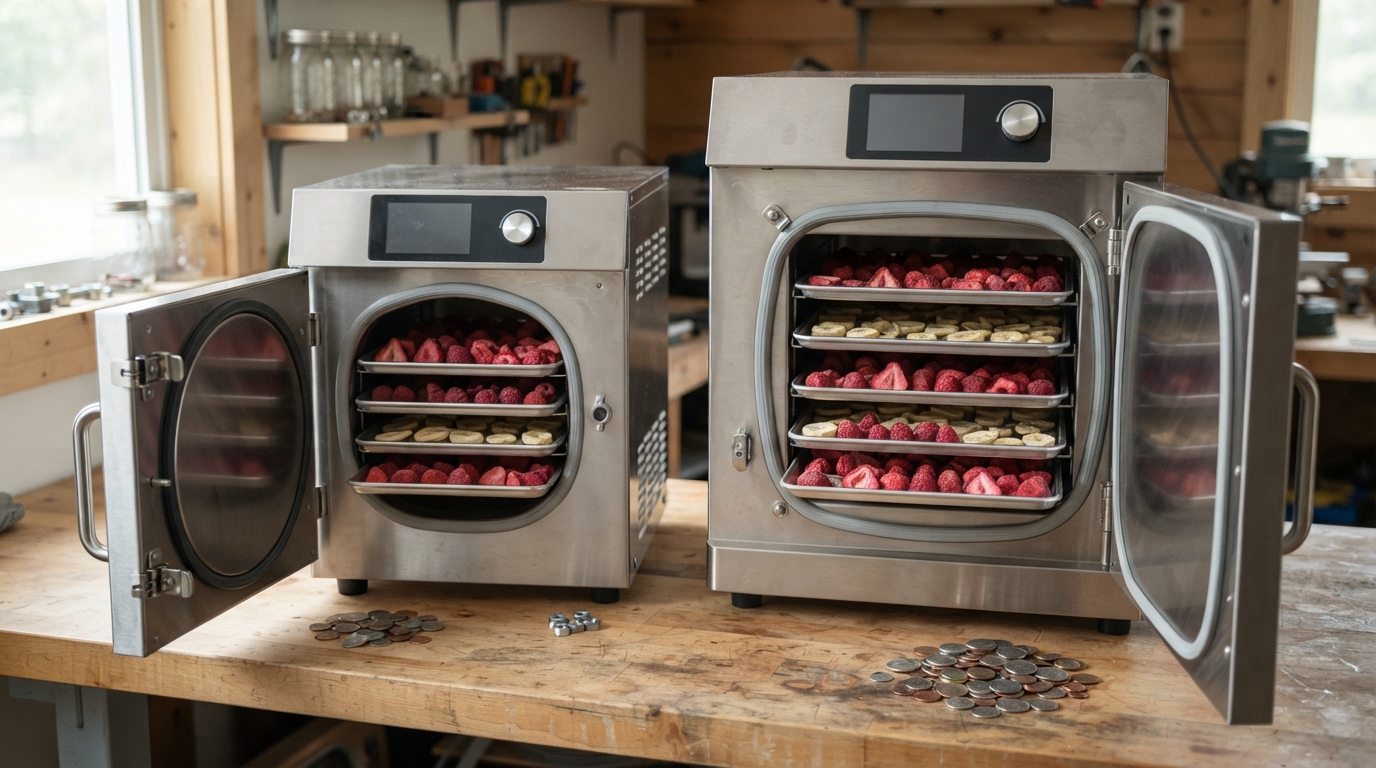
Harvest Right lists average batch weights alongside starting prices. Treat each batch weight as fresh-food input, not the finished food’s weight after drying. Harvest Right’s model list
Another manufacturer lists fresh-food capacity for its Standard and Large models. The Standard has 800 square inches of tray space, and its listed price changes with the pump choice: $2,699 with a Premier pump or $3,360 with a Commercial pump. Specifications for the Standard model
| Model | Listed starting price | Fresh-food capacity per batch | Tray space or pump detail |
|---|---|---|---|
| Harvest Right Small | $2,495 | 6 pounds average | Not shown in the listed figures |
| Harvest Right Medium | $3,095 | 12 pounds average | N/A |
| Harvest Right Large | $3,795 | 18 pounds average | N/A |
| Harvest Right X-Large | $4,995 | 38 pounds average | N/A |
| Harvest Right HRC100 | $14,795 | 82 pounds average | N/A |
| Other manufacturer Standard | $2,699 with Premier pump; $3,360 with Commercial pump | 12–18 pounds | 800 square inches; two pump choices |
| Other manufacturer Large | $4,335 | 20–35 pounds | Tray space and pump choice not shown in the listed figures |
The pounds in the table show how much fresh food a batch can hold, not how much finished food you’ll store. Keep that distinction in mind when you compare a machine’s capacity with the amount of food you want on hand.
Tray area, batch capacity, pump choice, and price each tell you something different. For example, the Standard’s 800 square inches describes tray space, while its 12–18-pound capacity describes fresh-food input. Its two pump configurations also have different listed prices, so compare the setup you’d actually choose rather than treating the Standard as a single-price option.
Start with your likely workload. If you expect to process smaller loads, paying for a machine built to handle much more may not be good value. If you regularly process larger loads, a higher-capacity model may suit you better than running several smaller batches. Match the machine to the amount you expect to freeze-dry, not the biggest number on the page.
What Does It Cost to Run?
Expect electricity charges of $1.25–$2.80 per Small or Medium batch, $2–$3 per Large batch, or about $4 per X-Large batch. You’ll also need to account for vacuum-pump oil and packaging. The amount of food you process affects your cost per batch, too. Harvest Right’s electricity estimates offer a starting point, not a complete running-cost total.
Time is another cost, especially if you plan to process food regularly. Harvest Right says most cycles last 13–35 hours. The machine may be occupied for much of a day or longer before it’s ready for another load. Long cycles can limit how many batches you process in a short time. Your pace also depends on how quickly you prepare and load food.
Oil adds a maintenance expense if you own a Pro model with an oil-based vacuum pump. Harvest Right recommends changing Pro freeze-dryer vacuum-pump oil every 20–30 batches. This guidance gives a replacement interval, not an oil price. Check the cost of oil for your pump, then spread that expense across the batches between changes.
Packaging also affects the cost of each batch. Bags and oxygen absorbers are recurring supplies, and the amount you pack determines how much packaging you use. A full batch can spread its electricity cost across more food, while a partial load may produce less food for a similar cycle. The cost per batch is only part of the picture. Track how much food goes in, the packaging you use, electricity, and any oil changes to estimate what your stored food really costs.
Why Can Setup Cost More?
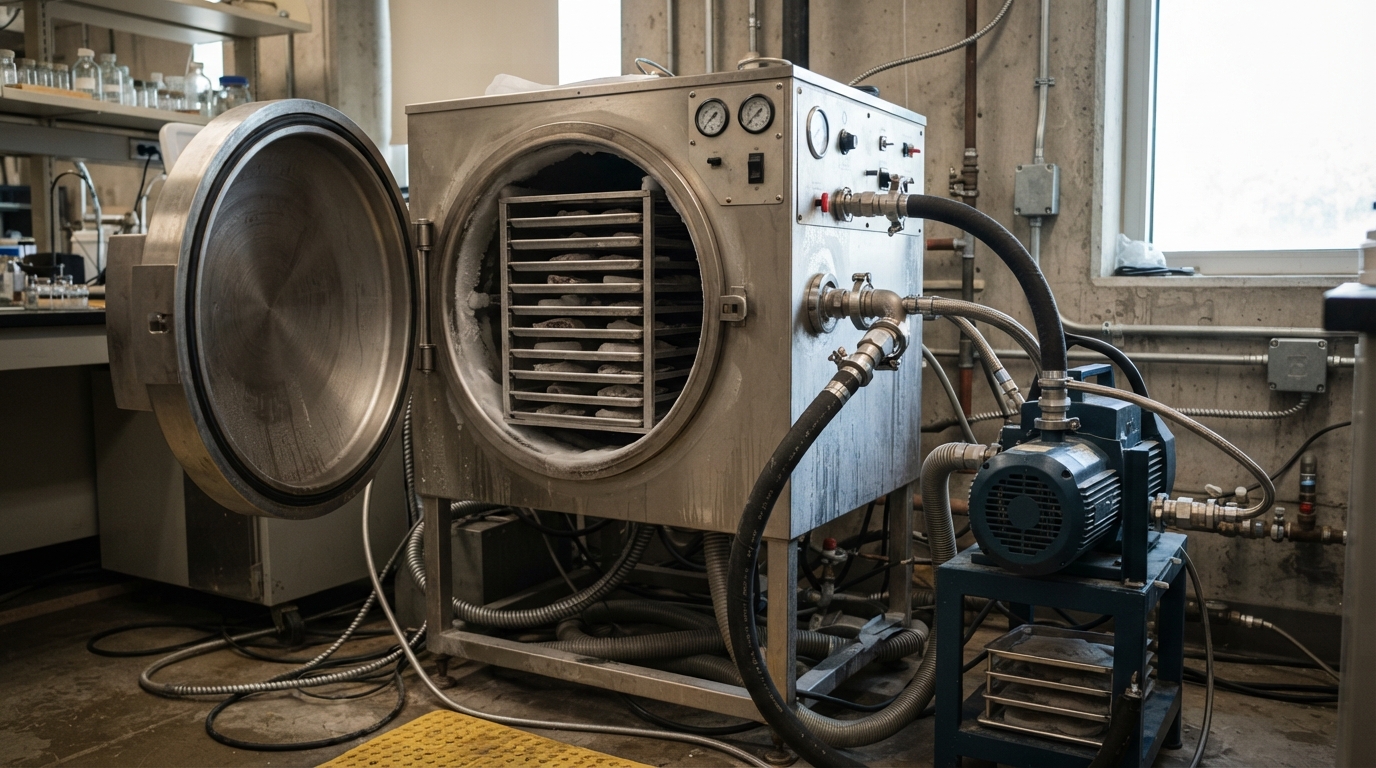
Your setup can cost more than the listed machine price if the pump, packaging, shipping, or electrical work adds expenses that the base listing doesn’t cover.
For another manufacturer’s Standard model, the pump changes the listed price: it costs $2,699 with a Premier pump or $3,360 with a Commercial pump. Check which configuration a price refers to before comparing it with another machine’s listing. Pump and price options for the Standard model
Packaging is another reason two listings may differ. Harvest Right’s listed bundle includes 50 Mylar bags, 50 oxygen absorbers, and an impulse sealer. If your package doesn’t include those supplies, you may need to budget for them separately. Harvest Right bundle contents
Before buying, check whether the specific listing includes the supplies you need and what delivery terms apply. Also check whether your electrical setup is ready or needs changes. Don’t assume either cost is included in the sticker price.
- Pump: Confirm which pump is included and the price of your chosen configuration.
- Packaging: Check whether the package includes bags, oxygen absorbers, and a sealer.
- Shipping: Review delivery terms and any charges shown at checkout.
- Electrical setup: Check whether your space is ready or needs work.
Compare the exact bundle contents and delivery terms for each listing, not just the machine prices. Two similar-looking prices may cover different supplies or delivery arrangements.
When Is the Price Worth It?
A freeze dryer is worth the price when your planned food-storage workload uses its capacity often enough to justify the purchase and ongoing costs. There is no established break-even point that fits every household.
Estimate how much food you expect to process, how often you’ll run batches, and whether your usual loads match the machine’s capacity. Cycle time matters, too. Another manufacturer lists 16–30 hours of main drying time for an 8-pound load in its Standard model, so consider how long the machine may be occupied between batches, not just how much it can hold. Specifications for the Standard model
The available evidence does not establish one freeze dryer-versus-dehydrator price or a single point where one option becomes better value. Compare the current listed cost of each machine with the workload you plan to handle. A lower price or a bigger capacity alone doesn’t settle the question. The right fit depends on how much you plan to process and how often you’ll use the equipment.
For preparedness, start with the food-storage needs you’ve actually planned. A large machine is hard to justify if you won’t use much of its capacity, while a smaller model may mean more batches if you want to build a larger supply. Treat sales-page claims as claims, not proof that you need the biggest unit.
Before treating any price as a complete quote, check current listings for the exact model, pump, and included supplies. Then account for recurring electricity, oil, and packaging costs, along with shipping and any electrical setup. A listing that leaves out supplies or uses a different pump may not be a fair comparison.
Are Commercial Freeze Dryers Different?
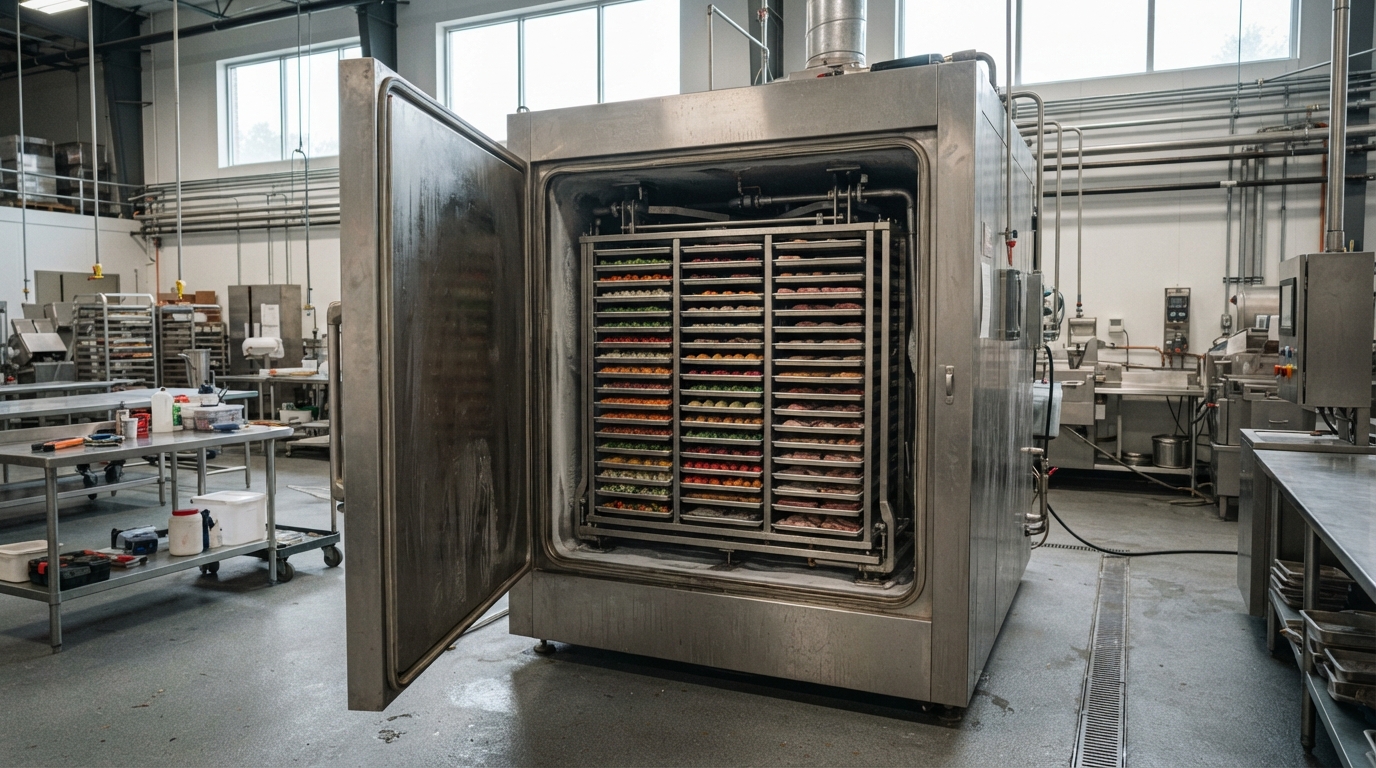
Commercial freeze dryers differ in more than capacity. Selling freeze-dried food can bring food-safety rules that don’t apply in the same way to household preparedness. A large machine does not make a product safe just because it removes moisture. The Indiana Department of Health says freeze-drying is not a microbiological kill step, so you should not treat it as a way to kill harmful microbes. Indiana Department of Health freeze-dried food guidance Indiana example: Retail food establishments in Indiana that make reduced-oxygen-packaged freeze-dried products must obtain variance approval or comply with 410 IAC 7-24-195 before production. That requirement is tied to the product and packaging, not simply the size or price of the machine. Indiana’s retail guidance also calls for a HACCP plan, a displayed best-by date, and water-activity test records kept for one year. Requirements can differ by state, locality, and product. Check the rules for your jurisdiction and the specific food you plan to sell before buying equipment for commercial production. Don’t assume Indiana’s requirements apply everywhere.
Compare Your Food Storage Options
Before choosing a freeze dryer, write down the foods you plan to process and how much you want to store. Then decide whether you want to prepare those foods yourself or keep commercially packaged emergency food on hand. These are different storage plans, so start by considering what you expect to eat.
If you plan to freeze-dry your own food, compare each planned load with the listed batch capacity of the models you’re considering. If your plan relies on packaged emergency food, read Ruckus Reviews’ food-storage reviews before treating a freeze dryer as your only option. A water filter meets a different preparedness need, so compare water-filter reviews separately rather than counting a filter as food storage.
If your household plan combines approaches, list what you’ll make, what you’ll store ready to eat, and what supplies you still need. Use that list to compare the machine’s capacity, pump configuration, included packaging, and ongoing costs with your actual workload. If you intend to sell freeze-dried food, check the rules for your location and product before buying equipment. Indiana’s requirements are not universal.
Your next step: build your food list, then compare equipment and food-storage reviews against that specific plan. Don’t let a large capacity or a sales-page promise make the decision for you.
Frequently Asked Questions
1. How much does a freeze dryer cost in electricity over a year?
There is no single annual electricity cost because it depends on how many batches you run and which model you use. To estimate your cost, multiply your expected yearly batches by the model’s per-batch estimate. Harvest Right lists $1.25–$2.80 for Small or Medium batches, $2–$3 for Large batches, and about $4 for X-Large batches (Harvest Right’s electricity estimates).
2. What should you check when buying a used freeze dryer?
Before buying a used freeze dryer, confirm the exact model, pump type, and included supplies. Ask the seller to show you the machine running. Check the warranty terms rather than assuming coverage transfers. Harvest Right says its three-year limited warranty applies to its listed bundle (Harvest Right’s bundle details).