Red light eye safety depends on four things: the device, the wavelength, how much light it puts out, and how long that light reaches your eyes. Plenty of people assume a glowing panel is harmless because it’s “just red,” but that’s not a safety test. The FDA’s January 2023 draft guidance on photobiomodulation devices says light output above the maximum permissible eye exposure may put eye tissue at risk, and it recommends safeguards in the instructions when eye harm is possible.
Here’s the catch: no FDA mandatory performance standards apply specifically to LED products, so the rulebook is thinner than most shoppers expect. A 510(k) clearance only means a device is substantially equivalent to one already on the market. It doesn’t mean anyone proved it’s safe for your eyes. And price tells you nothing about safety, either. At-home units run anywhere from about US$100 to US$3,500.
Key Takeaways
- Red light is still visible light, so a device that glows red is not automatically safe for your eyes.
- Your red light device’s safety depends on four factors: the device itself, its wavelength, its output, and how long that light reaches your eyes.
- Sunglasses won’t protect your eyes from a red light device, so you should wear the goggles the manufacturer specifies and keep them on for the entire session.
- The American Academy of Ophthalmology says evidence that red light regenerates damaged retinal cells is limited, and its ophthalmologists have no evidence to recommend red-light therapy to patients.
- Before you buy an at-home red light device, check the manual for the wavelength range, the output figure, and an eye-protection section, because no FDA mandatory performance standards apply specifically to LED products.
Can Red Light Actually Reach Your Eyes?
Yes, red light can reach your eyes, and it does so more easily than most people expect. Red light is still visible light, so your eyes take it in the same way they take in a lamp or a sunset. If the light hits your eyes, it gets in.
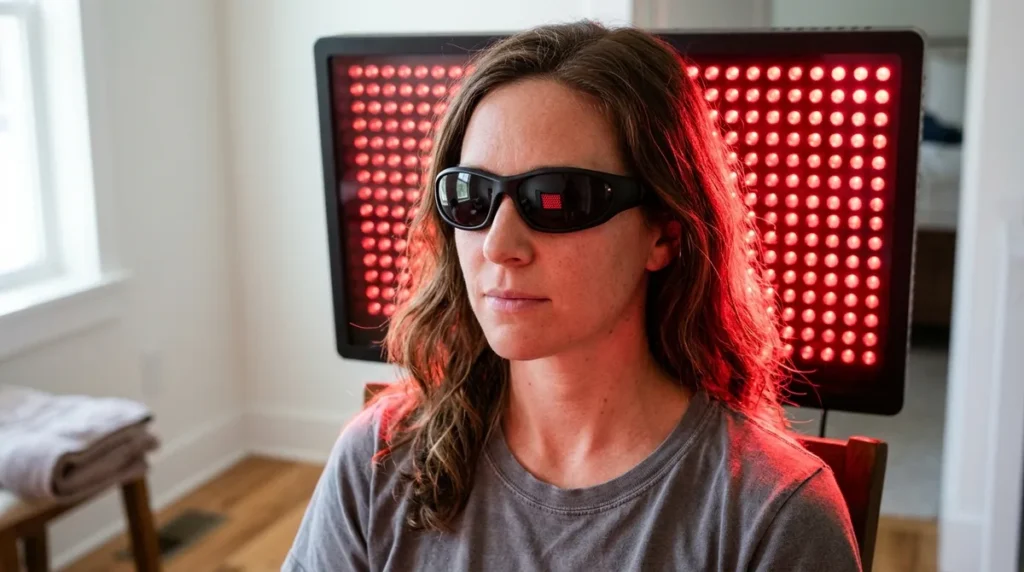
Think about how people actually use these devices. A panel sits a foot or two away, and most people don’t keep their eyes shut the whole session. They scroll, check the clock, or doze off with the glow on their face. Every one of those moments is exposure.
Masks are sneakier. Even a snug-looking mask can leave gaps at the nose bridge, the corners, or the sides, and light finds those gaps fast.
Closed eyelids help. They block a good share of visible light and cut down how much reaches the eye. But they don’t make a bright device safe to stare into. Eyelids are thin, and the eye still gets a dose.
Skin devices were built for skin. Engineers designed them to deliver light to the face and body, so eye exposure was never the main design goal. A mask that does its job on your skin tells you nothing about what reaches your eyes. The American Academy of Dermatology says red-light therapy appears safe in the short term, but it notes that long-term effects are not known. For the eye, the long-term picture is just as unclear.
So “it’s just red” is not a safety test. Color says nothing about how much light a device puts out or how long it reaches your eyes. Look for output and eye-exposure details in the manual. If they’re missing, that’s your first red flag.
What Makes Red Light Risky for Your Eyes?
Four things decide how risky red light is for your eyes, and they work together:
- The device: Two panels can both glow red and behave very differently, so the box color tells you nothing.
- The wavelength: Many devices also emit near-infrared light, which you can’t see at all.
- The output: This is how much light the device pushes out, also called irradiance.
- The exposure time: This is how long that light actually reaches your eyes.
Miss one of these and your safety math falls apart. The device’s manual is where you’ll find the output and exposure details, so start there.
The invisible part matters most. Near-infrared light doesn’t look bright, so your eyes can’t warn you when the dose gets high. The brightness you notice is only part of the story.
The FDA’s draft guidance treats output as the key line. When a device’s energy goes past the maximum permissible eye exposure, the guidance says eye tissue may be at risk. It also recommends that instructions include safety eyewear or other safeguards whenever eye harm is possible. If a device’s instructions skip that warning, treat the omission as a red flag.
Engineers measure this with IEC 62471:2006, a framework from the International Electrotechnical Commission. It sets exposure limits, explains how to measure light, and sorts light sources by how much photobiological hazard they carry. It covers LEDs, though it excludes lasers. Manufacturers and testers use it to judge how much eye hazard a light source poses.
Time is the multiplier. A study described by the American Academy of Ophthalmology used 670-nm red light for three minutes a day over two weeks. The academy warned readers not to try that approach at home. Treat it as a research protocol, not a template for your living room.
Higher output and longer sessions raise the stakes. Crank the brightness or stretch the session, and the dose climbs. Nobody can judge that dose by squinting at a glowing panel. Treatment time and frequency also vary by device, so the schedule printed by the manufacturer is the one to follow, not a number you pick because it sounds right.
Do Red Light Face Masks Protect Your Eyes?
Not by default. A mask’s skin results say nothing about your eyes, and a mask only protects them if its maker builds in eye protection and says so in the instructions.
Skin studies ask whether light helps your face. They don’t ask whether light is safe to take in through your eyes. Those are different questions, and most marketing answers only the first one. The American Academy of Ophthalmology says evidence that red light regenerates damaged retinal cells is limited, mostly from animal and cell studies, and its ophthalmologists have no evidence to recommend red-light therapy to patients.
Clearance doesn’t close that gap. A 510(k) clearance says a device is similar to one already sold, which is a narrower claim than “tested for your eyes.” A San Francisco Chronicle report on red-light masks made this point: clearance signals similarity to another legally marketed device, not necessarily rigorous testing of the specific mask you’d wear.
So check the box and the manual before your first session. Ask three questions:
- Does the maker supply eye protection? Goggles or shields designed for that exact device count for more than a line on the sales page.
- Does the manual tell you to keep your eyes closed? If it does, follow that instruction exactly. If it doesn’t, don’t assume closed lids are enough.
- Does the manual list output or eye-exposure limits? No numbers means you can’t judge the dose, and you shouldn’t guess.
A mask with a gap at the nose, no goggles, and no eye instructions has told you what it wants you to believe. Read what it says about your eyes. If the answer is nothing, treat that silence as the answer.
Are Sunglasses Enough for Red Light Eye Protection?

No, sunglasses are the wrong tool for red-light eye protection, even expensive ones. They’re built to cut glare and UV in everyday life, not to block the specific wavelength a red-light device emits. Many tinted lenses also let near-infrared light through, and you can’t see that light at all. A dark lens can feel safe while the dose still gets through.
Dermatology guidance is blunt about this. Follow the device’s directions, and when the instructions call for eye protection, wear the kind they specify. Sunglasses are not a substitute for protective goggles.
So what should you use? Start with the goggles the manufacturer specifies for that device, matched to its wavelength. Don’t grab a generic pair from a drugstore, and don’t reuse a pair from a different light gadget. A pair built for one wavelength may not block another.
Before you put them on, check the label. The goggles should name the wavelength range they block, and that range should cover the output listed in your device’s manual. If the goggles don’t name a range, or the manual doesn’t name a wavelength, stop there. Guessing is how people end up with a false sense of security.
If the device calls for goggles and none came in the box, contact the maker and ask for the right pair before you switch the light on. Wear them for the whole session, not just while the panel is aimed at your face. Taking them off halfway through because they feel annoying is exactly the moment the light starts reaching your eyes.
Is Red Light Good for Your Eyes or Just Hype?
No, red light has not been shown to improve your eyes, and right now most eye-health claims are hype. Plenty of sales pages promise sharper vision or repaired retinas. The evidence doesn’t back that up.
The American Academy of Ophthalmology says evidence that red light regenerates damaged retinal cells is limited. Most of what exists comes from animals and cell lines, not people. The academy also says its ophthalmologists have no evidence to recommend red-light therapy to patients. Read that twice. The doctors who treat retinas for a living are not recommending it.
Sound too good to be true? Usually it is. So let’s look at the one human study the academy describes.
In a 2020 report, the academy described a study of 24 people. Each got 670-nm red light for three minutes a day over two weeks, and researchers measured color-contrast sensitivity, or how well people tell similar shades apart. The academy’s warning was blunt: don’t try this at home.
Look at what that study actually was. Twenty-four people, two weeks, one wavelength, one controlled routine. Your bedroom panel is a different animal. Nobody has measured the dose it puts into your eyes, and nobody has checked whether it matches that protocol at all.
Skin is the one area where short-term use looks reasonably safe. Dermatologists say red-light therapy appears safe in the short term, but long-term effects on skin or hair are not known. Eyes get less attention than skin, so the long-term picture there is even blurrier.
That gap is where the marketing lives. A skin result, a testimonial about brighter eyes, or a “clinically inspired” badge is not evidence that the light helps your retina. It’s a promise, and promises are cheap.
How Do You Use Red Light Safely Around Your Eyes?
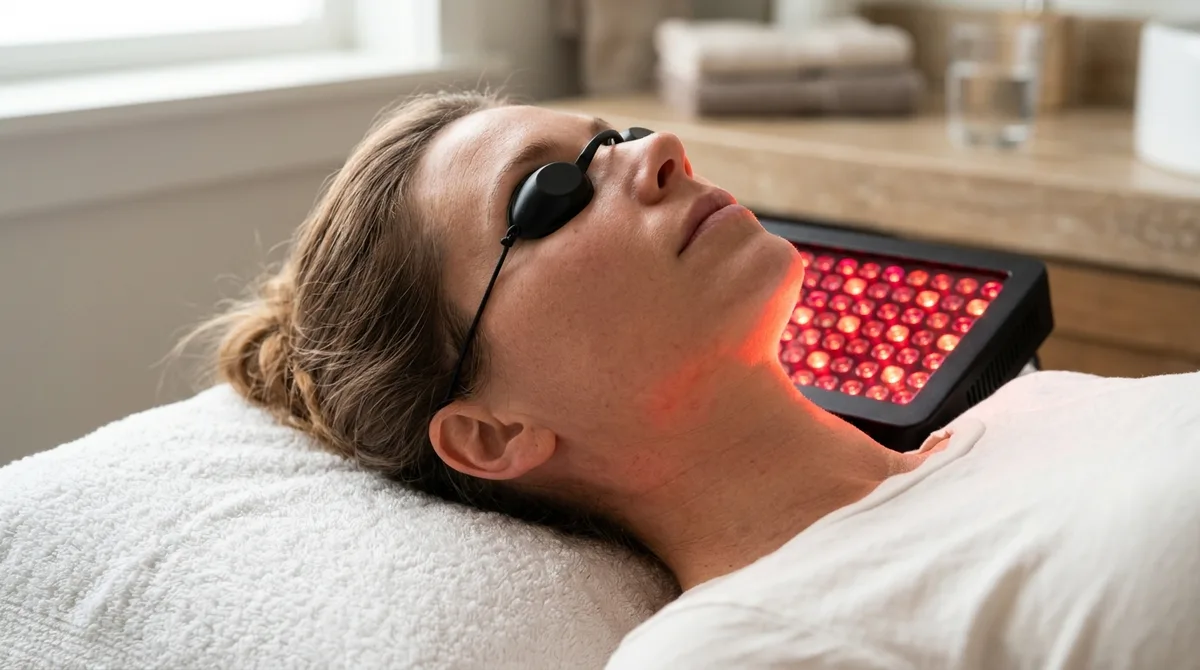
Use red light safely around your eyes by following the manual’s treatment time and distance, wearing the eye protection the maker specifies, and stopping the moment your eyes object. Here’s the routine to run before every session, not just the first one.
- Read the full manual before you switch the device on. Find the treatment time, the recommended distance from the panel or mask, and any warning about eye exposure. If the manual skips those details, don’t start the device.
- Set the distance and time exactly as printed. Don’t move the panel closer for a stronger effect, and don’t stretch the session because it feels relaxing. Schedules differ from device to device, so the maker’s numbers are the only ones that apply to your unit.
- Put on the eye protection the manual specifies. Wear it for the entire session, even when you’re using a mask. A mask doesn’t replace goggles, and a gap at the nose can let light reach your eyes anyway.
- Keep your eyes closed only if the instructions allow it. Some manuals include closed eyes as part of the routine. If yours doesn’t mention it, don’t assume closed lids are enough protection.
- Stop the session at once if your eyes hurt, your vision blurs, or they become irritated. Don’t push through it or wait to see if it passes. If symptoms continue after you stop, book an appointment with an eye doctor.
- Keep children and pets away from the active light. Don’t let kids or pets sit or lie near a running panel unless the maker says that’s safe. Switch the device off when you leave the room.
The classic failure is falling asleep under the glow. Set a phone timer for the session length in the manual, so you aren’t guessing at the clock or dozing through the end. Your eyes can’t tell you how much light they’ve taken in, so the timer has to do that job.
What Should You Check Before Buying an At-Home Device?
Before you pay, check four things: the eye protection, the wavelength and output specs, the real cost of regular use, and whether the marketing hides any red flags. Start with the price, but don’t stop there. At-home devices run from about US$100 to US$3,500, a spread that a 2025 JMIR Dermatology article reported for the devices it examined. Price alone won’t tell you whether a device is safe for your eyes.
Goggles are the cost most buyers forget. If the manual calls for eye protection, check whether a pair comes in the box. Goggles made for one device’s wavelength don’t work for another, so a generic pair from a drugstore isn’t a substitute. Ask the maker whether replacement goggles are sold separately and what they cost, because a cracked or lost pair can leave you with no protection until you buy a new one.
Regular use is where the bill grows. Red-light treatment is a repeated routine, not a one-time purchase. Multiply the session length in the manual by the sessions per week and the number of weeks the schedule calls for. Schedules differ by device, so the same sticker price can hide very different time commitments. Masks follow the same pattern. Red-light masks run from budget models under US$100 to premium options at US$500 or more, and a pricier mask doesn’t mean a safer one for your eyes.
Watch the marketing for three red flags:
- No eye-protection guidance: If neither the manual nor the sales page mentions eyes, the maker hasn’t addressed the risk.
- Vague wavelength or output specs: “Powerful red light” tells you nothing. You want a nanometer range and an output figure.
- “Eye-safe” with no test details: A claim should name the test standard, the measurement method, and the data behind it. If it doesn’t, the words are just decoration.
Vague marketing is a choice. Sellers who have real specs put them up front, so when you can’t find them, assume they’re hiding something.
Your Safest Next Move Before the First Session
Your next move is simple: pull up the manual for the device you’re considering and read it before you buy. Look for three things: the wavelength range in nanometers, the output figure, and a section on eye protection. If any of the three is missing, email the maker and ask for them in writing. Save the reply with your receipt.
Then check the goggles. Ask whether a pair comes in the box, which wavelength range they block, and what a replacement pair costs. Write those answers down next to the sticker price, because the goggles are part of what you’re really paying for.
Before your first session, set your phone timer to the length in the manual, put the goggles on, and sit at the distance the manual prints. For the first week, keep a short log of each session’s length and how your eyes felt afterward. If you notice pain, blurring, or irritation, stop and book an appointment with an eye doctor.
The FDA’s radiation-emitting product FAQ explains that LEDs fall under general radiation rules, but no mandatory performance standards apply to LED products specifically. That means the manual and the maker’s written answers are your main safety checks, so don’t skip them.
Frequently Asked Questions
1. Are blue light goggles good enough for red light therapy?
No, goggles are built for a specific wavelength range, so a pair made for blue light may not block the red or near-infrared light your device emits. Check the label for the range the goggles block and compare it with the wavelength in your device’s manual. If the two don’t match, don’t assume the pair will protect your eyes.
2. Do red light goggles block all the light from a panel?
No, goggles block only the wavelength range printed on their label, not every bit of light a panel gives off. That’s why a pair should cover the output range listed in the manual. Wear them for the entire session, because taking them off even briefly lets light reach your eyes again.
3. Should I talk to an eye doctor before using red light therapy?
Yes, it’s a smart move before your first session if you already have an eye condition or take medication that makes your eyes more sensitive to light. An eye doctor can tell you whether a session is a reasonable risk for your specific eyes. Bring the device’s manual so they can see the output and exposure details.
4. How often can I use red light therapy near my eyes?
There’s no universal number, because frequency is set by each device’s manual. Schedules differ from device to device, and red-light treatment is a regular routine rather than a one-time use. Follow the printed schedule exactly and don’t add extra sessions to chase faster results.